
Assessment Tools
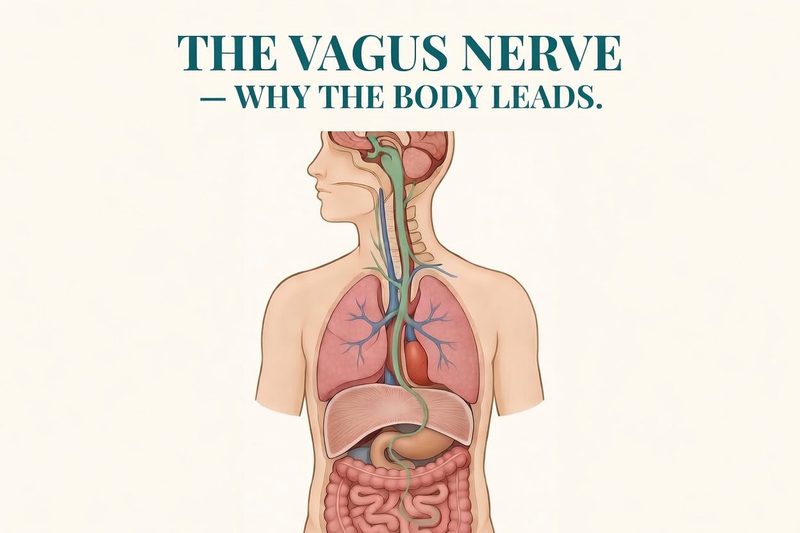
When you extend the exhale, you are triggering a specific neurochemical event. During exhalation, the vagus nerve releases acetylcholine — what the early researchers called *vagusstoff*, vagus substance — directly to the sinoatrial node of the heart. This slows the heart rate. Otto Loewi identified this in 1921; it was the first neurotransmitter ever discovered.
A 2022 meta-analysis of 223 studies on slow breathing confirms that vagally-mediated HRV parameters increase during slow breathing, immediately after a single session, and after multi-session interventions. This is among the strongest evidence bases in the entire breathwork field.
The optimal breathing rate for maximum vagal tone is 4.5–6.5 breaths per minute. Most research settles on 6 breaths per minute — a 5-second inhale and a 5-second exhale. An extended exhale (4 seconds in, 6 seconds out) produces more vagal activation than equal ratios. Every time you say *breathe out slowly*, you are facilitating vagusstoff release.
Why Objective Assessment Matters
The BOLT Score (Body Oxygen Level Test)
1. Sit comfortably and breathe normally for a few minutes.
2. After a normal exhale (NOT a deep breath), pinch your nose.
3. Time how long until you feel the FIRST DISTINCT urge to breathe. This urge might be: involuntary contraction of diaphragm, swallowing reflex, tensing of throat, clear desire to breathe.
4. The moment you feel this first urge, note the time.
5. Resume normal breathing (you should NOT be gasping).
Important: You are NOT measuring how long you CAN hold your breath. You are measuring when the body first signals to breathe. If you are gasping when you resume, you held too long.
The BOLT score gives you a functional baseline before any breathwork journey. A client who scores below 15 seconds has very low CO2 tolerance and will hit activation, tingling, or tetany quickly under any intensifying breath practice. This person needs functional breathwork first — building CO2 tolerance gradually — before any connected conscious breathing. The BOLT score is your clinical starting point.
Under 10 sec — Severely dysfunctional: Very gentle work; focus on functional basics.
10–20 sec — Dysfunctional: Significant room for improvement.
20–30 sec — Borderline: Making progress; continue training.
30–40 sec — Good: Healthy range; can do most practices.
40+ sec — Excellent: Advanced capacity; ready for intensive work.
What BOLT reveals: Low BOLT = Low CO2 tolerance = Chronic over-breathing pattern. The body has become sensitized to CO2. Even normal levels feel suffocating. So the person breathes more, which lowers CO2 more, which increases sensitivity.
The CO2 Tolerance Exhale Test
1. Take a normal breath IN through the nose.
2. Start timer.
3. Exhale slowly and steadily through the mouth.
4. Exhale at a consistent, controlled pace (not forcing, not holding back).
5. Continue until lungs are empty.
6. Note the time.
Interpreting results:
- Under 25 sec — Low tolerance
- 25–45 sec — Moderate tolerance
- 45–65 sec — Good tolerance
- 65–80 sec — Very good tolerance
- 80+ sec — Elite tolerance
Use both for a fuller picture. BOLT measures response to CO2 buildup. CO2 Exhale measures breath control and tolerance during depletion. Someone might score differently on each, giving you more information about their pattern.
Additional Assessment Tools
Count breaths for one minute at rest. Functional: 6–12/min. Borderline: 12–15/min. Dysfunctional: 15+/min.
Watch the client breathe for 2 minutes: Pathway (nose or mouth) · Location (belly, chest, or both) · Rate · Quality (smooth, jerky, gasping) · Muscle use · Pattern.
Ask about: Dry mouth on waking · Snoring · Sighing/yawning frequency · Breath awareness level · Known respiratory conditions · Exercise tolerance · Anxiety/panic history.
If you have access: provides objective nervous system data · tracks changes over time · shows immediate effects of practices.
- 1Day 1: BOLT score (test 3 times during the day, average them).
- 2Day 2: CO2 Exhale test (test 3 times, average).
- 3Day 3: Breath rate count (count 3 times in different situations).
- 4Day 4: Self-observation (observe your own patterns for 10 minutes).
- 5Day 5: Pattern identification (which of the 6 patterns do you recognize in yourself?).
- 6Day 6: Review and reflect.
- 7Day 7: Retest BOLT and CO2 Exhale.
Week 1–2: Practice nasal breathing as much as possible. Slow your breath slightly (aim for 10–12 breaths/min). No breath holds yet.
Week 3–4: Introduce small breath holds after exhale. Hold until first urge, then breathe normally. Do 5–10 of these daily.
Week 5–6: Extend breath holds slightly. Introduce nasal breathing during light exercise (walking). Practice coherent breathing (6 breaths/min).
Week 7–8: Continue all practices. Nasal breathing during moderate exercise. Retest BOLT and CO2 Exhale.
Expected improvement: 5–10 second improvement in BOLT over 8 weeks is excellent.
| Score | Interpretation | Clinical Implication |
|---|---|---|
| Under 10 sec | Severely dysfunctional | Very gentle work; focus on functional basics |
| 10-20 sec | Dysfunctional | Significant room for improvement |
| 20-30 sec | Borderline | Making progress; continue training |
| 30-40 sec | Good | Healthy range; can do most practices |
| 40+ sec | Excellent | Advanced capacity; ready for intensive work |
| Time | Interpretation |
|---|---|
| Under 25 sec | Low tolerance |
| 25-45 sec | Moderate tolerance |
| 45-65 sec | Good tolerance |
| 65-80 sec | Very good tolerance |
| 80+ sec | Elite tolerance |
| Week | BOLT | CO2 Exhale | Breath Rate | Notes |
|---|---|---|---|---|
| 0 | 15 | 28 | 16 | Baseline |
| 2 | 17 | 32 | 14 | Starting to notice patterns |
| 4 | 22 | 38 | 12 | Nasal breathing becoming easier |
| 6 | 25 | 45 | 11 | Feeling calmer overall |
| 8 | 28 | 52 | 10 | Significant improvement |
| Characteristic | Yes/No | Notes |
|---|---|---|
| Nose breathing at rest | ||
| Diaphragmatic | ||
| Slow (under 12/min) | ||
| Silent | ||
| Smooth | ||
| Effortless | ||
| Flexible |
| Dimension | Present? | Quality (1-10) |
|---|---|---|
| Vertical | ||
| Lateral | ||
| Anterior-Posterior |