The Brain & Psychology
Neuroscience of trauma, breath, and regulation
The Cocoon Method — Practitioner Training Manual
Contents
- 01Where the Body Keeps the Score
- 02Nine Perspectives on Brain & Psychology
- 03Top-Down vs. Bottom-Up Processing
- 04The Triune Brain Model
- 05The Amygdala and Fear
- 06The Prefrontal Cortex: The Regulator
- 07Transient Hypofrontality
- 08How Trauma Stores in the Body
- 09The Defense Cascade
- 10Why Breath Works
- 11Brainwave States and Breathwork
- 12Interoception: The Eighth Sense
- 13Putting It All Together: Clinical Integration
- 14Part 5 Completion Checklist
Where the Body Keeps the Score
Before You Begin: Self-Assessment
I understand the difference between top-down and bottom-up processing. I can explain the triune brain model to a client. I understand what the amygdala does and how to work with activation. I know what transient hypofrontality is and why it matters for breathwork. I can identify the defense cascade stages in a client session. I understand interoception and how to develop it in myself and clients.
I can observe which "brain" is dominant in a client moment-to-moment. I have explored my own default processing mode (thinking vs. feeling).
Dear Practitioner in Training,
I want to share something with you. A woman came to me once presenting with chronic shoulder pain. She had seen doctors, physical therapists, massage therapists. Nothing helped for long. As she spoke, I watched her body. When she mentioned her mother, her shoulders rose. When she spoke of her father, they dropped and collapsed. Her shoulders were holding a story her words were not telling. We never talked about the pain directly. We worked with what lived beneath. The pain released when the grief and the anger found their expression. That was the moment I understood what this work really is.
You have learned the nervous system. You have studied the breath. Now we go into something deeper. We look at how the brain processes experience. And how trauma finds a home there.
This part will change how you see people. You will understand why years of talking therapy can leave someone exactly the same. You will see why the body holds what the mind cannot. And you will learn why breathwork can reach places words never could.
The research is clear. Van der Kolk found that yoga, a body-based practice, worked better than medication for PTSD. Peter Levine's work shows that processing body sensation is more effective than processing story. EMDR works through the body, not through talk. Breathwork changes real things: HRV, cortisol, brain activity. The body is not an add-on to healing. It is where healing happens.
Here is something that surprises most people. Talking about trauma can sometimes make it worse. When someone tells the same story again and again without releasing it through the body, the nervous system activates but never completes. The story becomes almost rehearsed. The person can say the words without feeling anything. Nothing actually changes. Body first. Words second. Always.
Most of your clients will come having tried other approaches. They have read the books. They have done the therapy. They can tell you exactly why they are the way they are. But knowing *why* has not set them free.
This is not about those approaches being wrong. They have their place. But trauma does not live in the thinking brain. And when you try to heal something through a part of the brain that does not hold it, you will not get far.
Bessel van der Kolk titled his landmark book "The Body Keeps the Score" for a reason. The body keeps score of every experience we have ever had. And the body — not just the mind — must be involved in the healing.
Trauma is not about what happened to us. It is about what got stuck inside us. The energy that could not discharge. The response that could not complete. The breath that could not move.
The Cocoon Method works because we meet the brain and body where they actually store pain — not where we wish they would.
With reverence for the complexity of healing,
Nina Hinterschitt — Creator, The Cocoon Method
Nine Perspectives on Brain & Psychology
Trauma literally changes brain structure — the amygdala grows larger, the prefrontal cortex shrinks. This is not metaphor; it is measurable physical change. And because of neuroplasticity, what has been wired can be rewired. Healing is possible.
Patterns of thought, emotion, and behavior are shaped by experience. What once served as protection can become prison. And healing happens in relationship — the quality of attunement and being truly seen are central to transformation.
The heart houses the shen (spirit/mind). The liver governs the smooth flow of chi and is connected to anger. The kidneys store fear. The lungs hold grief. When these organ systems are out of balance, emotional patterns arise. Breathwork directly affects all three. Psychological disturbance is disrupted chi — stagnation, deficiency, or excess.
Ayurveda sees mental health through the three gunas: sattva (clarity), rajas (activity), and tamas (heaviness). Vata types tend toward anxiety. Pitta toward anger. Kapha toward depression and heaviness. Healing means restoring balance. Treatment addresses the doshic imbalance creating the pattern.
The gut-brain axis, nutrition, inflammation, toxic load — all affect the brain. Sleep, exercise, nature exposure, stress management profoundly affect brain function. Mental health is not separate from physical health.
Psychological patterns are energy patterns. Trauma is stuck energy that has not completed its natural movement. The chakra system maps psychological development from survival (root) to spiritual connection (crown).
Trauma and difficulty are not random misfortune but opportunities for growth and awakening. The problems of the ego — fear, attachment, control — are universal human conditions that dissolve with awakening to our true nature.
Natal charts reveal inherent psychological predispositions. Transiting planets highlight periods of growth, tension, or transformation. Individual experiences are interwoven with larger cosmic rhythms — a framework for understanding the "why."
Restricted breathing patterns reflect and reinforce psychological blockages, suppressed emotions, and body-stored trauma. By consciously altering the breath, we bypass the analytical mind to bring about profound emotional release and somatic healing. The breath offers a direct pathway to inner transformation.
Top-Down vs. Bottom-Up Processing
“The body keeps the score. And the breath is the language it understands.”
Why Talk Alone Is Not Enough
The Limitation of Insight
You cannot think your way out of a body-based wound. You cannot analyze your way through a nervous system stuck in survival mode. Understanding why you flinch does not stop you from flinching.
The Two Approaches Compared
Starting with the thinking brain. Thoughts, beliefs, language, insight. Useful after body work when the mind needs to integrate what happened. But it cannot reach what is stored in the body before language. Examples: CBT, psychoanalysis, coaching, journaling.
Start with the body. Sensation. Breath. Movement. Work with the nervous system directly. Let feelings emerge from experience, not from thinking about experience. Meaning comes after somatic processing. Examples: Somatic Experiencing, Breathwork, EMDR, The Cocoon Method.
The Cocoon Approach: Body-Led, Mind-Integrated
1. Create safety (nervous system regulation)
2. Work through the body (breath, sensation, movement)
3. Allow expression (sound, emotion, discharge)
4. Make meaning (integration, understanding)
We do not rush to meaning-making. We do not start with the story. We meet the body first. We let it do what it needs. Then, and only then, we invite the thinking brain in.
Take a moment to notice yourself. Are you more of a thinker or a feeler? When you are stressed, do you go straight to analysis, or do you go into your body first? Share with the group. There is no right answer. Just awareness.
What is your default mode — thinking or feeling? When have you tried to think your way through something and it did not work?
When have you had a shift that did not come from understanding, but from body experience? What was different about that?
The Triune Brain Model
“You cannot reason with the reptilian brain. You can only make it feel safe.”
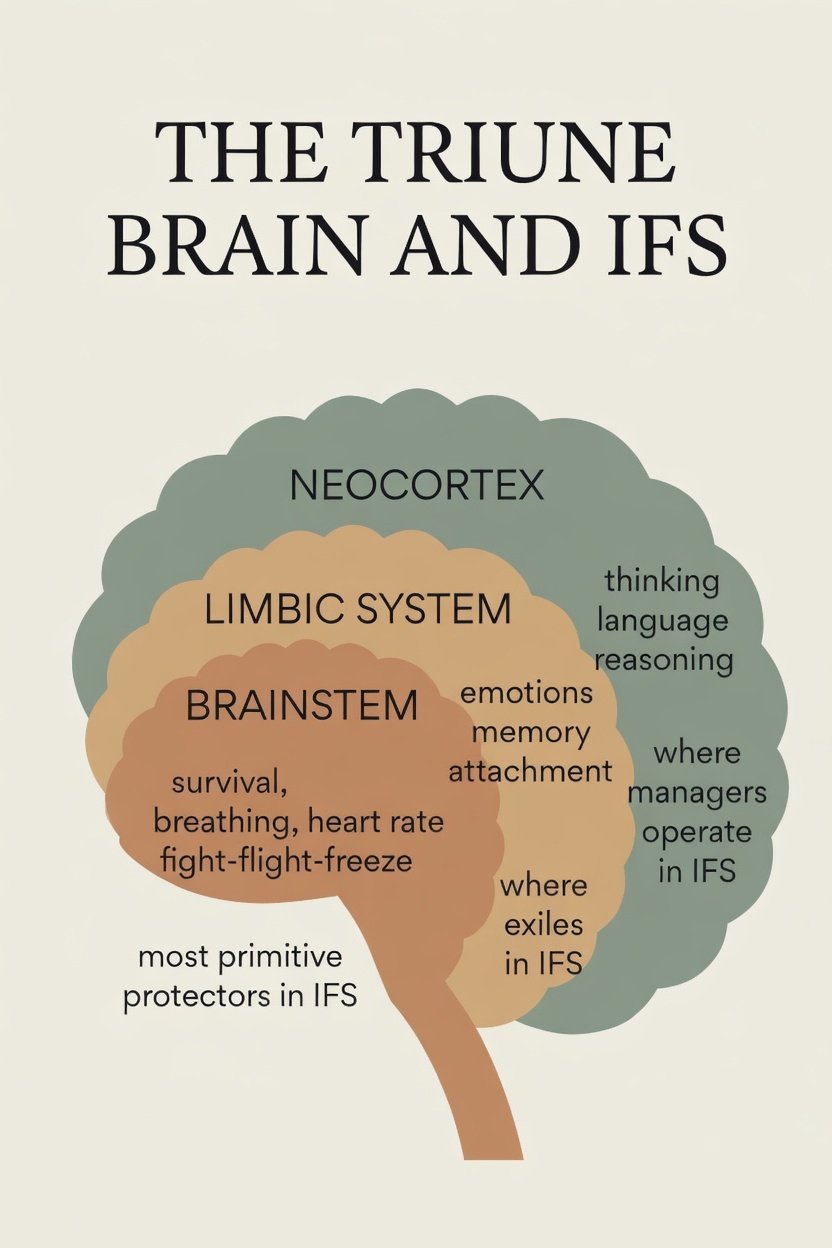
Brainstem. Pure survival logic — binary, instinctive, fast. Does not think; it reacts. Fight, flight, freeze. Governs heartbeat, breathing, basic alertness. Does not understand nuance or explanation.
Emotional brain. Creates emotional meaning, stores emotional memory, drives social behavior. This is where attachment patterns form, where relational wounds live. This is where trauma stores.
Thinking brain. Analyzes, plans, creates meaning. Language, abstract reasoning, self-reflection. Slow but nuanced. Can serve healing or block it — insight is valuable only after the body has done its work.
Brainstem (primitive protectors), Limbic (exiles), Neocortex (managers). From The Cocoon Method.
The Speed Factor
Clinical Guidance: Reptilian Brain Active
Speak slowly and simply, or say nothing at all. Your regulation is the most important thing in the room. Offer grounding: feet on the floor, the weight of a blanket. Stay present. Do not try to fix. The body needs to complete what it started, not be interrupted.
Try to talk them through it. Rush the process. Ask questions requiring thought. Touch without clear consent. Get activated yourself. Show fear or panic. Try to stop what is happening. Offer "it's okay" — this bypasses what the body needs.
The Limbic Brain: Key Structures
Clinical Guidance: Limbic Brain Active
Stay present and connected. Match their emotional register — attuned, not identical. Offer your regulated presence. Validate the emotion without amplifying it. Use warm, connected tone. Allow the feeling to move. Be with them, not above them. Trust that the emotion has somewhere to go.
Analyse or interpret while they are feeling. Try to fix or stop the emotion. Withdraw or become distant. Get lost in their feeling (you are the anchor). Offer premature reassurance. Rush to meaning-making before the emotion has moved through.
The Neocortex: Double-Edged
The Integration of All Three
Clinical Reading: Which Brain Is Active?
Freezing, trembling, shaking, primal sounds, glazed eyes, skin colour changes. This brain does not need words. It needs safety, warmth, and your calm presence.
Big emotions. Grief. Rage. Terror. Longing. Attachment needs surfacing. The client may seem younger. This brain needs attunement, emotional presence, and co-regulation. It needs to feel felt.
Explaining, analysing, asking why, making meaning. This is helpful after body-based work. But watch for it as a way of avoiding feeling instead of processing it. Then you gently bring them back to the body.
Which brain needs attention right now? Reptilian: create safety, ground, and wait. Limbic: attune, allow expression, validate. Neocortex: invite understanding and help them integrate what has moved through.
The Typical Session Flow
1. Begin with Neocortex: Conscious intention, understanding the process, consent, orientation.
2. Move to Limbic: Emotion arises, feelings emerge, attachment material surfaces.
3. Access Reptilian: Deep survival material, primal expression, body-level processing.
4. Return through Limbic: Emotional integration, feeling completion, relational repair.
5. Complete with Neocortex: Meaning-making, conscious integration, planning.
The thought lives in the neocortex. The trauma lives in the limbic brain and brainstem. These structures do not share a language. The neocortex cannot directly modify subcortical encoding. This is why affirmations can feel hollow — the words live in one place; the wound lives in another.
Notice yourself this week. Which brain takes over in work stress? In intimate conversations? In conflict? In moments of creativity? Share with the group. Knowing your own patterns is the foundation for recognising them in others.
- Reptilian (2 min): Is there any sense of threat? Any survival tension? Notice your most basic sensations — temperature, heartbeat, basic aliveness.
- Limbic (3 min): What emotions are present? What feelings want attention? Notice what your heart wants. What connection or expression is needed?
- Neocortex (3 min): What thoughts are running? What analysis or meaning-making is happening? What is your mind trying to figure out?
- Integration (2 min): Which brain is most active? What would each one need right now? Can you sense all three simultaneously?
Which brain was easiest to sense? Which was hardest? What did you learn about your default?
The Amygdala and Fear
“Most emotions are fear in disguise. — Karl Ulmer”
The Two Roads to Response
Thalamus directly to amygdala. Fast. Direct. Unconscious. The alarm sounds before you even know what triggered it. This is why you flinch before you know what startled you.
Thalamus → Cortex → Amygdala. Slower, conscious, contextual. The cortex evaluates whether the threat is real before the amygdala responds. This is what allows us to choose our response — but it takes time.
Amygdala Hijack
Trauma creates a sensitized amygdala. After traumatic experience, the amygdala becomes hypervigilant — scanning for threat more intensely, firing more easily, generalizing danger more broadly. What was once protective becomes a hair trigger.
The Two Roads: Timing
The Ulmer Principle: Fear Underneath Every Emotion
Fear of being violated, disrespected, or powerless.
Fear of loss, abandonment, aloneness.
Fear of being seen as defective and rejected.
Fear of punishment or loss of connection.
Fear of future threat.
Fear of hopelessness or meaninglessness.
Fear of losing what we have.
Fear of inadequacy.
What might they be afraid of, underneath this emotion? Anger guards grief. Grief guards terror. Find the fear, and you find what actually needs to heal.
Amygdala Hijack: The Sequence
Triggers Are Time Machines
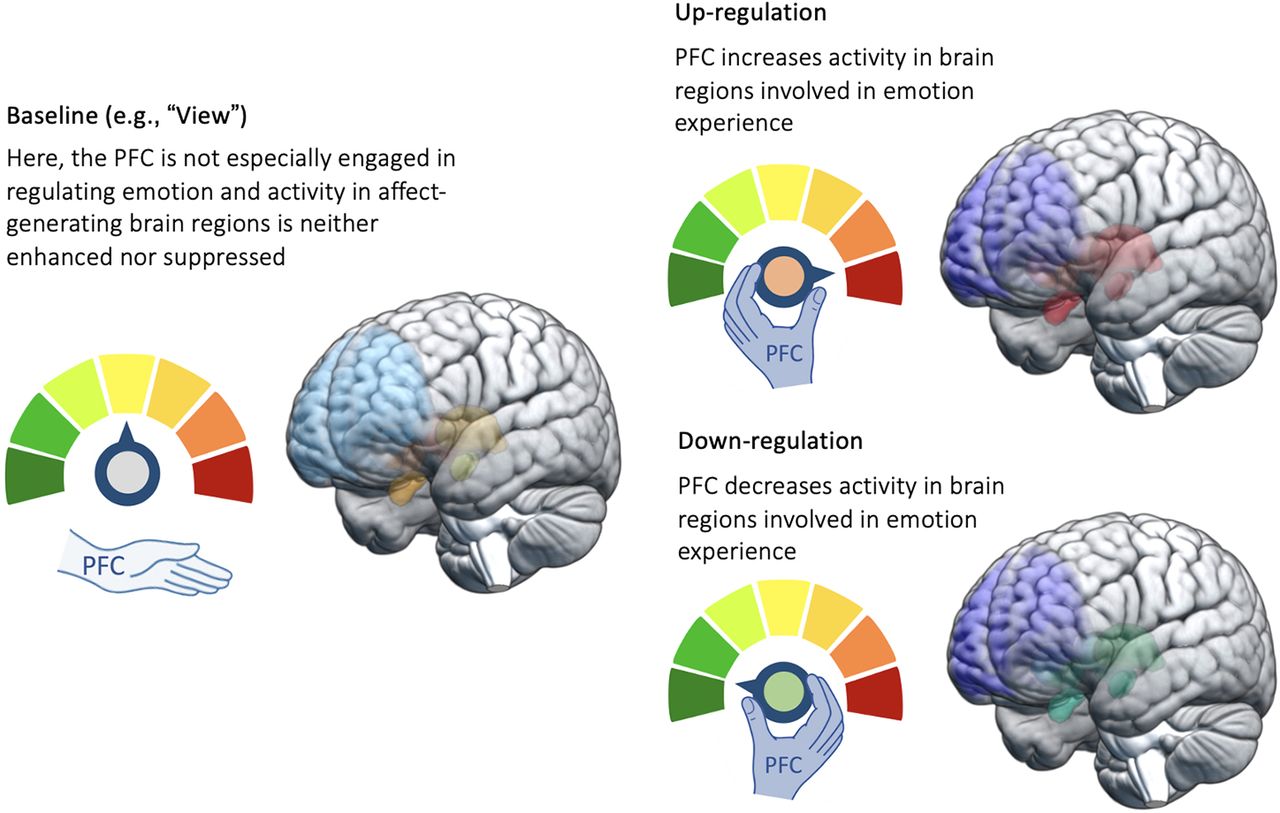
At baseline, activity in emotion regions is neutral. Up-regulation amplifies emotional experience; down-regulation suppresses it. Breathwork builds the PFC's capacity to regulate flexibly rather than rigidly suppress.
Working With the Amygdala in Session
Extended exhale (activates vagal brake). Grounding (feet on floor, sensory contact with present). Slowing everything — speech, movement, breath. Your regulated nervous system co-regulating theirs. Soft voice, warm eye contact, open posture.
Tell them to calm down (activates shame). Explain why they should not be afraid (logic does not reach amygdala). Rush or add urgency. Get activated yourself. Show fear or panic.
Create a personal trigger map: What are your most common triggers? What do you notice in your body when activated? What helps you return to regulation? Share one trigger and one recovery strategy with the group. Begin to build a collective map of what works.
The Prefrontal Cortex: The Regulator
The PFC handles everything that makes us human. Emotional regulation. Impulse control. Decision-making. Empathy. The ability to pause and think before we act. This is the part of the brain that says "wait" before you act. That asks "is this real?" before you react.
Under threat, blood moves away from the PFC toward the survival centres. The wise brain goes quiet. This is why people say things in anger they would never normally say. Stress does not just affect how you feel. It literally reduces your access to your own wisdom.
Trauma's Impact on the PFC
The PFC and the Window of Tolerance
Strengthening the PFC
Transient Hypofrontality
When It Happens & Why It Matters
It happens during intense exercise, flow states, deep meditation, and conscious connected breathing. Breathwork is one of the most reliable ways to create this state intentionally.
When the thinking brain quiets down, the inner critic goes with it. Deeper structures become accessible. Things that were locked away can surface. Old defenses relax. The body can lead. Without the constant commentary of the analytical mind, the body's own intelligence gets a chance to do what it needs to do.
The Science Behind Breathwork States
This is not dangerous in healthy individuals in a controlled setting. It is temporary and self-limiting. When normal breathing resumes, everything returns to baseline. This is why screening is essential — and why our No-Tetany Philosophy protects the process.
We are not just having a conversation — we are temporarily shifting the neurological filtering mechanism. What was gated becomes accessible. What was defended becomes available.
Think of a time when your thinking brain went quiet and something else took over. What were you doing? Exercise, music, movement, a creative state? What became possible in that moment that usually is not? Share with the group.
How Trauma Stores in the Body
“Trauma is not what happens to you. Trauma is what happens inside you as a result of what happens to you. — Gabor Maté”
Explicit vs Implicit Memory: The Detail That Changes Everything
The Full Picture: Where Trauma Lives
Defining Trauma
The kind that would overwhelm almost anyone. Natural disasters. Accidents. Assault. War. Severe abuse or neglect. These are events that clearly and obviously exceed what the nervous system can process at the time.
More personal. Chronic criticism. Emotional neglect. Humiliation. Relational ruptures. A family where emotions were never safe. A childhood where you always had to be good. Often dismissed as "not that bad." But the nervous system does not compare. It just responds.
Implicit vs. Explicit Memory
The body does not know the event is over. This is why trauma feels like now, not then. The body is not being dramatic — it is responding to what it genuinely believes is still happening.
Peter Levine's Contribution: Completing the Response
Take a blank piece of paper. Draw a simple body outline. Where do you hold stress? Where does emotion live in your body? Where do you feel joy, grief, fear, love? Share with the group. Your body map is completely unique to you. And it tells you things no questionnaire can.
The Defense Cascade
Social Engagement: The First Line
Fight: What Is Actually Happening
Flight: The Blocked Escape
Fawn: Surviving Through Pleasing
Collapse: The Final Protection
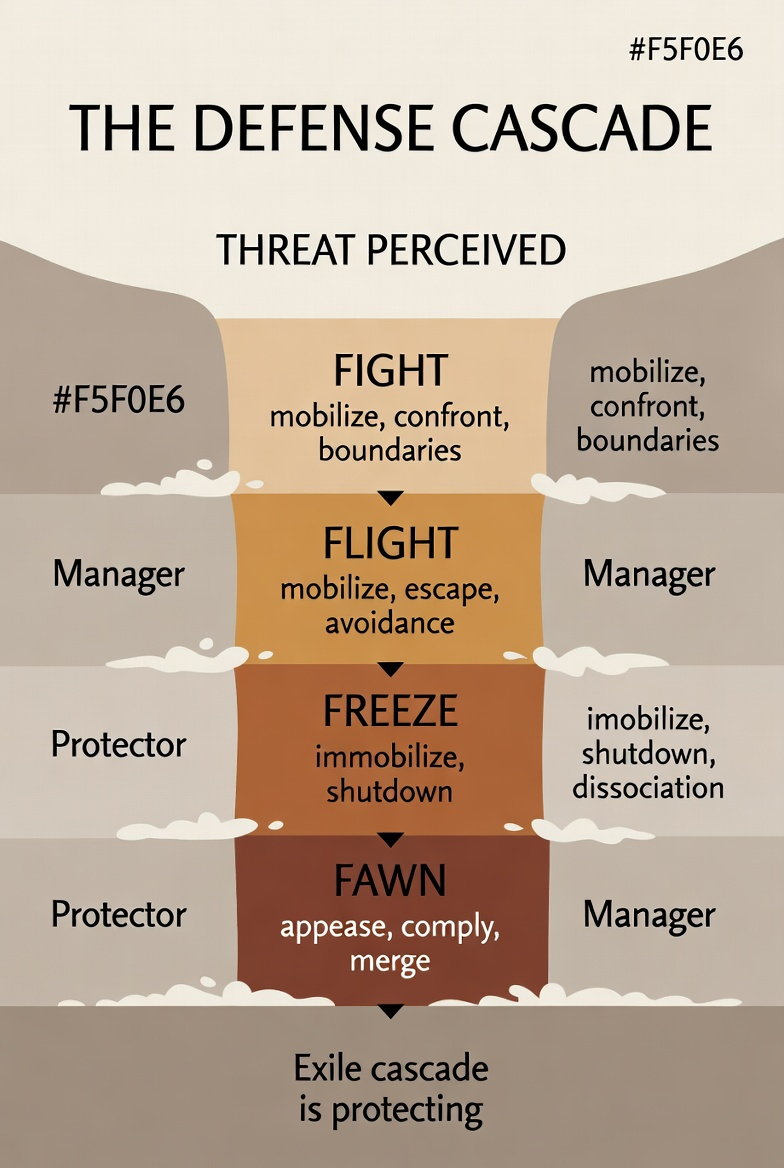
Fight and flight are managed by managers. Freeze and fawn are protector responses. The exile cascade is what all defenses are ultimately protecting. Every response has positive intent.
The Four Stages
Fight or Flight. Sympathetic activation. Adrenaline floods the system. Heart rate and breathing accelerate. Muscles prime for action. The body is ready to fight or run. This is healthy survival machinery.
When fighting or running is not possible, the system freezes. The body goes still. Eyes glaze. Breath becomes very shallow. But underneath that stillness the system is still fully activated. Not calm. Suspension.
Particularly common in relational trauma. When the threat comes from someone we need, the system learns to please, appease, comply. To make itself as unthreatening as possible. Over time this can become the default way of moving through the world.
Dorsal vagal shutdown. When nothing has worked and overwhelm is complete, the system collapses. Dissociation. Numbness. Disconnection. Often mistaken for calm. It is not calm. It is the deepest level of protection the nervous system has.
What Completion Actually Looks Like
Pushing through the arms. Striking movements. Sounds of assertion, growls, a firm "no." A sense of power returning to the body. Often followed by tears or laughter. Relief afterward.
Running movements in the legs. Kicking. Pushing away with the feet. The breath suddenly releasing. A physical sense of escape finally finishing. Relief, often followed by tears.
Tremoring and shaking. This is not a problem. This is the nervous system discharging. Temperature changes. Breath returning on its own. Often the underlying fight or flight energy surfaces afterward.
Sensation slowly coming back. Movement returning. A feeling of coming back into the room. Waves of emotion as full contact is restored. Warmth returning to the face and hands. "There you are."
Creating the Conditions for Completion
1. Safety first. The nervous system will not release survival energy without sensing safety. Everything depends on this.
2. Slow and titrated. Manageable doses at the productive edge, not the overwhelming one.
3. Resource throughout. Ground, breathe, connect with the present — not just at edges.
4. Allow whatever emerges. Do not direct the completion. You are making it safe to happen on its own.
5. Integrate after. Meaning-making only after somatic processing. Never before.
Reading the Cascade in Session
The goal is never to force a client to a different stage. The goal is to create the safety and support that allows the nervous system to complete what it started and return to regulation naturally. Trust the body's intelligence.
Rate your own tendencies for each defense response from 1 to 5. Which one do you move to most naturally? Share with the group. You cannot recognise in clients what you have not first recognised in yourself.
Why Breath Works
“Breath is the only function under both voluntary and involuntary control — making it our direct line to the unconscious.”
The Unique Position of Breath
The Mechanisms of Breathwork Healing
Slow, deep breathing activates the vagus nerve. The extended exhale is especially powerful. It tells the nervous system: the threat is over. You can rest now. HRV, heart rate variability, increases. This is a direct measure of nervous system flexibility and vagal tone. More HRV means a more resilient, adaptable nervous system.
The diaphragm has a direct connection to the limbic system, the emotional brain. When the diaphragm is restricted, emotions get stuck. When the diaphragm releases, emotion moves. Restricted breathing holds emotional content. When the breath releases, what the restriction was holding releases with it. This is not a metaphor. This is anatomy.
Through transient hypofrontality, breathwork opens access to material that is normally locked behind the thinking brain. What could not be reached through conversation suddenly becomes available.
When breathwork helps the body complete what was interrupted, something real changes. The old alarm patterns are recalibrated. The body learns, through direct experience, that it is safe now. This is not a coping strategy. This is actual healing.
Breath Holds and CO2 Tolerance
The Yogic Understanding: Pranayama
Brainwave States and Breathwork
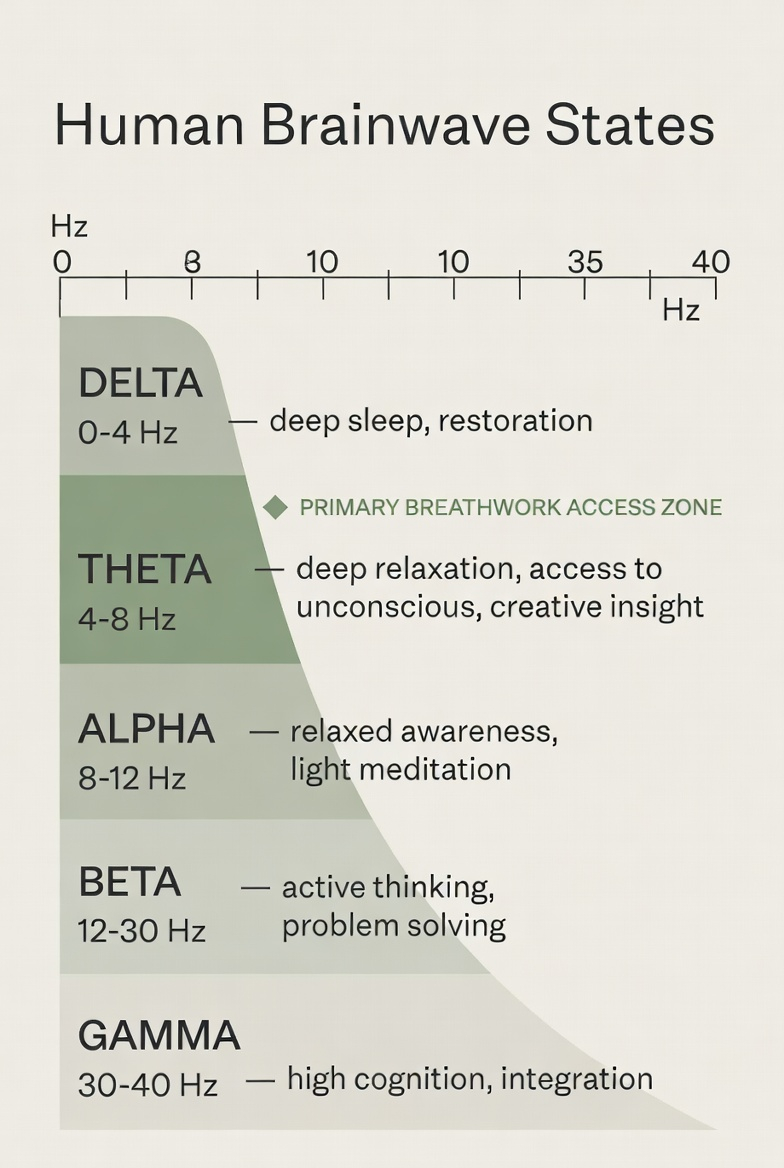
Normal waking consciousness. Active thinking, problem-solving, focused attention. The inner critic is online. Defenses are up. This is where most people live most of the time, and where talk therapy takes place.
Relaxed awareness. Meditation, creative states, light relaxation. The inner critic begins to quiet. This is the doorway to deeper states.
Deep meditation, the state just before sleep. Where breathwork often takes people. Access to implicit memory, emotional content stored below awareness. Vivid imagery. Emotional release. Somatic access to what words cannot reach.
Deep sleep, profound altered states. Some clients reach this in longer sessions. Deep integration, transpersonal experiences. Your steady, grounded presence is essential when a client goes this deep.
Peak concentration, "in the zone." Mystical and transcendent experiences. Integration of information across brain regions. Associated with insight, higher cognition, and moments of profound clarity. Some deep breathwork sessions touch gamma territory.
The anxious, overactive mind. Racing thoughts, worry, analysing without resolution. Cannot settle. Many trauma survivors live here chronically — the nervous system stuck in vigilance even when no threat is present. Entry point for most sessions.
The Theta zone (4–8 Hz) is the primary breathwork access zone — where unconscious material, emotional memory, and somatic intelligence become available. This is why breathwork reaches what talk alone cannot.
Breathwork and Brainwave Shifts
For the next seven days, notice your states. When are you in beta? Alpha? Theta? What brings you into each state? What returns you to regulation? Bring your observations to the group.
Interoception: The Eighth Sense
Interoception is the foundation of emotional intelligence. Before we can name an emotion, we must sense a bodily state. If we cannot feel our body, we cannot fully feel our emotions. If we cannot feel our emotions, we cannot regulate them.
What Interoception Includes
Heart rate and rhythm. Breath depth and quality. Temperature fluctuations. Hunger and satiety. Pain and pleasure. Tension and release. Nausea and ease. The gut's second brain. All internal sensory data from organs and tissues.
Trauma survivors often lose interoception. Feeling less protects against being overwhelmed. But it also becomes a barrier to healing. You cannot release what you cannot feel. You cannot complete what you cannot sense.
Developing Interoception in Session Work
- Heartbeat Awareness: Sit quietly. Without touching your chest, can you feel your heartbeat? If not, place your hand on your chest until you feel it, then remove your hand and try to maintain awareness. The practice is the trying — each attempt builds the circuit.
- Breath Tracking: Follow your breath without changing it. Where exactly do you feel it? Notice the temperature difference between inhale and exhale. Subtle sensations in nostrils, throat, chest, belly — how far down does it reach?
- Body Scanning: Move attention slowly through your body from feet to crown. What sensations are present — temperature, pressure, tingling, pulsing? Can you feel the internal organs? Notice what is there without trying to change it.
- Emotional Body Sensing: When you notice an emotion arising, pause before naming it. Where do you feel it in the body? What are the specific physical sensations? Can you stay with the sensation for ten seconds before reaching for a label or story?
Which practice was easiest? Which was hardest? What does that tell you about where to grow?
A Progressive Four-Week Approach
"Where do you feel that in your body?" — Localizing sensation
"What does it feel like?" — Describing quality
"What happens as you stay with it?" — Tracking change over time
These three questions are not just assessment tools. They are therapeutic interventions in themselves. The act of paying attention to sensation changes it. The noticing is already the beginning of healing.
Each morning for four weeks: take five minutes to scan your body from feet to head. Name three sensations. Ask what they feel like. Notice what changes as you pay attention. Share one observation each week with the group. Watch what becomes more available as your interoceptive capacity grows.
Putting It All Together: Clinical Integration
Sarah, 38, has done years of CBT, psychoanalysis, and medication for anxiety. She understands her patterns perfectly. "I know it's my amygdala. I know it's my nervous system. But I can't stop it." In session, the moment she describes a trigger, her breath immediately becomes shallow. Her shoulders rise. She reaches for explanation before she has even finished feeling.
Instead of adding more cognitive understanding, which she already has in abundance, we slow down. "Before we talk about it, where do you feel that in your body right now?" We stay with the sensation before any story. The breath becomes the guide. Over six sessions, Sarah discovers that she has been using understanding as a defence against feeling. And that the feeling, when she finally meets it, has somewhere to go.
The Four Assessment Lenses
Reptilian, limbic, or neocortex? Survival, emotion, or analysis? Your whole approach changes depending on the answer. This is why reading the brain state is the first thing you do in every session.
Fight or flight, freeze, fawn, or collapse. Each defense stage needs completely different facilitation. Knowing where someone is tells you what to do next.
Forget the words for a moment. Look at the posture. The breath. The muscle tone. The colour of the skin. The quality of eye contact. The body is always telling the truth, even when the words are saying something different.
Are they in the window of tolerance? Above it? Below it? Everything you do in the session follows from this one assessment. Never add more activation to someone who is already beyond their window.
Session Protocols
Arrive regulated yourself — your state is the first therapeutic tool. Create environmental safety. Assess state: which brain, which nervous system state. Orient to today. Establish consent. Resource before going anywhere deep.
Follow their process, not your agenda. Track continuously — where relative to their window? Titrate: productive edge, not flooding. Resource as needed throughout. Allow expression — do not stop what is moving. Stay regulated yourself.
Begin closing with time remaining — never abrupt. Ground thoroughly. Brief integration. Normalise the experience. Resource for departure. Mark the ending clearly.
Memory Reconsolidation
Attachment Patterns Shape the Brain
Comes from a caregiver who consistently dismissed emotions. The child learns to manage alone. To not need. To be strong. These clients often intellectualise beautifully. They understand their patterns. And feel very little.
Comes from inconsistent caregiving. The child cannot predict whether their needs will be met. They become hypervigilant to relational cues and have difficulty self-regulating. These clients may flood easily.
Happens when the caregiver is both the source of threat and the source of comfort. The system has no coherent strategy. These clients often show complex trauma patterns, including dissociation.
Vicarious Trauma and Self-Care
Every day: a morning regulation practice before you see anyone. Clearing between sessions so you do not carry one client into the next. An end-of-day discharge so the work does not come home with you.
Every week: a longer personal practice and peer support.
Every month: supervision or your own therapy.
If signs of vicarious trauma appear, seek support right away. This is professional responsibility.
Tracking Emotions Through the Body
Bring a real or hypothetical case to the group. Practice applying everything from Part 5 together. Which brain? Which defense stage? What does the body say? What does the window look like? What does this person need right now? Learning to see together is how clinical judgment actually develops.
Synthesize your key insights from Part 5: What three things have most changed how you understand human psychology? What do you now see about your own patterns that you could not see before? What are you most excited to bring into your practice? Share with the group.
Client Assessment Checklist
Breathing (rate, location, quality). Posture (collapsed, rigid, open). Eye contact (avoidant, intense, soft). Voice (monotone, rapid, melodic). Movement (restless, frozen, fluid). Skin colour or temperature changes. Quality of presence.
Reptilian: survival mode, reflexive. Limbic: emotional, attachment-focused. Neocortex: analytical, narrative. Which brain is available for the work today?
Current position (hyper / within / hypo). Width (narrow / moderate / wide). What pushes them out? What helps them return?
Fight / flight / freeze / fawn / collapse tendency. Primary and secondary. When likely developed. How it shows up in session.
Session Tracking Form
Presenting state: Which brain dominant? Which nervous system state?
What emerged: Themes, material, expressions.
Peak activation: 1–10, and what occurred.
Tools used: What helped?
Completion observed: Any survival responses that moved?
Closing state: Compared to opening.
My own state: Any activations? What needed attention in me?
Next session: What wants to continue?
Comprehensive Self-Assessment
Dominant brain daily: _. Under stress I shift to: _. Brain I have least access to: _. Signs telling me which brain is active: _.
Typical state: _. Window width: narrow / moderate / wide. What pushes me hyperaroused: _. What drops me hypoaroused: _. What helps me return: _.
Primary response: _. When it developed: _. Triggers: _. Signs it is activating: _.
Chronic tension: _. Numb areas: _. Interoceptive capacity: low / moderate / high. Emotions I can feel: _. Emotions I struggle to locate: _.
Most challenging area: _. Area to develop: _. What I commit to: _.
Personal Development Plan
Which concepts want further study? Which books from the reading list? Which training programmes address your growing edges?
What practical skills need practice? How will you practise them? Who will give feedback? What does accountability look like?
What in you needs continued attention? What defence patterns still run the show? What support will you seek?
Morning: how will you arrive regulated? Throughout: what check-ins? Evening: how will you clear what is not yours and prepare for sleep?
Part 5 Completion Checklist
Concepts Understood
Top-down vs. bottom-up processing — and why this matters clinically. The triune brain model and how to read which brain is active. Amygdala function and how to work with activation. Prefrontal cortex role and trauma's impact on it. Transient hypofrontality and why it explains breathwork's unique access.
Implicit vs. explicit memory and why trauma feels like "now." The defense cascade — all four stages. Brainwave states and what shifts in breathwork. Interoception — what it is and how to develop it. The four clinical assessment lenses.
Practices Completed
- All 10 community exercises
- Daily life laboratories and observations
- Embodiment practices
- Journal reflections
- Personal development plan updated
The Core Principles of Part 5
The only function under both voluntary and involuntary control. Through breath, we access what is normally automatic.
You cannot regulate what you cannot feel. Building body awareness is not preliminary — it is central to the work.
The nervous system must detect safety before healing can occur. Creating safety is the work — not the prelude to the work.
Neuroplasticity means what was wired can be rewired. Healing is possible. Always. This is not inspirational language — it is neuroscience.
How Far You Have Come
What has most changed in how you understand the brain and trauma?
What from Part 5 do you most want to bring into your practice?
What aspects of your own psychology do you see more clearly now?
Client Nervous System Assessment Checklist
Breathing pattern (rate, location, quality). Posture (collapsed, rigid, open). Eye contact (avoidant, intense, soft). Voice (monotone, rapid, melodic). Movement (restless, frozen, fluid). Skin colour or temperature changes. Overall quality of presence — are they here?
Reptilian signs: survival mode, reflexive, not thinking. Limbic signs: emotional, attachment-focused, relational. Neocortex signs: analytical, narrative, explaining. And crucially: which brain is available for the work you want to do together today?
Current position (hyper / within / hypo). Estimated width (narrow / moderate / wide). What pushes them out of their window? What resources and tools help them return?
Fight tendency. Flight tendency. Freeze tendency. Fawn tendency. Collapse tendency. Most clients have a primary and a secondary. Knowing this shapes how you approach them from the first session.
Session Tracking Form
Presenting state: Which brain dominant? Which nervous system state?
What emerged: Themes, material, expressions, surprises.
Peak activation level: 1–10, and what occurred at the peak.
Regulation tools used: What helped? What did not?
Completion observed: Any survival responses that moved?
Closing state: Compared to opening — better, same, more open?
My own state during session: Any activations? What needed attention?
Notes for next session: What wants to be continued or held?
Comprehensive Self-Assessment
My dominant brain in daily life is: _. Under stress, I shift to: _. The brain I have least access to is: _. Signs that tell me which brain is active: _.
My typical nervous system state is: _. My window of tolerance is: narrow / moderate / wide. What pushes me into hyperarousal: _. What drops me into hypoarousal: _. What helps me return to the window: _.
My primary defense response is: _. This pattern probably developed because: _. Situations that trigger it: _. Signs that it is activating in me: _.
Where I hold tension chronically: _. Areas of numbness or disconnection: _. My interoceptive capacity is: low / moderate / high. Emotions I can easily feel in my body: _. Emotions I struggle to locate: _.
The area of this material most challenging for me: _. The area I most need to develop: _. What I commit to practising: _.
Personal Development Plan
Which concepts want further study? Which books from the reading list are calling? Which training programmes are relevant to your growing edges?
What practical skills need practice? How will you practice them? Who will give you feedback? What does accountability look like for this?
What in you needs continued attention? What defence patterns are still running the show? What support will you seek — therapy, supervision, peer practice?
Morning: what will you do to arrive regulated each day? Throughout the day: what check-ins will you build in? Evening: how will you clear what is not yours and prepare for sleep?