Your Nervous System: A First Look
Before we close Part 1, I want to introduce the foundation that everything else in this training rests on. Part 3 goes deep into nervous system science. But you need a basic map now, because without it, nothing else makes complete sense.
The two main branches
Your autonomic nervous system operates below conscious awareness, regulating heartbeat, digestion, breath rate, and countless other functions. It has two main branches. The sympathetic branch is your gas pedal — it floods the body with adrenaline, increases heart rate, and prepares you to fight or flee. The parasympathetic branch is your brake pedal — it slows heart rate, activates digestion, and allows healing and regeneration.
Most of the people who come to you are stuck somewhere between chronic activation and chronic collapse. Very few have found their way back to regulation and know how to stay there. That is what we are teaching them — and what we must embody ourselves first.
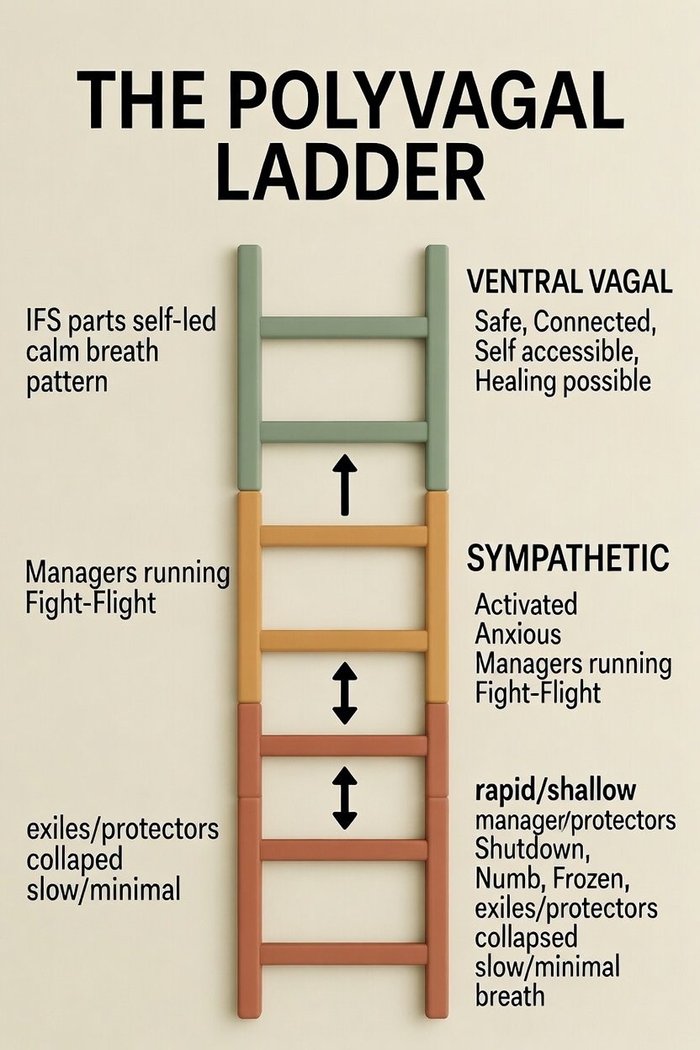
Polyvagal theory and the three states
Stephen Porges' Polyvagal Theory, developed in the 1990s, revealed something important: the parasympathetic branch has two distinct pathways. Ventral vagal is the state of safety and connection — calm, alert, able to connect and think clearly. This is the state from which healing happens. This is where we want clients to be able to access. This is where we as practitioners need to operate.
Sympathetic is the mobilisation state — activated, anxious, fight or flight running. Breath is rapid and shallow, muscles are tense, thinking is narrowed. Dorsal vagal is the shutdown state — dissociated, flat, numbed out. The system has determined that escape is impossible and has withdrawn inward.
Your state affects your clients more than any technique. Your regulation — or dysregulation — shapes what is possible in a session. Before you can help others regulate, you must develop your own capacity. Your nervous system is the primary instrument of your practice.
Neuroception — your body's security system
Your nervous system constantly scans for danger below the level of conscious awareness. Stephen Porges calls this neuroception. Before you consciously perceive a threat, your body has already begun responding.
This is why someone can feel unsafe even when they cognitively know they are safe. Their neuroception is detecting subtle cues of danger that their conscious mind has not registered. The breath shifts, muscles tighten, the face becomes guarded — all before any conscious thought of threat.
Warm, friendly face. Calm, melodious voice. Relaxed body language. Predictable movements. Prosodic speech — the natural rise and fall that signals social engagement. Your ventral vagal state is the most powerful safety cue you can offer. It is not what you say. It is what your system broadcasts.
Flat or harsh facial expressions. Sharp or monotone voice. Tense body language. Unpredictable movements. Rushed or erratic energy. Your clients' nervous systems will read these cues below conscious awareness and respond accordingly — regardless of what your words are saying. This is why regulation is the first clinical skill, not the last.
The direct link between breath and nervous system state
This is why breath is so powerful clinically — it is the most direct voluntary access point to the autonomic nervous system.
Activates the parasympathetic branch. This is why a long exhale is the fastest regulation tool available.
Activates the sympathetic branch and signals mobilisation — useful in activation phases of sessions, but dangerous if uncontrolled.
Can access dorsal vagal states — useful therapeutically in very careful contexts, but a red flag if it arrives involuntarily.
By guiding the breath, you guide the nervous system. By shifting the breath pattern, you shift what emotional material is accessible. This is the mechanism behind everything we do.
What each state looks like
Calm but alert. Face expressive, voice warm and varied. Able to connect, think clearly, feel. This is where healing happens.
Heart racing, shallow rapid breathing. Muscle tension, sweating, scanning. Racing thoughts, difficulty relaxing. Useful in short bursts — exhausting when chronic.
Slow, deep breathing OR barely perceptible breath. Relaxed muscles but in a collapsed, not regulated way. Flat affect, disconnection, numbness. Protective in extreme danger — problematic when chronic.
The goal of our work is not to eliminate sympathetic or dorsal responses — they are necessary survival tools. The goal is to increase flexibility: the ability to move between states and return to ventral vagal when the threat has passed.
Where in the body it lives
Chronic tension often represents held defensive impulses: the punch that could not be thrown, the run that could not be completed, the bracing against impact still held years later.
The connective tissue that wraps every muscle and organ can become restricted and adhered. These restrictions can hold both physical and emotional residue.
Chinese medicine associates specific emotions with specific organs: grief with the lungs, fear with the kidneys, anger with the liver. Whether or not you work within that framework, many clients report emotional release when specific organ areas are addressed.
How we carry ourselves reflects our history. The collapsed chest of defeated hope. The raised shoulders of chronic anxiety. The retracted pelvis of shame. The body becomes a monument to what has been lived.
Sometimes the body stores images that emerge during work: visual memories, dream-like sequences, symbolic pictures. These are body memory expressing itself through the language of image rather than sensation.
What happens when body memory is accessed
When body memory surfaces through breathwork or touch, several things may happen. Emergence — material rises from storage into experience as sensation, emotion, image, or impulse. Completion — the body may need to complete interrupted defensive responses: the push that never happened, the run that was stopped. Discharge — stored energy releases through tremoring, temperature change, tears, sound, or movement. Your job is to create the conditions for this to happen safely, then get out of the way.