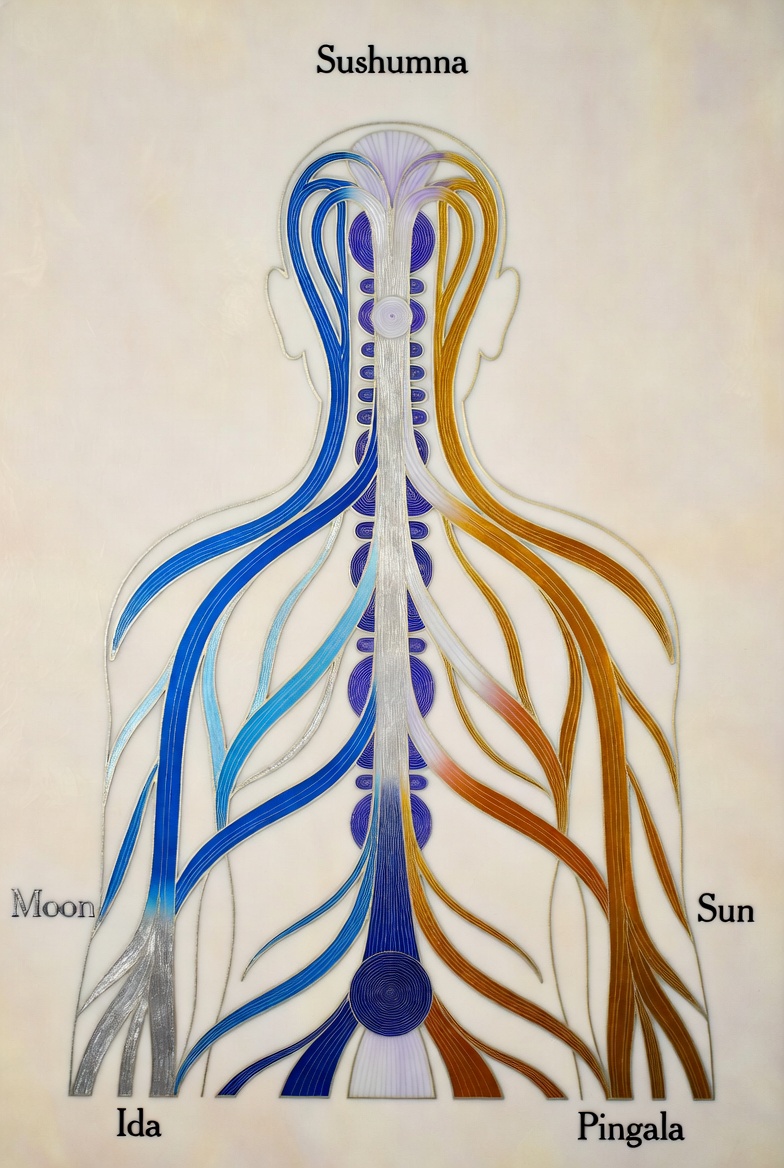
“"In the body, there are said to be 72,000 nadis — channels through which prana flows. Three are primary: Ida, Pingala, and Sushumna."”
Nadis are the energy channels through which prana flows throughout the subtle body. They are to the energy body what blood vessels are to the physical body, what nerves are to the nervous system. Understanding nadis transforms your breathwork practice. You are not just moving air — you are directing prana through specific channels, creating specific effects.
Ida, Pingala & Sushumna — the three primary energy channels
Ida (Moon/left), Pingala (Sun/right), Sushumna (central). When Ida and Pingala balance, Sushumna opens.
The Three Primary Nadis
✍
Ida Nadi
✍
Pingala Nadi
✍
Sushumna Nadi
The key insight: Most people constantly swing between Ida dominance and Pingala dominance. The goal of yogic practice is to balance these so that energy can flow through the central channel. When Ida and Pingala are balanced, Sushumna opens naturally.
The Nasal Cycle and Practical Nostril Work
There is a natural rhythm of nostril dominance. Throughout the day, dominance shifts between nostrils approximately every 90-120 minutes. This corresponds to shifts between sympathetic and parasympathetic activation, between active and receptive modes.
To activate (when tired, sluggish) Breathe through right nostril only. Lie on left side (opens right nostril). Use activating breathwork. To calm (when anxious, activated) Breathe through left nostril only. Lie on right side (opens left nostril). Use calming breathwork.
To balance (for meditation, integration) Alternate nostril breathing. Equal breathing through both. Notice which is dominant and balance.
The Five Pranas (Pancha Prana)
Prana is not one undifferentiated energy. It differentiates into five major functions called the Pancha Prana or Five Vayus (winds). Understanding these helps you work more precisely with breath and energy.
✍
Prana Vayu
✍
Apana Vayu
✍
Samana Vayu
✍
Udana Vayu
✍
Vyana Vayu
Kundalini: The Dormant Energy
Kundalini is described as dormant spiritual energy coiled at the base of the spine, often depicted as a serpent sleeping at the root chakra. Present in everyone, usually dormant. When awakened, it rises through Sushumna, passing through each chakra. Full rising leads to enlightenment — the union of Shakti and Shiva at the crown.
Signs of Kundalini Activation Heat or energy moving up spine. Spontaneous movements or kriyas. Visions or altered states. Emotional releases. Heightened sensitivity. Bliss states. Electrical or tingling sensations. Changes in sleep patterns. Increased creativity or insight. Cautions Kundalini awakening is powerful and can be destabilising if the system is not prepared, if awakening is forced or premature, if there is no proper guidance, if the person is not grounded, or if there are unresolved psychological issues.
The Cocoon Approach to Kundalini
We do not force Kundalini awakening. If it happens naturally through practice, we support safe integration: grounding practices, resourcing, slow integration, professional support if needed, prioritising stability over dramatic experiences. Kundalini experiences are not the goal — they are a byproduct of deeper opening. The goal is integration, not fireworks.
The Koshas: Five Sheaths
Yoga philosophy describes five layers or sheaths (koshas) that make up the human being, from gross to subtle.
Annamaya Kosha The physical body made of food. This is what we see and touch. Pranamaya Kosha The vital/breath body. Made of prana. Contains nadis and chakras. Where breathwork primarily works.
Manomaya Kosha The mental body. Contains thoughts, emotions, sensory processing. Vijnanamaya Kosha The intellectual/intuitive body. Contains discernment, wisdom, higher knowing.
Anandamaya Kosha The causal body. Closest to the Self. Made of bliss. Source of deep peace.
In Practice
Breathwork primarily works with Pranamaya Kosha but affects all layers. As we work with breath, we affect energy, which affects mind, which affects wisdom, which opens us to bliss.
Community Exercise 3 — Nadi Balance Practice
Practice Nadi Shodhana together. Sit comfortably, spine straight. Right hand in Vishnu mudra (index and middle fingers folded). Close right nostril with thumb, inhale through left (4 counts). Close both, hold briefly (2 counts). Release right nostril, exhale through right (4 counts). Inhale through right (4 counts). Close both, hold briefly (2 counts). Release left, exhale through left (4 counts). This is one round. Practice 10 rounds. Share: What did you notice? Which side felt more open at the start? What's the quality of your mind now?
✍
Journal Invitation
Ida, Pingala & Sushumna — the three primary energy channels