Energy Work & Ancient Healing Systems
CHAKRAS, NADIS, TCM, AYURVEDA & REIKI
The Cocoon Method — Practitioner Training Manual
Contents
- 01Before You Begin
- 02Chapter One: The Energetic Framework
- 03Chapter Two: The Chakra System
- 04Chapter Three: Nadis, Pranas & Yogic Energy
- 05Chapter Four: Traditional Chinese Medicine & The Five Elements
- 06Chapter Five: Ayurveda: The Science of Life
- 07Chapter Six: Reiki & Practical Energy Healing
- 08Chapter Seven: Energy-Informed Breathwork
- 09Chapter Eight: Specific Practices for Each Energy Centre
- 10Chapter Nine: Daily Practice for Practitioners
- 11Part 9 Completion Checklist
Before You Begin
Before You Begin
Rate yourself honestly before reading. Return after completing Part 9 to see how far you have come.
Energy Knowledge
I understand what prana/chi/life force energy is and how it relates to breath
I can name the seven chakras, their locations, and their core themes
I understand the three primary nadis and how to work with them
I know the five pranas and what each one governs
I understand the TCM Five Elements and their organ-emotion connections
I know the three Ayurvedic doshas and how to tailor breathwork for each
I understand basic Reiki principles and energy healing concepts
I have a personal energy protection and clearing practice
I can sense my own energy body and notice shifts in clients
I know how to integrate energy awareness with breathwork facilitation
We now enter territory that some may find unfamiliar — the realm of energy, subtle bodies, and ancient healing systems. If you come from a purely scientific background, you may feel sceptical. If you come from spiritual traditions, this may feel like home.
I want to be honest about my own journey. When I first encountered energy work, I was sceptical. I had trained in evidence-based approaches. I wanted to understand the mechanisms. I needed proof.
And then I felt it. Not as belief, but as direct perception. I felt the energy in my hands when I placed them on a client's body. I felt blockages dissolve as they breathed. I felt the shift in the room when something released.
Something important before we begin: You do not need to leave your nervous system science at the door when you pick up the energy healing frameworks, and you do not need to leave the energy healing at the door when you pick up IFS. In this training, the chakra system, the TCM organ-emotion map, and IFS all point at the same inner system from different angles. A blocked throat chakra, a suppressed oral segment, a manager that will not let the truth be spoken — these are three languages for one reality. Let the frameworks layer rather than compete.
“"The Cocoon Method honours both perspectives — the scientific and the experiential. We do not ask you to abandon scientific rigour. We ask you to expand your framework to include what traditional cultures have known for millennia: that we are more than physical bodies, and that healing happens on levels beyond the material."”
As a breathwork practitioner, you are already working with energy. Prana, chi, ki, life force — whatever you call it, breath is its primary vehicle. This part of your training makes that work more conscious and skilful.
Chapter One: The Energetic Framework
Beyond the Physical Body
You have learned that the nervous system regulates our states. You have learned that trauma stores in the body. You have learned that breath bridges conscious and unconscious. You have learned about parts and the psychology of protection. Now we go deeper — into the territory that underlies all of this.
Underlying the physical body is an energy body — called the subtle body, the etheric body, or the pranic body depending on tradition. This energy body underlies and interpenetrates the physical form, contains energy centres (chakras) and channels (nadis or meridians), is affected by thoughts, emotions, and experiences, and can become blocked, depleted, or chaotic.
When you facilitate breathwork, you are not just changing respiratory patterns. You are moving energy. You are clearing blockages. You are activating centres of consciousness. You are facilitating the flow of life force. Understanding this dimension transforms your practice.
What Is Energy?
In the context of healing, "energy" refers to the vital force that animates living beings. Different traditions name it differently, but they all point to the same territory.
Prana (Sanskrit) Life force, carried primarily by breath. The word means "first unit" or "primary life force." Prana is the subtle essence that animates all living things. Chi / Qi (Chinese) Vital energy flowing through meridians. Chi means "breath" or "air" but refers to the life force that breath carries. All of Chinese medicine is based on the flow of chi.
Ki (Japanese) Universal life energy used in Reiki and martial arts. Same root as chi. Forms the basis of Japanese healing and martial traditions. Prana by other names Ruach (Hebrew: breath, spirit, life force). Mana (Polynesian: spiritual power). Pneuma (Greek: breath, spirit, vital force). Orgone (Wilhelm Reich: the life energy he studied scientifically in the 20th century).
All these traditions point to the same reality: there is something that animates living beings that is more than chemical processes. This something can be cultivated, directed, depleted, blocked, or healed.
The Scientific Perspective
Modern science is beginning to validate what traditions have long taught. While science does not yet have a complete theory of "life force energy," research points toward measurable phenomena.
Bioelectromagnetics The body generates measurable electromagnetic fields. The heart's field can be detected several feet away — HeartMath Institute has documented this extensively. Every cell generates electrical activity. Biophotons Cells emit ultra-weak light called biophotons. Research by Fritz-Albert Popp suggests these may be involved in cellular communication and may represent a measurable aspect of the "aura" described by healers.
Heart Rate Variability The heart's rhythm reflects the coherence of our energy system. HRV training essentially trains energetic coherence. States of coherence correlate with reports of "good energy flow." Biofield Science The emerging field of biofield science studies the electromagnetic and subtle energy fields of the body. The Consciousness and Healing Initiative is bringing scientific rigour to this research.
Practitioners have done so for thousands of years. Science will eventually catch up to what direct experience has always shown. The placebo effect alone demonstrates that belief and intention alter physical outcomes — suggesting energy and information influence matter.
The Aura and Energy Field
Every human has an individual aura — an energy body that permeates and surrounds the physical form. The aura has been depicted in art across cultures: halos around saints, the luminous fields in Eastern iconography, the "glow" we perceive around vital people.
The Etheric Body Closest to the physical, extending 1-4 inches. This is the energy template for the physical body. It is where acupuncture and direct energy healing primarily work. Physical symptoms often appear in the etheric body before manifesting physically. The Emotional Body Extends 1-3 feet. Contains emotional energy and the imprints of emotional experiences. Changes with emotional states. Emotional trauma is held in this layer. When you work with someone's emotions, you are working in their emotional body. Emotional releases during breathwork clear this layer.
The Mental Body Extends several feet. Contains thought patterns, beliefs, and mental structures. Where limiting beliefs are held as energy structures. When someone shifts a core belief, you can sometimes sense the restructuring. The Astral Body and Beyond The bridge between physical and spiritual planes. Contains the chakras in their fullest form. Beyond the astral are higher spiritual bodies — the causal, buddhic, and atmic bodies — which connect us to higher Self and universal consciousness.
Energy Flow and Blockage
When energy flows freely Vitality and aliveness. Emotional balance and resilience. Mental clarity and focus. Sense of connection and belonging. Physical health and immunity. Creative inspiration. Spiritual openness. When energy is blocked Fatigue and depletion. Emotional stagnation or volatility. Mental fog or obsessive thinking. Sense of disconnection and isolation. Physical symptoms or illness. Creative blocks. Spiritual disconnection.
How blockages form Trauma and overwhelming experiences. Chronic stress and tension. Repressed emotions held in the body. Limiting beliefs that constrict energy. Poor breathing patterns. Unhealthy relationships. Lack of movement and stagnation. How blockages release Breathwork (primary method). Bodywork and conscious touch. Direct energy healing. Emotional expression and release. Movement, dance, and shaking. Sound and vibration. Nature exposure and earthing. Meditation and presence. Loving relationships.
How Energy Work Relates to Breathwork
Breath is the primary carrier of prana and life force. When you facilitate breathwork, you are facilitating energy work whether you name it that or not.
Increased Energy Intake Deep, conscious breathing brings more prana into the system than normal breathing. This is why yogis developed pranayama — the science of directing prana through breath. Every inhale is an energy intake. Energy Activation Specific breathing patterns activate specific chakras and energy centres. Fast breathing activates upper chakras. Slow, deep breathing grounds lower chakras. Breath holds concentrate and intensify energy at specific points.
Blockage Release Built-up energy behind blockages begins to move. This is often experienced as emotion (energy in motion), sensation (tingling, heat, pressure), or involuntary movement (kriyas, tremoring). The release is energetic as much as physical or emotional. Channel Clearing and State Shift The nadis (energy channels) begin to open and clear. The overall energy body shifts from contracted/protected to open/flowing. The person's field literally expands. This is felt as lightness, opening, connection.
This is why integration time is important — the energy body needs time to reorganise. Understanding energy gives you a framework for what you are already doing with breath. It is not a mystical addition — it is recognition of what is actually happening.
The Seven Expert Perspectives on Energy
The IFS Practitioner The chakra system is a parts map. A blocked root chakra often houses an exile who learned that the world was not safe to be present in. An overactive solar plexus may hold a manager who learned that personal power was the only protection. A closed heart chakra almost always protects an exile carrying grief or the wound of love lost. The Neuroscientist "We measure electrical activity throughout the body. Neurons fire electrically. The heart generates an electromagnetic field. The idea of 'energy' may describe electromagnetic and bioelectric phenomena we're only beginning to understand. Dismissing it as 'woo' is premature."
The Psychologist "Energy concepts map onto psychological states remarkably well. 'Blocked energy' correlates with repressed emotion. 'Energy flow' correlates with emotional expression and integration. Whether the energy is 'real' or metaphorical, the framework is clinically useful." The TCM Doctor "Chi is the foundation of Chinese medicine. For 3,000 years we have mapped how it flows, what blocks it, and how to restore flow. We have extensive empirical evidence that these approaches work."
The Ayurvedic Practitioner "Prana is life itself. The five pranas govern different functions in the body. Pranayama is the science of directing prana for health and consciousness. This is not belief — it is technology refined over thousands of years." The Energy Healer and Spiritual Teacher "Energy is perceivable, workable, and real. With training, anyone can sense and direct it. The body's energy system responds to intention. I have seen too many healings to doubt this." And: "Energy is the interface between spirit and matter. Every healing tradition includes this dimension because it is real."
Daily Life Laboratory: Energy Awareness
Morning (5 min): Before getting up, sense your energy body. Notice where you feel vital, depleted, or blocked. Set an intention for your energy for the day.
Throughout the day: Notice how your energy changes in different environments. Notice how different people affect your energy. Notice what activities give you energy vs. drain you.
Evening (5 min): Rub palms together vigorously for 30 seconds. Hold hands 6 inches apart, palms facing. Slowly move them closer together and further apart. Notice: What do you feel between your hands? This is your own energy field — chi, prana.
In pairs. Round 1 (5 min each): Partner A holds hands palms up, eyes closed. Partner B holds hands 6 inches above and slowly moves closer and farther. Partner A reports what they sense. Switch. Round 2 (5 min each): Partner A stands with eyes closed. Partner B slowly walks toward them from 10 feet away. Partner A raises hand when they sense Partner B's field. Note the distance. Switch. Group discussion: what did you notice? How would you describe the sensation?
What is your relationship to the concept of "energy"?
Do you feel it naturally, or is this new territory?
Have you had experiences that suggested something beyond the physical — sensing someone's mood, feeling a place's energy, knowing something before it happened?
How does understanding breath as energy carrier change how you think about breathwork?
What happens to your scepticism when you actually feel the energy between your hands?
Chapter Two: The Chakra System
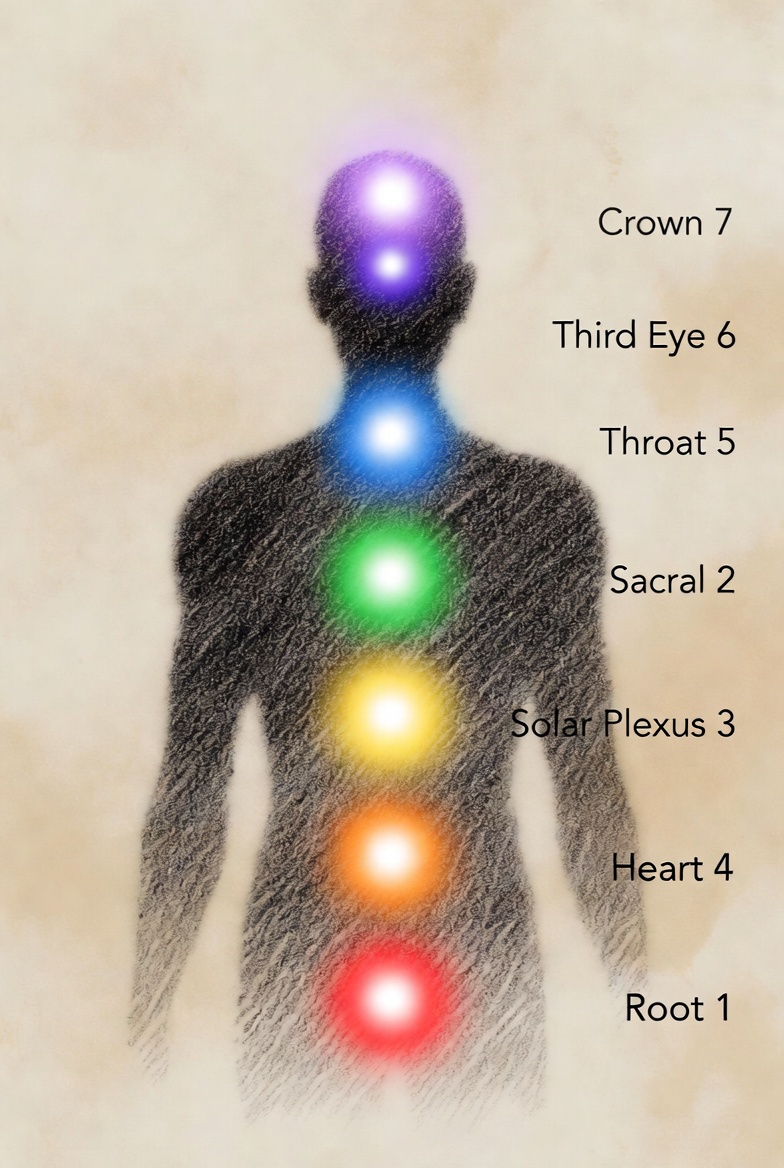
Chakra is Sanskrit for "wheel" or "disk." Chakras are spinning energy centres located along the central axis of the body. They receive, process, and distribute life force energy throughout the system. Think of chakras as transformers — they step down universal energy into forms usable by the human system. Each chakra processes specific frequencies of energy and governs specific aspects of our experience.
Each chakra also carries an IFS signature. The root holds exiles who learned that existing was not safe. The sacral holds parts carrying shame around emotion, creativity, and desire. The solar plexus holds managers who use personal power and control as protection. The heart holds exiles carrying grief, loss, and the wounds of love. The throat holds parts who learned that speaking the truth was dangerous. The third eye holds parts who learned not to trust their own perception. The crown connects to the deepest Self — the awareness that has never been damaged by anything that happened.
When chakras are balanced Energy flows freely through the system. We feel vital, aligned, and capable of meeting life's challenges. Each area of life functions well. When chakras are blocked or excessive Blocked: energy stagnates in specific areas. We experience symptoms related to that chakra's domain. Excessive: too much energy accumulates in one area, often at the expense of others. This creates a different kind of imbalance.
The Seven Major Chakras
Each chakra governs specific physical, emotional, and psychological territory. IFS parts live at each level.
The Seven Major Chakras
C1 Chakra 1: Root Muladhara · Base of spine, perineum Element: Earth Sound: LAM / C Gland: Adrenals Color: #E74C3C Developmental Stage: Womb to 12 months When balanced: Grounded, secure, stable, trusting of life, comfortable in body, financially stable, sense of belonging, physical vitality, strong immune system. When blocked: Fear, anxiety, insecurity, disconnection from body, financial instability, feeling unsafe, survival panic, ungrounded, eating disorders, chronic fatigue, lower back pain, leg problems. When excessive: Hoarding, materialism, greed, resistance to change, sluggishness, obesity, excessive attachment to security, rigidity, stubbornness. Breath connection: Grounding breaths, belly breathing, slow exhales all strengthen root. Focus on connection to earth during practice. Breathing into the base of the spine. Exhale into the ground. Bodywork: Feet, legs, base of spine, grounding work. In session ask: Do you feel your feet on the floor?
Where is home for you?
Do you feel safe in your body?
"I am safe. I am grounded. I belong here. I have a right to exist."?
C2 Chakra 2: Sacral Svadhisthana · Lower abdomen, 2 inches below navel Element: Water Sound: VAM / D Gland: Ovaries / Testes Color: #E67E22 Developmental Stage: 6 months to 2 years When balanced: Creative, passionate, emotionally fluid, healthy sexuality, pleasure-positive, able to feel and express emotions, flexible, connected to desire, good boundaries in relationships. When blocked: Emotional numbness, guilt, sexual shame or dysfunction, creative blocks, rigidity, joylessness, fear of pleasure, stiffness in hips and lower back, reproductive issues, fear of change. When excessive: Emotional overwhelm, sexual addiction, manipulation through emotion, codependency, poor boundaries, obsessive attachment, mood swings. Breath connection: Fluid, wave-like breathing patterns. Hip-opening combined with breath. Allowing sound and movement with breath. Breathing into the pelvis and sacrum. Bodywork: Hips, pelvis, lower back, sacrum. In session ask: What are you feeling right now?
What brings you pleasure?
How is your creative life?
"I feel. I flow. I embrace pleasure and creativity. I deserve to enjoy life."?
C3 Chakra 3: Solar Plexus Manipura · Upper abdomen, stomach area Element: Fire Sound: RAM / E Gland: Pancreas, Adrenals Color: #F1C40F Developmental Stage: 18 months to 4 years When balanced: Confident, motivated, clear sense of self, healthy boundaries, able to take action, comfortable with power, good self-esteem, strong digestion, ability to transform and change. When blocked: Low self-esteem, shame, powerlessness, victim mentality, lack of motivation, weak will, poor boundaries, digestive problems, chronic fatigue, cold, passive, blaming others. When excessive: Domination, aggression, arrogance, workaholic patterns, need to control, anger issues, inflammation, perfectionism, competitive. Breath connection: Breath of Fire activates solar plexus. Kapalabhati strengthens this centre. Core engagement with breath. Full, empowered breathing. Bodywork: Abdomen, diaphragm, middle back. In session ask: What do you want?
How do you feel about your personal power?
Where do you give your power away?
What makes you angry?
"I am powerful. I honour myself. I act with purpose. I define my own worth."?
C4 Chakra 4: Heart Anahata · Centre of chest Element: Air Sound: YAM / F Gland: Thymus Color: #27AE60 Developmental Stage: 4 to 7 years When balanced: Loving, compassionate, able to give and receive equally, forgiving, connected, at peace, self-accepting, good relationships, open heart, healthy lungs, strong immune system. When blocked: Grief, loneliness, isolation, bitterness, inability to forgive, defended heart, fear of intimacy, self-rejection, cold, respiratory problems, immune deficiency, unable to receive. When excessive: Codependency, poor boundaries, giving to depletion, jealousy, martyrdom, possessiveness, smothering, demanding, unable to be alone. Breath connection: Heart-centred breathing. Coherent breathing at 5-6 breaths per minute maximises heart-brain coherence. The heart chakra is the bridge between lower and upper chakras. Bodywork: Chest, upper back, arms, hands. In session ask: How do you give love?
Receive love?
What do you need to forgive?
What griefs do you carry?
"I love and am loved. I forgive myself and others. My heart is open. I am worthy of love."?
C5 Chakra 5: Throat Vishuddha · Throat Element: Ether / Space Sound: HAM / G Gland: Thyroid, Parathyroid Color: #3498DB Developmental Stage: 7 to 12 years When balanced: Clear communication, speaks truth with kindness, creative expression flows, good listener, authentic, comfortable with silence, good voice quality, healthy thyroid. When blocked: Fear of speaking, throat tension, difficulty expressing, held-back words, lies or inauthenticity, not being heard, thyroid problems, neck and jaw tension, poor listening. When excessive: Talking too much, not listening, gossiping, dominating conversations, harsh speech, lying, over-talking, inability to be silent. Breath connection: Ujjayi breath (ocean breath) activates throat. Sound with exhale opens throat chakra. Humming, toning, and vocalisation. Breathing with an open throat. Bodywork: Throat, neck, jaw, shoulders. In session ask: What do you need to say that you haven't said?
Do you feel heard in your life?
What would you express if you could?
"I speak my truth with love. I express myself clearly. I am heard. My voice matters."?
C6 Chakra 6: Third Eye Ajna · Between and slightly above eyebrows Element: Light Sound: OM / AUM / A Gland: Pituitary Color: #8E44AD Developmental Stage: Adolescence When balanced: Intuitive, insightful, imaginative, wise, clear perception, vivid dreams, connected to inner guidance, good memory, clear thinking, able to visualise. When blocked: Disconnected from intuition, confusion, difficulty visualising, denial, closed-minded, headaches, eye problems, memory issues, poor dream recall, cannot imagine the future. When excessive: Hallucinations, delusions, disconnected from reality, living in fantasy, nightmares, overthinking, obsessive, spiritual bypass. Breath connection: Focus on third eye during breath holds. Alternate nostril breathing balances hemispheres and activates ajna. Meditation with breath. Visualisation with breath. Bodywork: Head, face, eyes (light work). In session ask: What does your intuition tell you?
What do you see clearly?
What feels unclear?
What are your dreams telling you?
"I see clearly. I trust my intuition. I am connected to inner wisdom. I see the truth."?
C7 Chakra 7: Crown Sahasrara · Top of head Element: Thought / Consciousness Sound: Silence or OM / B Gland: Pineal Color: #9B59B6 Developmental Stage: Early adulthood and beyond When balanced: Spiritually connected, sense of purpose, open to transcendence, wise, peaceful, connected to something greater, able to be present, sense of unity, trust in life. When blocked: Spiritual disconnection, meaninglessness, cynicism, close-minded to spiritual dimension, isolated, depression, rigid belief systems, materialism. When excessive: Spiritual bypassing, ungrounded, disconnected from body, avoiding earthly responsibilities, spiritual addiction, living in head, spiritual superiority. Breath connection: Breath holds at top of inhale activate crown. Meditation with breath. The natural pause between breaths touches crown consciousness. Full yoga breathing reaching the crown. Bodywork: Very light touch at crown; mostly energetic work. In session ask: What gives your life meaning?
What is your relationship with spirituality?
What is your sense of purpose?
"I am connected to the divine. I am one with all that is. I trust the universe. I am guided."?
Chakra Quick Reference
| Chakra | Location | Color | Theme | Blocked | Excessive | Key Question | | --- | --- | --- | --- | --- | --- | --- | | 1. Root | Base of spine | Red | Safety | Fear, ungrounded | Rigid, hoarding | "Do you feel safe?" | | 2. Sacral | Below navel | Orange | Feeling | Numb, guilty | Flooded, addicted | "What do you feel?" | | 3. Solar Plexus | Upper abdomen | Yellow | Power | Powerless, shame | Controlling, angry | "What do you want?" | | 4. Heart | Chest | Green | Love | Closed, grieving | Codependent, martyr | "Can you receive?" | | 5. Throat | Throat | Blue | Expression | Silent, inauthentic | Talks too much | "What's unspoken?" | | 6. Third Eye | Forehead | Indigo | Intuition | Confused, cynical | Delusional | "What do you see?" | | 7. Crown | Top of head | Violet | Spirit | Meaningless | Spiritual bypass | "What's your purpose?" |
In pairs. Person A shares briefly about their life right now (2-3 min). Person B listens for chakra clues: Root (safety, security, grounding), Sacral (emotions, creativity, pleasure), Solar Plexus (power, confidence, will), Heart (love, connection, grief), Throat (expression, truth), Third Eye (intuition, clarity), Crown (meaning, purpose). Person B shares which chakras seem most activated. Discuss together — does this resonate? Switch roles.
Which chakra do you feel is your strongest?
Your most challenged?
How do chakra themes show up in your life and in clients you work with?
Where do you notice patterns in your family or culture around specific chakras?
| Chakra | Location | Color | Theme | Blocked | Excessive | Key Question |
|---|---|---|---|---|---|---|
| 1. Root | Base of spine | Red | Safety | Fear, ungrounded | Rigid, hoarding | "Do you feel safe?" |
| 2. Sacral | Below navel | Orange | Feeling | Numb, guilty | Flooded, addicted | "What do you feel?" |
| 3. Solar Plexus | Upper abdomen | Yellow | Power | Powerless, shame | Controlling, angry | "What do you want?" |
| 4. Heart | Chest | Green | Love | Closed, grieving | Codependent, martyr | "Can you receive?" |
| 5. Throat | Throat | Blue | Expression | Silent, inauthentic | Talks too much | "What's unspoken?" |
| 6. Third Eye | Forehead | Indigo | Intuition | Confused, cynical | Delusional | "What do you see?" |
| 7. Crown | Top of head | Violet | Spirit | Meaningless | Spiritual bypass | "What's your purpose?" |
Chapter Three: Nadis, Pranas & Yogic Energy
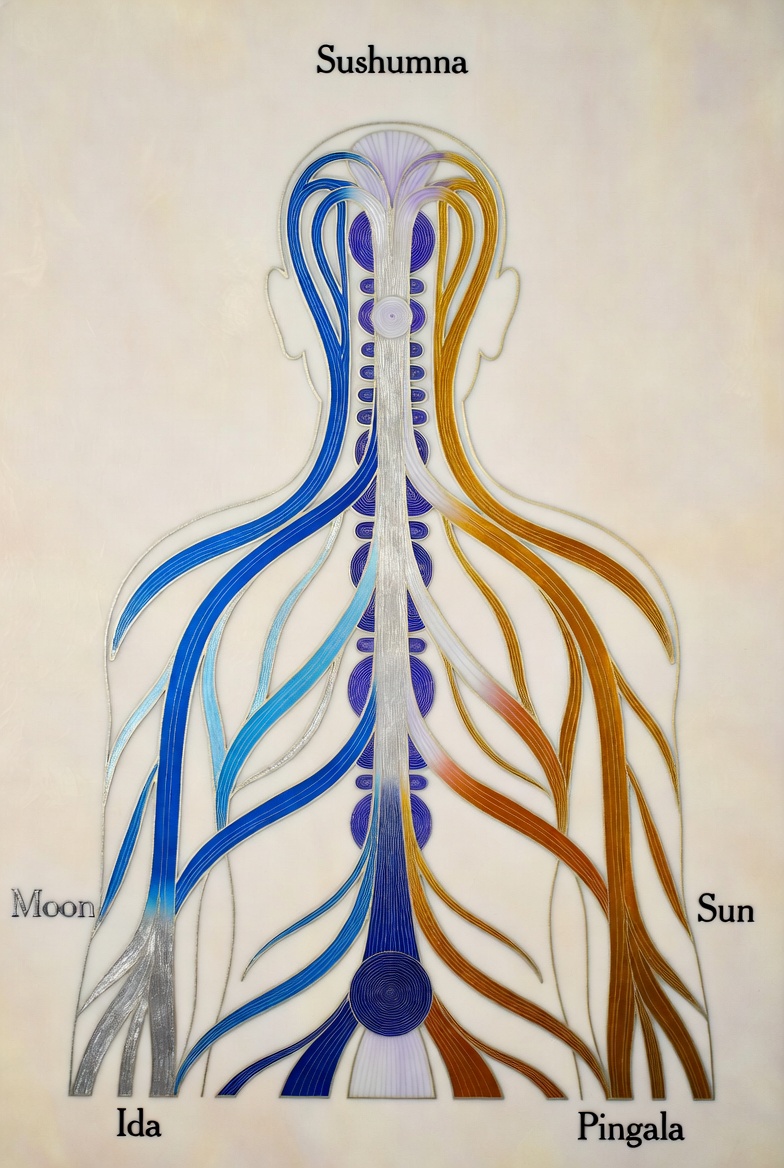
“"In the body, there are said to be 72,000 nadis — channels through which prana flows. Three are primary: Ida, Pingala, and Sushumna."”
Nadis are the energy channels through which prana flows throughout the subtle body. They are to the energy body what blood vessels are to the physical body, what nerves are to the nervous system. Understanding nadis transforms your breathwork practice. You are not just moving air — you are directing prana through specific channels, creating specific effects.
Ida, Pingala & Sushumna — the three primary energy channels
Ida (Moon/left), Pingala (Sun/right), Sushumna (central). When Ida and Pingala balance, Sushumna opens.
The Three Primary Nadis
Moon Channel — "Comfort" · Left side of body, ending at left nostril Quality: Lunar, feminine, cooling, receptive. Yin, parasympathetic, calming. Associated with right brain hemisphere, creativity, intuition. When dominant: Introspective, intuitive states. Calm, cool body temperature. Left nostril breathing more open. Receptive, passive, inward focus. Good for creative work, meditation, rest. Parasympathetic nervous system active. When blocked: Depression, lethargy, lack of creativity, emotional coldness or numbness, over-logical thinking, cannot access intuition, difficulty receiving. Practice: Breathe through left nostril only to activate Ida. Lie on right side to open left nostril. Use calming breathwork. Good for anxiety, over-activation, evening wind-down.?
Sun Channel — "Tawny/Golden" · Right side of body, ending at right nostril Quality: Solar, masculine, heating, active. Yang, sympathetic, energising. Associated with left brain hemisphere, logic, action. When dominant: Active, energised states. Warm body temperature. Right nostril breathing more open. Expressive, active, outward focus. Good for physical work, analysis, action. Sympathetic nervous system active. When blocked: Burnout, exhaustion, lack of motivation, physical coldness, inability to act or make decisions, no drive or ambition. Practice: Breathe through right nostril only to activate Pingala. Lie on left side to open right nostril. Use activating breathwork. Good for fatigue, depression, sluggishness, morning activation.?
Central Channel — "Very Gracious" · Centre of body, within the spinal column Quality: Neutral, balanced, transcendent. Unified consciousness, kundalini pathway. Both hemispheres integrated, spiritual awakening. When dominant: Deep meditation becomes possible. Kundalini can rise safely. States of unity and transcendence. Profound peace and clarity. Both nostrils breathe equally. Integration of opposites. When blocked: Spiritual disconnection, cannot access deeper states, energy cannot rise, stuck in duality, no sense of transcendence. Practice: Alternate nostril breathing (Nadi Shodhana) balances Ida and Pingala, which naturally opens Sushumna. When both channels are balanced, the central channel awakens. Dawn and dusk are natural Sushumna times (sandhya).?
The key insight: Most people constantly swing between Ida dominance and Pingala dominance. The goal of yogic practice is to balance these so that energy can flow through the central channel. When Ida and Pingala are balanced, Sushumna opens naturally.
The Nasal Cycle and Practical Nostril Work
There is a natural rhythm of nostril dominance. Throughout the day, dominance shifts between nostrils approximately every 90-120 minutes. This corresponds to shifts between sympathetic and parasympathetic activation, between active and receptive modes.
To activate (when tired, sluggish) Breathe through right nostril only. Lie on left side (opens right nostril). Use activating breathwork. To calm (when anxious, activated) Breathe through left nostril only. Lie on right side (opens left nostril). Use calming breathwork.
To balance (for meditation, integration) Alternate nostril breathing. Equal breathing through both. Notice which is dominant and balance.
The Five Pranas (Pancha Prana)
Prana is not one undifferentiated energy. It differentiates into five major functions called the Pancha Prana or Five Vayus (winds). Understanding these helps you work more precisely with breath and energy.
▲ Prana Vayu Inward Moving · Chest region, heart centre · Direction: Inward and upward What it governs: Governs intake — breathing in, eating, drinking, receiving sensory information. When balanced: Good respiratory function. Alert, responsive senses. Ability to receive nourishment and support. Openness to new information. When imbalanced: Respiratory problems, weak lungs. Anxiety, over-stimulation. Inability to take in nourishment. Closed to new input. Difficulty receiving. To strengthen: Focus on inhalation, chest expansion, receiving breath fully, open heart breathing.?
▲ Apana Vayu Downward Moving · Pelvic region, below the navel · Direction: Downward and outward What it governs: Governs elimination — exhaling, urination, defecation, menstruation, childbirth, releasing. When balanced: Good elimination. Groundedness. Ability to let go. Sense of completion. When imbalanced: Constipation, urinary issues. Inability to release or let go. Ungrounded, spacey. Things feel incomplete. To strengthen: Focus on exhalation, belly release, grounding through exhale, root lock (mula bandha) awareness.?
▲ Samana Vayu Equalising · Navel region, digestive centre · Direction: Spiraling, churning, centripetal What it governs: Governs digestion and assimilation — processing food, processing experience, balancing. When balanced: Good digestion. Ability to process experience. Balanced metabolism. Good discernment. Integration of opposites. When imbalanced: Digestive problems, bloating, indigestion. Inability to process or integrate experience. Stuck experiences. Poor discrimination. To strengthen: Focus on breath holds at navel, churning practices (agni sara), belly breathing with retention.?
▲ Udana Vayu Upward Moving · Throat region · Direction: Upward What it governs: Governs expression and growth — speech, self-expression, enthusiasm, will, spiritual growth. When balanced: Clear speech. Creative expression. Enthusiasm for life. Strong will. Spiritual aspiration. Healthy thyroid. When imbalanced: Throat problems. Difficulty expressing. Lack of motivation or enthusiasm. Weak will. Spiritual stagnation. To strengthen: Ujjayi breath, throat sounds, upward focus during breath, singing, chanting.?
▲ Vyana Vayu Outward Moving · Throughout entire body · Direction: Outward, circulating, centrifugal What it governs: Governs circulation and distribution — blood flow, nutrient distribution, coordination, expansion. When balanced: Good circulation. Coordination and grace. Ability to expand and reach out. Integrated movement. Strong energy field. When imbalanced: Poor circulation. Lack of coordination. Contraction, withdrawal. Disjointed movement. Weak boundaries and field. To strengthen: Full body breathing, awareness of breath filling entire body, expansive breathing, whole-body awareness.?
Kundalini: The Dormant Energy
Kundalini is described as dormant spiritual energy coiled at the base of the spine, often depicted as a serpent sleeping at the root chakra. Present in everyone, usually dormant. When awakened, it rises through Sushumna, passing through each chakra. Full rising leads to enlightenment — the union of Shakti and Shiva at the crown.
Signs of Kundalini Activation Heat or energy moving up spine. Spontaneous movements or kriyas. Visions or altered states. Emotional releases. Heightened sensitivity. Bliss states. Electrical or tingling sensations. Changes in sleep patterns. Increased creativity or insight. Cautions Kundalini awakening is powerful and can be destabilising if the system is not prepared, if awakening is forced or premature, if there is no proper guidance, if the person is not grounded, or if there are unresolved psychological issues.
We do not force Kundalini awakening. If it happens naturally through practice, we support safe integration: grounding practices, resourcing, slow integration, professional support if needed, prioritising stability over dramatic experiences. Kundalini experiences are not the goal — they are a byproduct of deeper opening. The goal is integration, not fireworks.
The Koshas: Five Sheaths
Yoga philosophy describes five layers or sheaths (koshas) that make up the human being, from gross to subtle.
Annamaya Kosha The physical body made of food. This is what we see and touch. Pranamaya Kosha The vital/breath body. Made of prana. Contains nadis and chakras. Where breathwork primarily works.
Manomaya Kosha The mental body. Contains thoughts, emotions, sensory processing. Vijnanamaya Kosha The intellectual/intuitive body. Contains discernment, wisdom, higher knowing.
Anandamaya Kosha The causal body. Closest to the Self. Made of bliss. Source of deep peace.
Breathwork primarily works with Pranamaya Kosha but affects all layers. As we work with breath, we affect energy, which affects mind, which affects wisdom, which opens us to bliss.
Practice Nadi Shodhana together. Sit comfortably, spine straight. Right hand in Vishnu mudra (index and middle fingers folded). Close right nostril with thumb, inhale through left (4 counts). Close both, hold briefly (2 counts). Release right nostril, exhale through right (4 counts). Inhale through right (4 counts). Close both, hold briefly (2 counts). Release left, exhale through left (4 counts). This is one round. Practice 10 rounds. Share: What did you notice? Which side felt more open at the start? What's the quality of your mind now?
Which nostril is dominant for you right now?
What does this suggest about your current state?
Which of the five pranas do you feel is strongest or weakest in your system?
How does understanding these subtle systems inform your breathwork practice?
Have you ever had experiences that might have been kundalini activation?
What happened?
Chapter Four: Traditional Chinese Medicine & The Five Elements
“"Health is the free flow of chi through the body. Disease arises when chi becomes blocked, deficient, or excessive."”
Traditional Chinese Medicine (TCM) is one of the oldest continuous medical systems in the world, with over 3,000 years of documented history. It views health as the balanced flow of Qi (chi) through the body. Illness arises when Qi becomes blocked, deficient, stagnant, or excessive.
TCM organ-emotion correlations also map onto parts. The liver holds anger — often a protector part defending something more vulnerable. The kidneys hold fear — often the exile who learned that the world was threatening. The lungs hold grief — often an exile who was not allowed to fully mourn. The spleen holds worry — often a manager that keeps the mind busy to prevent deeper material from surfacing. The heart holds joy — and when it is blocked, it holds the exile who was not allowed to feel fully alive.
The Five Elements are not elements in the Western chemical sense. They are qualities of energy, phases of transformation, ways that Qi manifests. Everything in nature — including the human body — can be understood through these five qualities.
The Five Elements — Complete Guide
木 Wood Element Season: Spring · Organs: Liver (Yin), Gallbladder (Yang) Balanced emotion: Assertiveness, healthy ambition, clear vision · Imbalanced emotion: Anger, frustration, irritability, rage When balanced: Clear vision for life. Good planning and organisation. Healthy boundaries and assertiveness. Flexible, adaptable. Creative expression. Smooth emotional flow. Good decision-making. When imbalanced: Deficient: no direction, cannot make decisions, depression, no ambition. Excessive/Stagnant: anger, frustration, rage, rigidity, headaches, eye problems, tight tendons, muscle tension. Breath connection: Sighing deeply releases liver qi stagnation. Anger is often held as breath holding. The liver governs the free flow of qi — when breath is restricted, liver qi stagnates. You see in clients: Chronic frustration or anger. Tension in shoulders and jaw. Eye problems or headaches. Difficulty with decisions. Feeling stuck or blocked. Supportive practices: Deep sighing. Sound release (shouting, growling). Side-body stretching. Green foods, sour foods. Spring walks, time in nature.?
火 Fire Element Season: Summer · Organs: Heart (Yin), Small Intestine (Yang), Pericardium, Triple Warmer Balanced emotion: Joy, warmth, good connection · Imbalanced emotion: Manic excitement, anxiety, restlessness When balanced: Joy and warmth. Good relationships. Clear communication. Appropriate enthusiasm. Ability to give and receive love. Good sleep. Calm heart. When imbalanced: Deficient: joylessness, flat affect, cold, disconnected, poor circulation, depression. Excessive: anxiety, restlessness, insomnia, heart palpitations, scattered energy, racing thoughts. Breath connection: Heart-centred breathing calms fire excess. Laughing breath activates healthy fire. The heart houses the Shen (spirit) — disturbed breathing disturbs the spirit. You see in clients: Anxiety or restlessness. Sleep difficulties. Relationship struggles. Heart palpitations. Either too much or too little joy. Supportive practices: Heart-coherent breathing. Laughing practice. Cooling breaths if excessive. Red and bitter foods. Joyful connection with others.?
土 Earth Element Season: Late Summer / Between Seasons · Organs: Spleen (Yin), Stomach (Yang) Balanced emotion: Groundedness, nourishment, stability · Imbalanced emotion: Worry, overthinking, rumination When balanced: Grounded and centred. Good digestion. Nurturing self and others. Able to receive and give support. Clear thinking. Stable energy. Sense of home and belonging. When imbalanced: Deficient: ungrounded, poor digestion, cannot receive support, weak muscles, exhaustion. Excessive: chronic worry and overthinking, bloating, neediness, codependency, sugar cravings. Breath connection: Belly breathing grounds earth element. Humming and toning support earth. The spleen transforms and transports — breathing helps this function. You see in clients: Chronic worrying. Digestive issues. Feeling uncentred. Difficulty with transitions. Codependent patterns. Supportive practices: Belly breathing. Humming, singing. Grounding practices. Yellow and orange foods. Creating home and sanctuary. Receiving nurturing.?
金 Metal Element Season: Autumn · Organs: Lungs (Yin), Large Intestine (Yang) Balanced emotion: Letting go gracefully, clear values · Imbalanced emotion: Chronic grief, sadness, inability to release When balanced: Able to let go gracefully. Clear boundaries. Values what matters. Deep, full breath. Resolved grief. Good skin health. Regular elimination. Sense of what is precious. When imbalanced: Deficient: cannot let go, poor boundaries, weak breath, prone to colds, constipation. Excessive: chronic unresolved grief, rigid boundaries, holding on too tightly, perfectionism, attachment to the past. Breath connection: Metal element IS breath. Lung capacity directly relates to metal health. Grief releases through breath. The exhale is the release — grief often involves inability to exhale fully. You see in clients: Chronic grief or sadness. Respiratory issues. Skin problems. Constipation. Cannot let go of past. Boundary issues. Supportive practices: Deep breathing. Crying, allowing grief. Exhale emphasis. White and pungent foods. Autumn walks. Decluttering as practice.?
水 Water Element Season: Winter · Organs: Kidneys (Yin), Bladder (Yang) Balanced emotion: Wisdom, courage (fear transformed) · Imbalanced emotion: Fear, chronic anxiety, exhaustion When balanced: Restful, able to be still. Wise, good judgment. Comfortable with depth. Deep reserves of energy. Strong will. Strong bones and teeth. Healthy aging. When imbalanced: Deficient: fear, chronic anxiety, depleted energy, burnout, overwork, adrenal exhaustion, lower back pain, thinning hair. Excessive: excessive fearfulness, paranoia, recklessness, water retention. Breath connection: Kidney breathing (into lower back). Slowing breath builds water and kidney energy. Fear affects the kidneys and breath — chronic fear depletes kidney qi. You see in clients: Chronic fear or anxiety. Burnout, exhaustion. Cannot rest or be still. Lower back problems. Adrenal fatigue. Ageing prematurely. Supportive practices: Kidney breathing. Rest and restoration. Slow, deep breathing. Black and blue foods, salty taste. Winter rest. Stillness practices.?
The Five Elements — Generation & Control Cycles
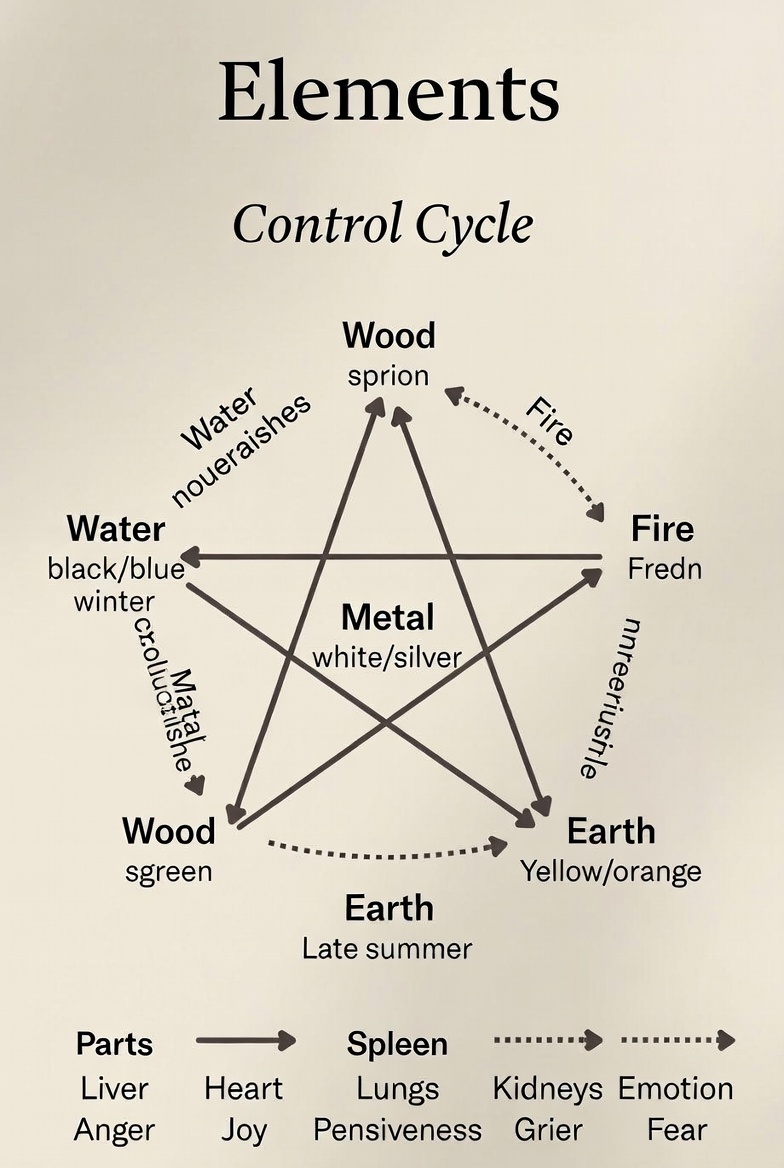
Solid arrows = Generation Cycle (each element nourishes the next). Dashed arrows = Control Cycle (each element controls another).
The Generation and Control Cycles
Generation Cycle (Sheng) Each element nourishes the next: Wood feeds Fire, Fire creates Earth (ash), Earth produces Metal, Metal enriches Water, Water nourishes Wood. When an element is deficient, strengthen the element before it in the cycle. Control Cycle (Ke) Each element controls another: Wood controls Earth, Earth controls Water, Water controls Fire, Fire controls Metal, Metal controls Wood. When an element is excessive, strengthen the element that controls it.
| Element | Season | Organ | Emotion | Balanced | Imbalanced | | --- | --- | --- | --- | --- | --- | | Wood | Spring | Liver | Anger | Visionary | Frustrated | | Fire | Summer | Heart | Joy | Connected | Anxious | | Earth | Late Summer | Spleen | Worry | Grounded | Worried | | Metal | Autumn | Lungs | Grief | Letting go | Stuck grief | | Water | Winter | Kidney | Fear | Wise | Fearful |
Which element do you feel most connected to constitutionally?
Which element seems imbalanced in your life right now?
How might understanding TCM inform how you work with different clients?
| Element | Season | Organ | Emotion | Balanced | Imbalanced |
|---|---|---|---|---|---|
| Wood | Spring | Liver | Anger | Visionary | Frustrated |
| Fire | Summer | Heart | Joy | Connected | Anxious |
| Earth | Late Summer | Spleen | Worry | Grounded | Worried |
| Metal | Autumn | Lungs | Grief | Letting go | Stuck grief |
| Water | Winter | Kidney | Fear | Wise | Fearful |
Chapter Five: Ayurveda: The Science of Life
Ayurveda, the traditional medicine of India, is over 5,000 years old. Ayur = life, Veda = knowledge. Ayurveda views health through the balance of three fundamental energies or doshas: Vata, Pitta, and Kapha. Each person has a unique constitution (prakrti) — their natural balance of doshas determined at conception. Current imbalance (vikrti) causes disease. The goal is to return to one's natural constitution.
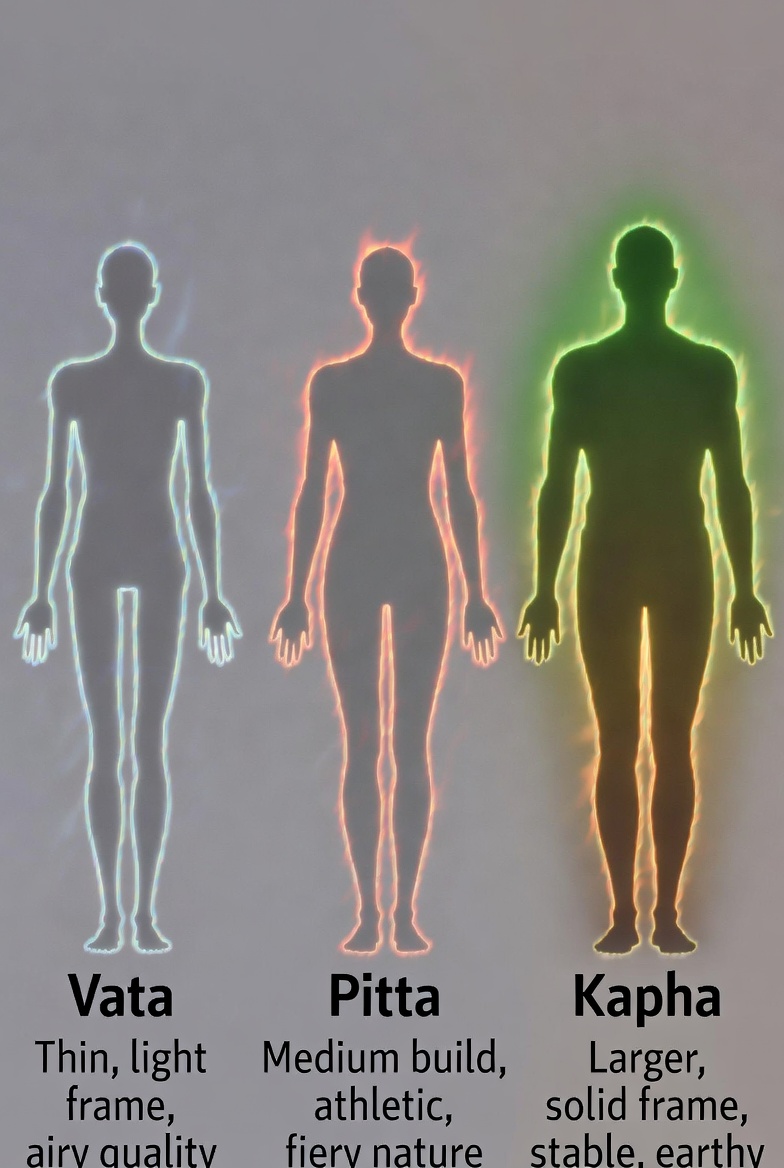
Vata, Pitta & Kapha — the three Ayurvedic doshas
Each constitution has a distinct energy quality: Vata (airy, light), Pitta (fiery, intense), Kapha (earthy, stable).
The Three Doshas
Air + Space Physical type: Thin, light frame. Dry skin and hair. Cold hands and feet. Variable digestion. Light, interrupted sleep. Moves quickly. Mental type: Creative, quick thinking, enthusiastic. When imbalanced: anxious, scattered, fearful. Learns fast, forgets fast. Artistic and sensitive. When balanced: Creative and flexible. Joyful and enthusiastic. Quick learner. Spiritually inclined. Adaptable. Good communicator. When imbalanced: Anxiety and fear. Insomnia. Constipation. Dry skin. Scattered thinking. Restlessness. Cannot focus. Worry and nervousness. Breath tendency: Tends toward irregular, shallow, fast breathing. May hold breath without noticing. Variable rhythm. Breathwork approach: Slow, grounding, regular rhythm. Emphasise exhale for grounding. Avoid overly activating practices. Belly breathing to ground. Regular, predictable patterns. Warming practices. Not too long or intense. Lifestyle: Regular routine (very important). Warm, cooked, grounding foods. Warm environment. Oil massage (abhyanga). Early bedtime. Avoid cold, raw, dry foods. Calm, quiet environment.?
Fire + Water Physical type: Medium build. Warm body, warm skin. Strong digestion. Penetrating eyes. Prone to inflammation. Medium sleep. Tendency toward baldness. Mental type: Sharp intellect, focused, driven. When imbalanced: critical, angry, perfectionist. Good memory. Natural leader. Competitive. When balanced: Intelligent and warm. Courageous. Good leader. Clear vision. Decisive. Efficient. When imbalanced: Anger, irritability. Inflammation. Acid reflux, heartburn. Skin rashes. Criticism, judgment. Burnout. Perfectionism. Breath tendency: Tends toward intense, focused breathing. May hold breath when concentrating. Can overdo practices. Breathwork approach: Cooling practices. Sheetali (cooling breath). Avoid excessive heat-building. Allow softness, not intensity. Moon (left nostril) breathing. Moderate practices, not extreme. Focus on surrender, not achievement. Lifestyle: Avoid excessive heat. Cooling foods and environment. Sweet, bitter, astringent tastes. Avoid hot, spicy, sour foods. Time in nature. Non-competitive exercise. Letting go of perfectionism.?
Earth + Water Physical type: Larger, solid frame. Thick skin and hair. Slow digestion. Deep sleep (may be excessive). Prone to congestion. Weight gain tendency. Strong stamina. Mental type: Calm, steady, loyal, devoted. When imbalanced: lethargic, attached, depressed. Slow to learn, excellent memory. Compassionate. Patient. When balanced: Grounded and loving. Patient and calm. Supportive. Stable. Strong. Enduring. When imbalanced: Depression, lethargy. Weight gain. Congestion. Excessive attachment. Resistance to change. Oversleeping. Possessiveness. Stagnation. Breath tendency: Tends toward slow, shallow breathing. May not breathe deeply. Congestion may block breath. Breathwork approach: Activating practices. Kapalabhati, Breath of Fire. Encourage fuller, more energising breath. Heat-building practices. Vigorous breathing. Longer, more intense sessions if fitness allows. Morning practice to energise. Lifestyle: Vigorous exercise. Light, warm, dry foods. Pungent, bitter, astringent tastes. Avoid cold, heavy, sweet foods. Stimulating environment. Wake early. Variety and change.?
Prana, Tejas, and Ojas
Prana The subtle essence of Vata. Life force, vitality, breath capacity. What we primarily work with in breathwork. Tejas The subtle essence of Pitta. Inner radiance, transformation capacity, intelligence, digestive fire of awareness.
Ojas The subtle essence of Kapha. Immunity, vitality reserves, deep strength, resilience. Good health requires all three in balance.
| Dosha | Elements | Type | Balanced | Imbalanced | Breath Approach | | --- | --- | --- | --- | --- | --- | | Vata | Air + Space | Thin, quick | Creative, flexible | Anxious, scattered | Slow, grounding | | Pitta | Fire + Water | Medium, intense | Intelligent, warm | Angry, perfectionist | Cooling, soft | | Kapha | Earth + Water | Solid, steady | Loving, stable | Lethargic, attached | Activating, vigorous |
Assess your own dosha. Consider physical characteristics, mental tendencies, and current imbalances. Which dosha(s) seem most prominent in your constitution (how you were born) and your current state (how you are now)? Share in group. Partner exercise: practice assessing a partner's dosha through observation and questions. Discuss what breathwork approaches might serve them.
Which element or dosha do you feel most connected to constitutionally?
Which element seems imbalanced in your life right now?
How might understanding TCM and Ayurveda inform how you work with different clients?
| Dosha | Elements | Type | Balanced | Imbalanced | Breath Approach |
|---|---|---|---|---|---|
| Vata | Air + Space | Thin, quick | Creative, flexible | Anxious, scattered | Slow, grounding |
| Pitta | Fire + Water | Medium, intense | Intelligent, warm | Angry, perfectionist | Cooling, soft |
| Kapha | Earth + Water | Solid, steady | Loving, stable | Lethargic, attached | Activating, vigorous |
Chapter Six: Reiki & Practical Energy Healing
“"The practitioner is a channel, not the source. The energy is intelligent and goes where it is needed."”
Reiki is a Japanese energy healing system developed by Mikao Usui in the early 20th century. The word means "universal life energy" — Rei (universal, spiritual) and Ki (life force, energy). Reiki practitioners learn to channel universal life energy through their hands to support healing in themselves and others.
Energy is intelligent It goes where needed without the practitioner directing it. The practitioner sets intention but does not force. The practitioner is a channel Healing energy flows through the practitioner, not from them. You do not give your energy — you channel universal energy.
Healing happens on all levels Physical, emotional, mental, and spiritual. Energy work addresses the whole person. Cannot cause harm Because energy is intelligent and the practitioner is not forcing, Reiki cannot cause harm. The worst that can happen is nothing.
The Five Reiki Principles (Gokai)
Mikao Usui gave these five principles as daily practice — a way of living, not just a healing technique. "Just for today" reminds us to work in the present moment, one day at a time.
Just for today, I will not be angry Anger blocks energy flow. Releasing anger opens channels. Notice anger without acting on it or suppressing it. Just for today, I will not worry Worry depletes vital energy. Trust supports healing. Worry is future-focused fear; release it to the present.
Just for today, I will be grateful Gratitude raises vibration and opens the heart. It shifts the energy field instantly. Practise genuine appreciation. Just for today, I will do my work honestly Integrity aligns us with universal energy. Dishonesty creates energetic distortion. Live with honour.
Just for today, I will be kind to every living thing Kindness is the expression of universal love. It creates harmony in the energy field. Extend compassion to all.
Basic Reiki Practice
Before Beginning Setting Intention: "I intend to channel healing energy for the highest good of this person." Centring: several deep breaths, ground yourself, connect with your own energy body. Self-Protection: visualise white or violet light flowing through your crown and surrounding your entire aura like a cocoon of light. Hand Positions Traditional Reiki uses a series of hand positions, typically starting at the head and moving down. Head: covering eyes, temples, back of head, throat. Torso: heart, solar plexus, navel, lower abdomen. Back: upper back, middle back, sacrum. Limbs: shoulders, arms, hips, legs, feet. Each position held 3-5 minutes or until the energy feels complete.
During the Session Allowing Flow: the practitioner does not push or direct energy — they allow it to flow. The energy is intelligent and goes where needed. Noticing Sensations: you may feel heat, tingling, pulsing, or coolness. These indicate energy flow. Staying Present: keep your attention on the client and the energy flow. After the Session Closing: thank the energy. Visualise the session closing with both fields intact. Releasing: wash hands, visualise releasing any energy that is not yours. Shake out hands. Visualise energy flowing out through your feet into the earth. Grounding: return fully to your own body and field.
Full Reiki training includes attunement from a Reiki Master and several sacred symbols. Cho Ku Rei (Power Symbol): increases energy flow. Sei He Ki (Emotional/Mental Symbol): for emotional and mental healing. Hon Sha Ze Sho Nen (Distance Symbol): allows sending Reiki across distance and time. Dai Ko Myo (Master Symbol): the most powerful symbol. Note: full Reiki training includes attunement ceremonies. This introduction provides awareness, not certification.
Pranic Healing (Introduction)
Pranic Healing, developed by Master Choa Kok Sui, is another system of energy healing based on the principle that the body has the innate ability to heal itself when given sufficient prana.
Scanning Using the hands to sense the energy field and locate areas of depletion (hollows, coolness) or congestion (density, heat). Hands are held a few inches from the body and moved slowly, noticing sensations. Cleansing Removing diseased or congested energy from the field BEFORE energising. This is crucial — adding energy to a congested area can worsen the problem. Energy is swept away using specific hand movements.
Energising Projecting fresh prana into areas that are depleted. After cleansing, fresh energy is channelled into the area to support healing. Different colours of prana have different healing properties.
Energy Protection for Practitioners
When working with others' energy, protection is essential. Without it, you may absorb clients' energy, become depleted, or take on their symptoms.
Before Sessions Ground yourself. Set intention: "I intend to be a clear channel. I release what is not mine. I remain protected while offering healing." Visualise protection: see yourself surrounded by white, gold, or violet light. Activate your own energy field with several deep breaths. During Sessions Stay centred: maintain awareness of your own body and energy. Do not attach: let energy flow through, not from you. Notice absorption: if you suddenly feel symptoms you did not have before, you may be absorbing — create separation. Keep breathing fully throughout.
After Sessions Wash hands with intention to release. Shake and release: physically shake out hands and arms. Visualise your field being cleansed. Ground: reconnect with earth. Discharge any excess energy into the ground. Spend time in nature after sessions if possible. Warning Signs You've Absorbed Energy Physical: sudden fatigue, headache, nausea, taking on client's physical symptoms. Emotional: sudden mood shift that matches client's, feeling their emotions as yours. Mental: thinking about client obsessively, confusion that isn't yours. Energetic: energy drain that persists, feeling depleted for days.
What to Do If You Have Absorbed Energy Cleanse immediately (salt bath, nature, smudging). Ground (bare feet on earth, tree contact). Return energy that is not yours (visualise sending it back or to the earth). Rest and restore your own energy. Consider supervision or consultation. Review your protection practices. This is why daily energy hygiene is not optional — it is professional self-care.
In pairs. Round 1 (5 min each) Scanning: Partner A lies down or sits comfortably. Partner B holds hands 4-6 inches from Partner A's body. Partner B slowly moves hands over the body, noticing: Where is heat? Cool? Dense? Hollow? Active? Quiet? Share findings. Switch. Round 2 (5 min each) Sending Energy: Partner A sits with eyes closed. Partner B holds hands over Partner A's shoulders (without touching). Partner B breathes fully, imagining light flowing through hands. Partner A notices any sensations. Share experience. Switch.
Practise the protection sequence together: (1) Ground: feel feet on floor, send roots into earth. (2) Centre: bring awareness to your core, breathe into centre. (3) Expand: feel your energy field extending around you. (4) Protect: visualise golden/white light surrounding your field like an egg. (5) Intend: "I am protected. I am a clear channel. I release what is not mine." (6) Check: how does this feel in your body? Practise this before every session until it becomes automatic.
Energy Clearing for Spaces
The energy of a space affects sessions. Clients unconsciously sense the energy of the room. A clean, protected, sacred space supports deep work.
Before Sessions Physical clearing: clean the space, clutter holds stagnant energy. Open windows to move energy. Use sound (bells, bowls, clapping in corners). Use smoke (sage, palo santo — with cultural respect). Use visualisation: see light filling the space. Between Sessions Open window briefly. Ring a bell or clap in corners. Visualise any released energy leaving. Reset the space energetically. This between-session reset takes 2-3 minutes and matters.
Weekly Deep Clear Full space clearing with sound, smoke, salt. Salt in corners overnight (then dispose). Rearrange furniture to clear stagnant areas. Refresh any plants, flowers, or natural elements. Full ventilation.
Chapter Seven: Energy-Informed Breathwork
Integrating Energy Awareness with Breathwork
You do not need to become a Reiki master or pranic healer to integrate energy awareness into your breathwork practice.
The most elegant integration of energy work and IFS happens through the hands. When you rest your hands at a client's heart with genuine warmth and zero agenda, you are communicating through multiple channels simultaneously — providing somatic contact, meeting the part that lives there, and offering energetic presence to the field. The chakra is the energy dimension of the same territory the IFS part occupies. Work with both. Let your hands carry both intentions. The client's system receives it all.
Before Sessions Sense the energy of the space — clear if needed. Notice your own energy state — regulate yourself. Attune to the client's field as they enter. Set energetic intention for the session. During Sessions Be aware of energetic shifts as they breathe. Notice when energy is releasing (heat, movement, sound). Feel when chakras activate. Sense blockages dissolving. Use your hands (if touch is part of your practice) with energetic awareness.
During Touch (if consented) Allow your presence to be healing. Intend support without forcing. Let energy flow through hands naturally. Notice what your hands sense. Trust the intelligence of the energy. After Sessions Clear your energy. Clear the space. Return to your own field. Ground before next client. Make this non-negotiable.
Overall field: Weak, contracted close to body. No vibrancy. Gray/dull quality. Chakra reading: Root: depleted, ungrounded. Sacral: blocked, no pleasure or creativity. Solar Plexus: exhausted, has given all her power to work. Heart: protected but not closed — still caring, but armoured. Elemental reading: Water severely depleted (kidneys/adrenals), Fire burned out, Earth weak. Dosha: Vata imbalance from chronic stress, underlying Pitta constitution depleted. Sessions 1-3: Restore. Restorative breathwork only. Long exhales, grounding. Kidney breathing (into lower back). No activation — she has no reserves. Build root and sacral energy first. Homework: daily rest, kidney breathing, no stimulants. Sessions 4-6: Rebuild. Gentle prana-building breath. Slow, nourishing rhythms. Begin to open heart again. Sacral activation (very gentle). Homework: pleasure practices, creative expression, nature time. Sessions 7+: Rebalance. Can now tolerate more activation. Build solar plexus strength. Full chakra breathing. Integration practices. New relationship with work and boundaries. Key insight: Sarah's system could not handle activating breathwork initially — she would have crashed harder. Energy assessment revealed the need for building before processing.
Overall field: Scattered, fragmented, extends erratically. Buzzing, unstable quality. Chakra reading: Root: deficient — all energy is up, nothing grounded. Sacral: blocked — no time for pleasure or feeling. Solar Plexus: EXCESSIVE — all energy here, overdrive. Heart: protected, cannot receive. Throat: excessive — talks constantly. Third Eye: excessive — overthinking. Crown: disconnected. Elemental reading: Fire excess, Air scatter, Earth and Water severely deficient. Dosha: Pitta-Vata aggravation, burning through prana. Sessions 1-3: Ground and Cool. NO activating breathwork. Extended exhale only. Left nostril breathing (cooling). Grounding into root. Slow, regular rhythms. Homework: no coffee, slower exercise, evening routine. Sessions 4-6: Redistribute. Draw energy down from upper chakras. Build root and sacral. Cool solar plexus excess. Open heart to receive. Sheetali (cooling breath). Homework: receiving practices, pleasure without achievement. Sessions 7+: Balance. Alternate nostril for balance. Heart-coherent breathing. Integration of fire and water. Sustainable energy patterns. Key insight: Marcus's instinct was to do MORE — more intense breathwork, more processing. Energy assessment showed he needed LESS and different. His system was already in overdrive.
Overall field: Contracted, dense, gray. Energy is not moving. Chakra reading: Root: weakened — world no longer feels safe. Sacral: frozen — emotions locked. Solar Plexus: collapsed — no will to move forward. Heart: blocked/armoured — grief is too much, so it's locked away. Throat: blocked — cannot express the grief. Elemental reading: Metal stagnation (grief locked in lungs), Water frozen, Earth unstable. Dosha: Not specified — constitutional assessment secondary to presenting grief. Sessions 1-3: Safety and Permission. Create safety for feeling. Gentle chest opening. Give permission for tears. NOT pushing — allowing. Simple breathing that creates space. Homework: journaling, nature walks, allowing whatever arises. Sessions 4-6: Gentle Opening. Grief-releasing breathwork (exhale emphasis, sound allowed). May begin to cry — this is the work. Heart-opening with support. Metal element breathing. Homework: crying allowed, grief rituals, speaking to her husband. Sessions 7+: Integration. Processing what has been unlocked. Rebuilding root security. Opening to new life while honouring loss. Key insight: Elena needed permission more than technique. Her energy assessment showed the grief was there but frozen. The work was creating conditions for natural thawing, not forcing breakthrough.
Overall field: Large but diffuse. Upper chakras active, lower weak. Disconnected from body. Chakra reading: Root: DEFICIENT — not embodied. Sacral: DEFICIENT — avoids emotion, pleasure, sexuality. Solar Plexus: DEFICIENT — no personal power, gives power to teachers. Heart: open but unprotected. Throat: excessive. Third Eye: EXCESSIVE — living in visions. Crown: excessive — spiritual experiences without grounding. Elemental reading: Air and Space excess, Earth and Water deficient. Vata severe excess. Dosha: Extensive spiritual work without commensurate grounding. Sessions 1-3: GROUND. No "spiritual" breathwork. Heavy grounding practices. Root and sacral focus. Belly breathing, not upper chest. Get into the body, not out of it. Homework: earthy activities, physical work, less meditation. Sessions 4-6: Embody. Bring spiritual energy into body. Sacral awakening (pleasure, emotion, creativity). Solar plexus activation (personal power). Build the container for spiritual energy. Homework: physical pleasure, decision-making practice, boundaries. Sessions 7+: Integrate. Balanced chakra practice. Ground the spiritual. Spirituality through the body, not despite it. Key insight: David came wanting "more spiritual experiences." Energy assessment showed he needed the opposite — more ground, more body, more earth. His spiritual seeking was avoidance of embodiment.
Chapter Eight: Specific Practices for Each Energy Centre
C1 Root Chakra Practices Breathing: Belly breathing with awareness at base of spine. Slow exhales, feeling connection to earth. Inhale energy up from earth, exhale roots down. LAM mantra with breath. Movement: Stamping, stomping. Squats, grounding poses. Walking meditation (very slow, feeling each step). Dancing with heavy, grounded quality. Visualisation: Red light at base of spine. Roots extending deep into earth. Connection to ancestors and land. Daily practice: Barefoot time on earth. Physical work (gardening, cleaning). Financial review. Cooking and eating mindfully. Time with family and tribe.?
C2 Sacral Chakra Practices Breathing: Fluid, wave-like breathing. Breathing into pelvis and hips. Allowing sound on exhale. VAM mantra with breath. Movement: Hip circles, figure-8s. Fluid, sensual movement. Water movement (swimming, flowing). Dancing with hips. Visualisation: Orange light in lower belly. Water flowing, waves. Creative energy glowing. Daily practice: Pleasure practices (what feels good?
). Creative expression (any form). Sensory experiences. Emotional awareness. Sexuality as sacred (if appropriate).?
C3 Solar Plexus Chakra Practices Breathing: Breath of Fire, Kapalabhati. Full, empowered breathing. Breathing into core, feeling strength. RAM mantra with breath. Movement: Core strengthening. Martial arts, power poses. Vigorous exercise. Dancing with power. Visualisation: Yellow sun at solar plexus. Fire burning, transformation. Personal power radiating. Daily practice: Decision-making practice (make small decisions quickly). Boundary setting. Physical challenges. Accomplishing goals. Healthy anger expression.?
C4 Heart Chakra Practices Breathing: Heart-coherent breathing (5-6 breaths/min). Chest-expanding breaths. Breathing love in, breathing love out. YAM mantra with breath. Movement: Chest opening (backbends, arm circles). Hugging, embracing. Slow, connected movement. Dancing with heart leading. Visualisation: Green/pink light at heart centre. Heart opening like a flower. Giving and receiving love equally. Daily practice: Loving-kindness meditation. Gratitude practice. Forgiveness practice. Acts of kindness. Receiving practice (letting others help).?
C5 Throat Chakra Practices Breathing: Ujjayi breath. Humming on exhale. Lion's breath. HAM mantra with breath. Movement: Neck circles, stretches. Shoulder releases. Singing, chanting. Speaking truth. Visualisation: Blue light at throat. Sound waves emanating. Truth flowing out freely. Daily practice: Speaking truth (small truths first). Singing (shower, car, anywhere). Journaling (written expression). Active listening. Comfortable silence.?
C6 Third Eye Chakra Practices Breathing: Alternate nostril breathing. Breath holds with third eye focus. Visualisation breathing. OM mantra with breath. Movement: Child's pose (forehead on ground). Eye exercises. Gentle inversions. Slow, mindful movement. Visualisation: Indigo light between brows. Inner vision opening. Clarity of perception. Daily practice: Meditation. Dream journaling. Intuition practice (follow hunches). Reduce screen time. Visualisation exercises.?
C7 Crown Chakra Practices Breathing: Breath holds at top of inhale. Very slow, meditative breathing. Breathing into crown. OM or silence. Movement: Very still practices. Savasana. Meditation postures. Slow, sacred movement. Visualisation: Violet/white light at crown. Connection to cosmos. Light pouring in from above. Daily practice: Meditation. Prayer or spiritual practice. Time in nature (sense of awe). Study of wisdom traditions. Service (connection to larger purpose).?
Working with the Five Elements in Practice
Wood — Signs of Imbalance Anger, frustration, irritability. Vision problems, headaches. Muscle tension especially shoulders and neck. Difficulty making decisions. Feeling stuck. Breathwork approach: deep sighing, lateral breathing (into sides of ribs), sound release (growling, shouting into pillow), movement with breath. Fire — Signs of Imbalance Anxiety, restlessness, insomnia. Heat symptoms, inflammation. Heart palpitations. Scattered energy. Either excessive or absent joy. Breathwork approach: cooling breaths (Sheetali, Sitkari), heart-coherent breathing, left nostril emphasis, slow regular rhythms, laughing breath if deficient.
Earth — Signs of Imbalance Worry, overthinking. Digestive problems. Feeling uncentred. Neediness or excessive caretaking. Cannot settle or feel home. Breathwork approach: belly breathing, humming on exhale, grounding exhales, regular rhythmic patterns, navel-centred awareness. Metal — Signs of Imbalance Chronic grief or sadness. Respiratory problems. Skin issues. Cannot let go. Rigid boundaries or no boundaries. Breathwork approach: deep full breathing, exhale emphasis, crying breath (allowing tears), releasing sounds on exhale, pungent essential oils with breath.
Water — Signs of Imbalance Fear, anxiety. Exhaustion, burnout. Cannot rest. Lower back pain. Adrenal fatigue. Breathwork approach: kidney breathing (into lower back), very slow restorative breathing, long exhales, minimal effort, stillness practices.
Chapter Nine: Daily Practice for Practitioners
You cannot maintain energy awareness while depleted. Your sensitivity requires protection. Your practice is not optional. You need community who understands.
Wake with Awareness: Before getting up, sense your energy body. Notice overnight processing (dreams, shifts). Set intention for the day.
Clear Sleep Energy: Shake the body gently. Take several clearing breaths. Brush off the aura (hands sweeping downward).
Ground: Stand barefoot if possible. Feel connection to earth. Send roots down, draw earth energy up.
Activate and Protect: Simple chakra breathing (awareness through each centre). Visualise protective light surrounding you. State intention: "I am protected and clear today."
Energise: Full body breathing. Feel vitality filling every cell. Ready to engage with the world.
Review: How was your energy today? What drained you? What did you absorb?
Release: Shake off the day. Breathe out anything that is not yours. Let the earth receive and compost it.
Clear: Shower with intention to cleanse energy. Or visualise light washing through you.
Ground for Sleep: Grounding breath. Release tomorrow's worries. Prepare for restorative sleep.
Gratitude: Three things you are grateful for. Appreciation raises vibration. Close the day with positive energy.
Weekly Practices Deep clearing (30-60 min): salt bath with intention, longer nature time (minimum 1 hour), personal breathwork session, space clearing. Energy accounting: where did I lose energy this week? Where did I gain energy? What adjustments do I need to make? Warning Signs You Need More Support Dreading sessions. Feeling depleted after most sessions. Losing compassion for clients. Taking client material home. Sleep disruption related to work. Irritability or reactivity increasing. Physical symptoms appearing. Substance use increasing. Boundaries slipping.
These warning signs mean you need: reduced caseload, more supervision, time off, personal therapeutic support, review of self-care practices. You cannot pour from an empty cup. Taking care of yourself is taking care of your clients.
Groups of 4. Person A: client. Person B: practitioner (with energy awareness). Person C: observer of practitioner. Person D: observer of client. Process: (1) Person A shares presenting concern (2 min). (2) Person B does silent energy assessment — overall field, chakra reading, elemental/dosha impression (2 min). (3) Person B shares assessment with group (2 min). (4) Person B designs and facilitates short breathwork based on energy reading (10 min). (5) Debrief — What was that like? Did the energy assessment resonate? What did observers notice? Rotate through all four roles if time permits.
Energy Work Ethics
Non-Harm and Consent Never use energy to manipulate. Do not impose your will. Allow energy to work with its own intelligence. Client should know you are working energetically. Explain what you are doing in accessible terms. Respect if someone declines energy work. Do not project energy without consent. Humility and Boundaries You are a channel, not the source. You do not "heal" anyone — you support their healing. Stay humble about what you perceive. Be clear about scope of practice. Refer appropriately. Do not diagnose medical conditions. Keep appropriate professional boundaries.
If a client asks "What do you see?": be honest but appropriate. Share what serves them. Do not create fear or dependency. "I sense some congestion in your heart area — does that resonate with your experience?" If a client wants you to diagnose illness: clear boundaries. "I can share what I sense energetically, but I'm not qualified to diagnose medical conditions. That's for your doctor." If a client becomes dependent on your readings: empower them. "Let's help you develop your own sense of your energy. What do YOU notice?" If you sense something you don't understand: humility. "I'm sensing something I don't fully understand. I recommend seeing a specialist."
Part 9 Completion Checklist
Knowledge
☐ The energy body and its layers (etheric, emotional, mental, astral)
☐ The seven chakras — location, colour, theme, IFS signature, breathwork connection
☐ The difference between blocked and excessive chakra states
☐ The three primary nadis and what each governs
☐ The nasal cycle and how to use nostril breathing therapeutically
☐ The five pranas (Pancha Vayus) and which breathwork approach targets each
☐ Kundalini — what it is, signs of activation, the Cocoon approach
☐ The five Koshas and which breathwork primarily affects
☐ The TCM Five Elements — seasons, organs, emotions, balanced and imbalanced expressions
☐ The Generation and Control cycles of the Five Elements
☐ The three Ayurvedic doshas — characteristics, imbalances, and breathwork approach for each
☐ Prana, Tejas, and Ojas — the subtle essences
☐ Basic Reiki principles — the five Gokai and core practice
☐ Basic Pranic Healing concepts — scanning, cleansing, energising
☐ Energy protection protocol — before, during, and after sessions
☐ Warning signs of energy absorption and what to do
☐ Space clearing — daily, between sessions, and weekly deep clear
☐ Energy hygiene — morning and evening practitioner protocols
☐ Energy ethics — consent, humility, boundaries, when to refer
☐ How to choose breathwork based on energy assessment (dosha, element, chakra)
Skills
☐ I can sense my own energy body and identify shifts in it
☐ I can feel the energy between my hands (basic prana sensing)
☐ I can assess which chakras seem blocked or excessive in a client
☐ I can identify which TCM element or dosha seems most prominent
☐ I have practised Nadi Shodhana (alternate nostril breathing)
☐ I have a daily morning and evening energy hygiene practice
☐ I know my protection visualisation and use it before sessions
☐ I can clear my energy after sessions and clear my space
☐ I can integrate energy awareness into breathwork without losing clinical grounding
Part 9 Video Library
9.1 — 15 min
Introduction to Energy Awareness
9.2 — 20 min
The Seven Chakras: IFS Correlations and Breathwork
9.3 — 18 min
Nadis, Pranas & the Subtle Body
9.4 — 22 min
TCM Five Elements in Session
9.5 — 18 min
Ayurveda & Doshas: Tailoring Breathwork
9.6 — 15 min
Energy Protection & Clearing
9.7 — 20 min
Energy-Informed Breathwork in Practice
9.8 — 12 min
Energy Hygiene for Practitioners
Part 9 Glossary
Aura
The energy field surrounding the physical body, composed of multiple layers.
Chakra
Spinning energy centre; seven major chakras along the central axis.
Chi / Qi
Chinese term for life force energy.
Dosha
Ayurvedic constitutional type (Vata, Pitta, Kapha).
Etheric Body
Densest layer of the aura, energy template for the physical body.
Five Elements
TCM framework (Wood, Fire, Earth, Metal, Water) describing energy qualities.
Ida Nadi
Left energy channel, lunar/feminine/cooling.
Ki
Japanese term for life force energy.
Koshas
Five sheaths or layers of being in yogic philosophy.
Kundalini
Dormant spiritual energy at base of spine.
Meridians
Energy channels in Chinese medicine (similar to nadis).
Nadis
Energy channels in yogic system (72,000 total, three primary).
Ojas
Subtle essence of Kapha; deep vitality and immunity.
Pancha Prana
The five pranas or vayus governing different functions.
Pingala Nadi
Right energy channel, solar/masculine/heating.
Prakrti
Ayurvedic constitutional type at birth.
Prana
Sanskrit term for life force energy; also one of the five vayus.
Pranic Healing
Energy healing system developed by Choa Kok Sui.
Reiki
Japanese energy healing system; means "universal life energy."
Subtle Body
The energy body underlying the physical.
Sushumna Nadi
Central energy channel through which kundalini rises.
Tejas
Subtle essence of Pitta; inner radiance and transformation capacity.
Vikrti
Current state of doshic imbalance in Ayurveda.
How Far You Have Come
Return to your pre-assessment ratings. Compare. Then reflect on these questions.
What is the most important thing you learned in Part 9? How will it change how you work?
Which energy system — chakras, elements, doshas — most resonates with you and why?
How will you integrate energy awareness into your breathwork practice without losing scientific grounding?
What personal energy practices are you committing to? Be specific.
The Cocoon Method is built on the principle that chakras, IFS parts, and nervous system science are three languages for one reality. What does that mean to you now?
Save Reflection
Saved — carry this into Part 10.