
Chapter Four: The 6 F's Protocol
“"The 6 F's provide a systematic approach to working with protective parts. Build relationship before asking for change."”
The 6 F's give you a clear path through working with protective parts. The whole thing rests on one idea: build the relationship before you ask for anything. The whole approach rests on one idea: build the relationship before you ask for anything to change. A part that feels genuinely seen and appreciated will relax on its own. A part that feels cornered or judged will dig in harder. Every time.
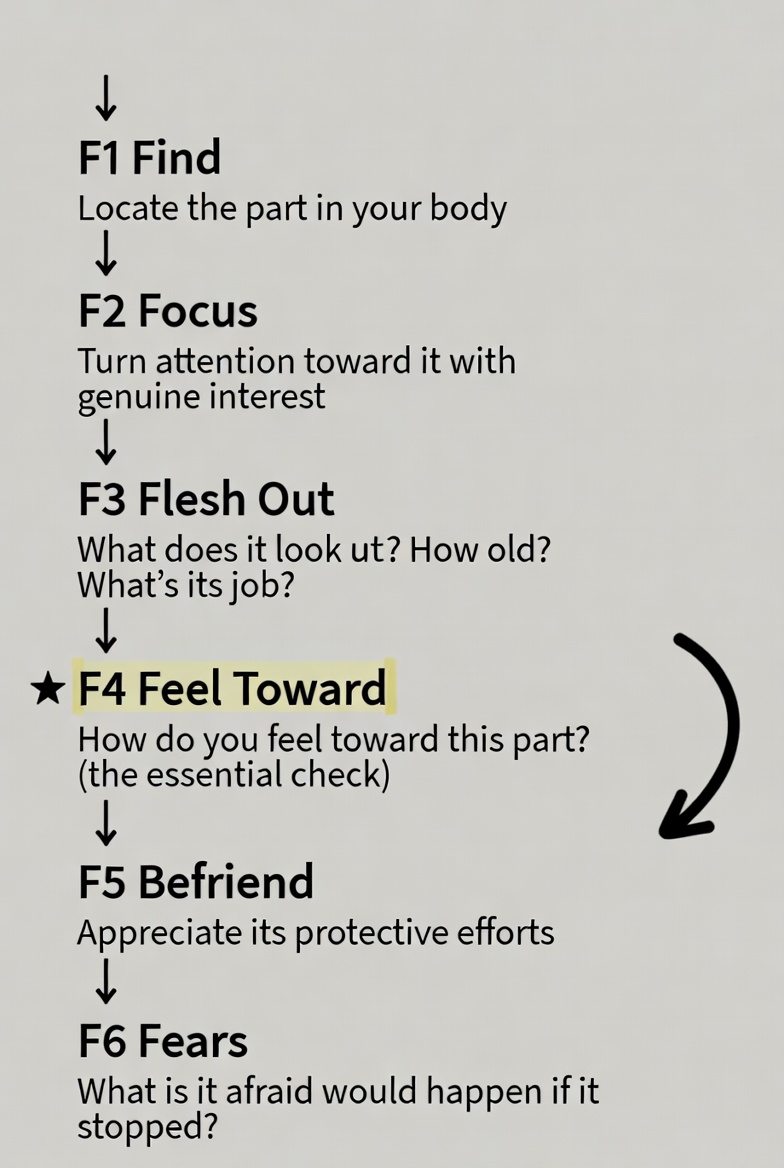
| Step | Question | Purpose | | --- | --- | --- | | F1: Find | "Where do you feel this part in your body?" | Locate and concretize the part | | F2: Focus | "Can you give this part your full attention?" | Turn toward it with genuine interest | | F3: Flesh Out | "What does it look like? How old? What's its job?" | Get to know the part as a person | | F4: Feel Toward | "How do you FEEL toward this part?" | Check for Self-energy — NEVER skip this | | F5: Befriend | "Can you appreciate its protective efforts?" | Build genuine relationship | | F6: Fears | "What is it afraid would happen if it stopped?" | Understand what it protects against |
The 6 F's Protocol — locate the part, focus attention, flesh it out, check how you feel toward it (the essential step — never skip it), befriend it, discover its fears.
Each Step in Depth
F1: Find "Is there a part that feels anxious right now?" "Where do you notice this perfectionism in your body?" Parts often have a location: tight throat, heavy chest, clenched stomach, tension in shoulders. Finding the part makes it concrete and workable. You cannot work with what you cannot locate. F2: Focus Turn your attention toward the part with genuine interest. Not analysing. Not trying to fix. Simply turning to face it. Like turning toward someone who has been waiting for you to notice them. "Just be with it for a moment." Focusing gives the part your presence. Many parts have never received genuine attention.
F3: Flesh Out "What does this part look like?" "How old does it seem?" "What's its job?" "When did it first start doing this?" You are getting to know the part the same way you would get to know a person. It is building a relationship, not gathering data. You are getting to know the part as you would get to know a person. Get specific — age, appearance, job description. F4: Feel Toward This is the step you never skip. "How do you feel toward this part?" If the answer is curious, compassionate, caring: you are in Self. Proceed. If the answer is frustrated, annoyed, wanting to get rid of it: a different part has taken over. Work with that first. If blended: "I notice there's frustration here. Can we ask that frustrated part to step back?" NEVER SKIP THIS STEP.
F5: Befriend "Thank you for working so hard to protect me." "I can see you've been doing this a long time." "What would you like me to know about you?" This is the heart of parts work. Genuine relationship. Not technique. Parts that feel appreciated and understood are willing to change. Parts that feel attacked defend themselves. The befriending is not technique — it is genuine relationship. F6: Fears "What are you afraid would happen if you stopped?" "What are you protecting me from?" When you understand the fear, you understand the wound. The fear always points toward the exile that needs attention. Often the fear is about an Exile being overwhelmed, the system being destroyed, or something catastrophic happening. These fears point toward the wound that needs attention.
Getting Permission from Protectors
Before you go anywhere near Exile material, you need the protectors to actually agree. Not just quiet. Willing. There is a big difference. Without that, they will find a way to shut things down: the client checks out, the conversation goes sideways, something in the body closes up. The protectors are not obstacles — they are guardians. Work with them, not around them.
- Acknowledge the protector: "I notice there's a part that doesn't want us to go there." - Validate its concern: "That makes sense — it's protecting something important." - Ask about its fears: "What is it afraid might happen if we proceeded?" - Offer reassurance: "I/we will go slowly. The goal isn't to overwhelm anyone." - Request permission: "Would it be willing to let us get to know what it's protecting, just a little?" - Respect the answer. If no: work with the protector more. Pushing past protectors causes harm.
Never Bulldoze Past Protectors Protectors protect for good reason. If you push past them without permission, they will sabotage the work, the client may flood or dissociate, and the therapeutic relationship is damaged. When in doubt, wait. More relationship with the protector. More trust. More permission. This is the work.
In pairs, practice the 6 F's with a mild protective pattern (perfectionism, people-pleasing, worrying — something manageable). Partner A guides: (1) Find: "Where do you notice it in your body?" (2) Focus: "Let your attention rest there." (3) Flesh out: "What does it look like? How old? What's its job?" (4) Feel toward: "How do you feel toward this part?" (5) Befriend: "Can you thank it for its protective efforts?" (6) Fears: "What is it afraid would happen if it stopped?" 15 minutes per person then switch. Debrief: what shifted through the 6 F's?
| Step | Question | Purpose |
|---|---|---|
| F1: Find | "Where do you feel this part in your body?" | Locate and concretize the part |
| F2: Focus | "Can you give this part your full attention?" | Turn toward it with genuine interest |
| F3: Flesh Out | "What does it look like? How old? What's its job?" | Get to know the part as a person |
| F4: Feel Toward | "How do you FEEL toward this part?" | Check for Self-energy — NEVER skip this |
| F5: Befriend | "Can you appreciate its protective efforts?" | Build genuine relationship |
| F6: Fears | "What is it afraid would happen if it stopped?" | Understand what it protects against |