Chapter One: The Parts
“"Every part is doing its best with the resources it has. There are no bad parts — only parts that need help finding better roles."”
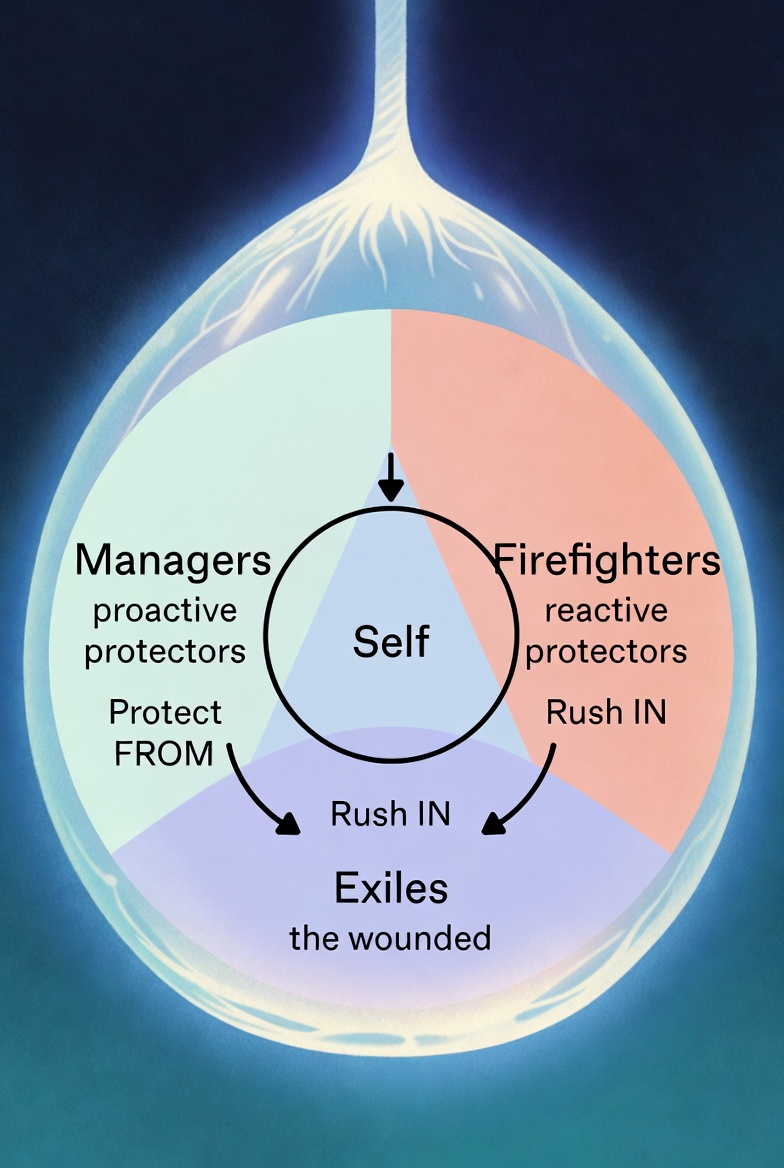
There are three types of parts. Two types of protectors: Managers and Firefighters. And the ones they protect: Exiles. Both types of protectors are trying to do the same thing. Stop the system from being overwhelmed by Exile pain. They are doing their jobs the best they can. They are doing their jobs the best they can. Understanding this transforms how we work with them.
The Parts Map — Self at the centre, Managers (proactive protectors) and Firefighters (reactive protectors) guarding the Exiles (the wounded).
How Managers Protect
Control Managing situations, people, and outcomes to avoid triggers. "If I manage everything, nothing unexpected can happen." If everything is controlled, nothing can surprise or hurt. Perfectionism "If I'm perfect, I cannot be criticised. If I never make mistakes, I cannot be rejected." The perfectionist Manager believes flawlessness means safety.
Caretaking "If I focus on others' needs, I don't have to feel my own pain. My needs don't matter; others' needs are safer to attend to." Caring for everyone else keeps the exile's pain at bay. People-Pleasing "If everyone likes me, I'm safe. If I never disappoint anyone, I cannot be abandoned." Others' approval equals survival in the language of this part.
Analyzing / Intellectualizing "If I understand it, I can prevent it. If I can explain it, I don't have to feel it." Understanding protects from pain. In session: gives you a theory of their own psychology. Self-Criticism "Criticising myself before others can. If I beat myself up first, others' criticism won't hurt as much." The inner critic Manager believes pre-emptive attack prevents external wounding.
Planning / Worrying "If I plan for every possibility, nothing can surprise me. Vigilance keeps me safe." Scanning for threats before they arrive. The hypervigilant quality that never quite rests. Performing / Achieving "Proving worth through accomplishment. If I achieve enough, I'll be valuable." Worth comes from doing. Cannot rest. Fear of worthlessness underneath the drive.
The Manager's core message, beneath all strategies: "I've got this handled. I will keep us safe by staying in control." Managers genuinely believe they are essential to survival. They work tirelessly, often for decades, without rest or appreciation. They deserve recognition for their dedication.
How Managers Show Up in Session
Body Signs Controlled, restricted breathing. Chronic tension (especially shoulders, jaw). Vigilant, scanning eyes. Held, braced posture. Controlled voice and movement. May seem "put together." Verbal Signs "I've thought about this a lot." "I know it's not rational, but..." "I just need to figure out why." Always explaining. Always analysing. Hard to actually feel anything. This is a Manager at work. Explaining and intellectualising. Staying "productive" in session. Difficulty accessing emotion. "I should be over this by now."
What Managers Need
Acknowledgment and Appreciation Managers have been working non-stop, often since childhood, with no recognition and no rest. Simply acknowledging that can change everything. They have been waiting for someone to notice how hard they have been trying. Thank them for their protective intention. They are not the enemy. Permission to Relax, Not Retire Managers do not need to stop existing. They need permission to relax and take on less extreme roles. They need to know that Self can handle things. Show them competence — it earns their trust.
Create your Manager Map: List all the Manager parts you can identify in yourself (Controller, Perfectionist, Planner, Worrier, People-Pleaser, Achiever, Caretaker, Analyzer, Inner Critic, others). For each: what does it do, what is it protecting you from, when did it develop, how does it show in your body? Which Manager is most dominant in your daily life? Share your dominant Manager with the group.