IFS & Parts Work Integration
Understanding the internal family — and how to work with it in breathwork sessions
The Cocoon Method — Practitioner Training Manual
Contents
- 01A Letter From Nina
- 02Introduction: Why IFS Matters for Breathwork
- 03The Growing Evidence Base: Research and Foundations
- 04The Model: Origins and Core Assumptions
- 05Chapter One: The Parts
- 06Managers
- 07The Protectors: Firefighters
- 08The Wounded: Exiles
- 09Chapter Two: The Self
- 10The 8 C's: Eight Qualities of Self-Energy
- 11Practice: Accessing Self-Energy
- 12Chapter Three: Parts in the Body
- 13Chapter Four: The 6 F's Protocol
- 14Chapter Five: Working with Exiles
- 15Chapter Six: IFS in Breathwork Sessions
- 16Chapter Seven: The Practitioner's Own Work
- 17Clinical Reference: Session Protocols
- 18Clinical Reference: IFS Language Bank
- 19Part 7 Completion Checklist
- 20Part 7 Glossary
A Letter From Nina
Dear Practitioner in Training,
Of all the psychological frameworks I have encountered, Internal Family Systems (IFS) has been the most transformative — for my own healing and for my work with clients.
I still remember the first time I truly understood what a "part" was. I had struggled for years with a harsh inner critic — that voice that told me I was never good enough. I had tried to silence it, argue with it, even love it away. Nothing worked. Then I learned to approach it differently. Instead of fighting, I got curious. "What are you afraid would happen if I weren't perfect?" I asked internally. The answer came: "They'll leave. If they see you're flawed, they'll abandon you." In that moment, I understood. This critic was not my enemy. It was a young part of me, terrified of abandonment, who had learned that perfection might keep people close. I wept — not with pain, but with recognition. And something shifted.
What makes IFS so powerful for breathwork is how naturally they go together. Parts do not just live in the mind. They live in the body. In the nervous system. In the breath. When you work with breath, you are working with parts. Always. When emotion surfaces in a session, we are meeting parts. When resistance arises, a part is protecting.
This training gives you the foundation. Not a full IFS certification. That requires more training. But enough to recognise what is happening in a session. To work with what arises. And to know when to refer someone for deeper work.
With gratitude to Richard Schwartz for this elegant model,
Introduction: Why IFS Matters for Breathwork
Before You Begin
Rate yourself honestly before reading. Return after completing Part 7 to see how far you have come.
Understanding
I understand the three part categories: Managers, Firefighters, and Exiles
I understand what the Self is and the 8 C's that characterize it
I understand the "no bad parts" principle and what it means in practice
I understand how parts correlate with nervous system states
I know the 6 F's protocol and can apply it with a protective part
I understand what is required before working with Exile material
I understand the unburdening process and its five steps
Practice
I can identify my own Manager parts and understand what they protect
I can access Self-energy reliably and notice when a part has blended
I can use IFS-informed language in session without it feeling forced
“"IFS provides a compassionate framework for what arises in sessions. It helps practitioners understand protective responses, offers a map for the territory of the inner world, and integrates seamlessly with nervous system work."”
The Problem IFS Solves
Have you ever wanted something and resisted it at the same time? Part of you wants to change. Another part keeps pulling you back. You can feel two completely opposite things at once. This is not a problem. This is how humans are built. This is not pathology. This is not weakness. This is the natural multiplicity of the human mind.
Without a Parts Framework Without this lens: we fight our resistance. We try to eliminate the parts of us we do not like. We shame ourselves for being contradictory. We start wars inside ourselves that nobody can win. We pathologize normal protective responses. We work against ourselves instead of with ourselves. With a Parts Framework With this lens: we understand that every part is trying to help. We work with protection instead of against it. We stop fighting ourselves. We start actually changing. We see symptoms as communication, not malfunction. We transform rather than eliminate.
IFS and Breathwork: The Natural Integration
Parts Live in the Body Parts show up in the body. The tight shoulders may be a Manager on constant alert. The collapsed chest may be an Exile carrying grief. The held breath may be a protector stopping you from feeling. The body and the parts are one conversation. Breath Bypasses Protectors Talk therapy often engages the protective parts that manage the story. A Manager can explain for an entire session without ever touching what is real. Breath bypasses that. It goes directly to where the pain actually lives.
The Body Reveals Truth A client can say "I'm fine" while their body shows terror. IFS gives you language for that moment. "I notice your body is telling a different story. There might be a part that has a different experience." Emotion in Sessions Is Parts Surfacing When grief floods in a session, when rage erupts, when numbness descends: these are parts surfacing. Knowing this changes everything. You do not try to stop the grief. You welcome the part that carries it.
The Growing Evidence Base: Research and Foundations
IFS has the research behind it. It was listed on the National Registry of Evidence-Based Programs in 2015. A 2021 study of adults with complex childhood trauma PTSD found that 92% of completers no longer met the PTSD diagnostic criteria after just 16 IFS sessions. 92%. A 2025 scoping review identified IFS as a promising approach for PTSD, depression, and chronic pain, noting significant symptom reduction in pilot trials.
Researchers think IFS may work through memory reconsolidation. When an exile is present and being genuinely witnessed by Self-energy at the same time, the brain creates the conditions to permanently update that memory. The mismatch between what the exile expected and what it actually receives: that is where the change happens.
The Model: Origins and Core Assumptions
Richard Schwartz developed IFS in the 1980s. He was trained as a family therapist. He started noticing something: his clients kept describing their inner experience in terms of parts. "Part of me wants to." "Something in me keeps doing this." He got curious instead of dismissing it. He discovered these internal parts behaved remarkably like members of a family system — they had relationships with each other, took on roles, protected each other, and could transform when the right conditions were present. Most significantly, he discovered that beneath all the parts was an undamaged core — the Self — that had the capacity to heal and integrate the entire system.
The Six Core Assumptions
1. Everyone Has a Self The Self is not earned through healthy parenting or positive experiences. It is an inherent, undamaged core that exists in everyone regardless of history. It cannot be destroyed, only obscured. 2. The Self Can and Should Lead When Self is in the lead, parts provide input but respect the leadership. Parts do not need to retire; they need appropriate guidance. The system functions harmoniously with Self at the centre.
3. There Are No Bad Parts Every part has a positive intention. Even the parts causing the most damage. They are trying to help. The goal is not to get rid of them. It is to help them find a role that does not cost so much. 4. Parts Develop to Protect Parts develop in response to what happens to us. A child criticised for every mistake grows a perfectionist part. A child who was abandoned grows a people-pleaser. These were brilliant responses to difficult situations. They are adaptations, not defects.
5. Rapid Change Is Possible When parts feel safe and trust the Self, change can happen fast. Years of therapy sometimes accomplish less than one genuine moment of Self-to-part connection. When a part finally feels truly heard, it often releases its extreme role on its own. When a part finally feels heard, it often releases its extreme role spontaneously. 6. Inner Work Creates Outer Change As your internal system heals, the outside world shifts too. When your inner critic relaxes, you stop drawing criticism from others. When your people-pleasing part heals, you start attracting relationships built on respect instead of need.
The Seven Expert Perspectives
The Neuroscientist The neuroscientist sees IFS as consistent with how we understand the brain. Different neural networks can operate somewhat independently. What IFS calls "parts" may correspond to distinct patterns of neural activation. The Self may correspond to integrated prefrontal functioning. The "Self" may correspond to integrated prefrontal-mediated functioning. The Psychologist The psychologist sees IFS as a non-pathologising framework for internal conflict. It does not label or diagnose. It understands. It brings together attachment theory, trauma research, and systems thinking into one coherent model.
The TCM Doctor In TCM, organs carry emotional as well as physical functions. The liver holds anger. The heart holds joy and anxiety. The kidneys hold fear. Working with parts may be similar to working with what TCM calls the organ spirits. Working with parts may be similar to working with organ spirits. The Energy Healer Parts can be felt energetically. They have locations in the body, colours, textures, even temperatures. Energy work can shift the patterns that hold parts in extreme roles, supporting the IFS work from a different angle.
The Spiritual Teacher The spiritual teacher recognises the Self immediately. It corresponds to what every wisdom tradition has pointed at: Buddha-nature, Atman, Christ consciousness. Beneath all the conditioning, beneath all the protective parts, there is something undamaged and whole. The work of healing is the work of removing what obscures our true nature. The Ayurvedic Practitioner In Ayurveda, parts may operate from different combinations of the gunas, the qualities of mind. The Self aligns with the concept of Atman — the unchanging witness consciousness beneath all experience.
Daily Life Laboratory — Parts Awareness
In daily activities: Notice when you shift states — a different part is active. Notice internal contradictions: "Part of me wants to, part of me doesn't." Notice different "voices" in your head.
In decisions: Notice the part that wants to. Notice the part that resists. Notice who wins and how.
In challenging moments: Notice what part takes over when stressed. Notice what part comes when you feel vulnerable. Notice what part manages your presentation to others.
Share with your group: (1) Identify one protective part you can clearly recognise in yourself — give it a name or description. (2) What is this part's job? How does it try to protect you? (3) When did it first develop? What did it learn that made this protection necessary? (4) How do you typically relate to this part — fight it, thank it, ignore it? (5) What might this part need from you? Group: what patterns do you notice across shares?
What parts can you most easily identify in yourself?
How has understanding "parts" changed how you see your own struggles?
What part of you is reading this right now?
What does it want from this material?
Chapter One: The Parts
“"Every part is doing its best with the resources it has. There are no bad parts — only parts that need help finding better roles."”
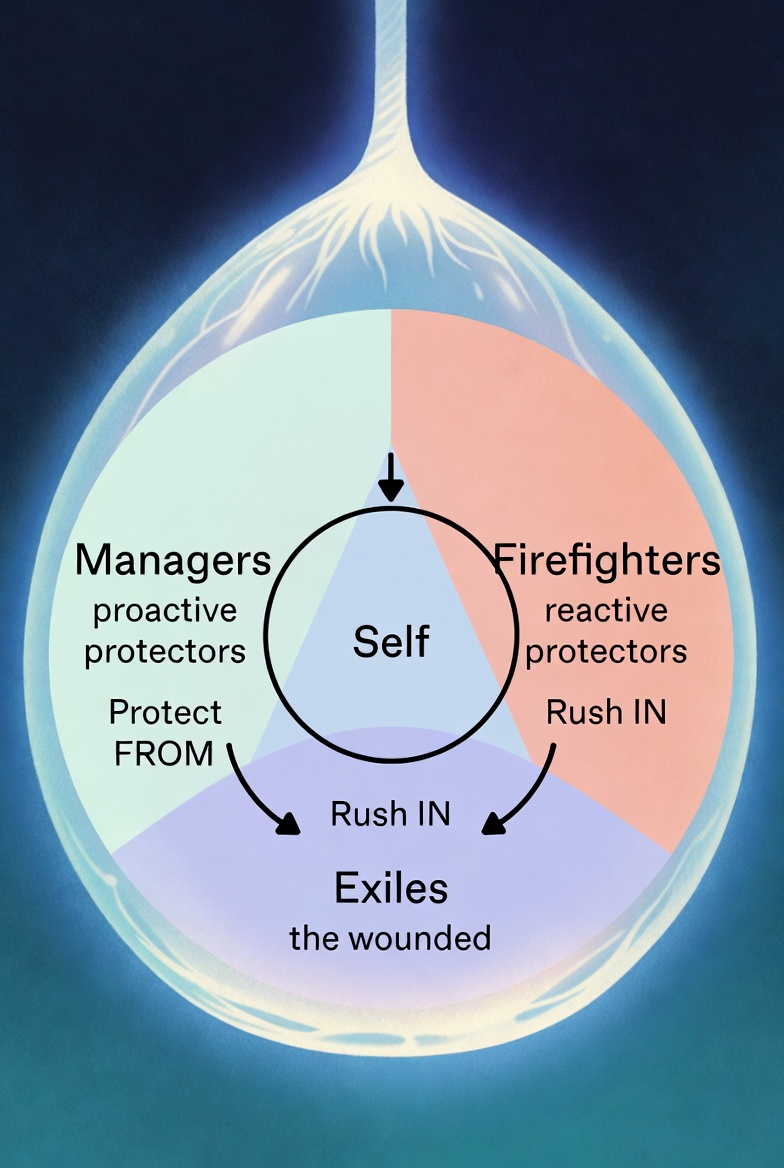
There are three types of parts. Two types of protectors: Managers and Firefighters. And the ones they protect: Exiles. Both types of protectors are trying to do the same thing. Stop the system from being overwhelmed by Exile pain. They are doing their jobs the best they can. They are doing their jobs the best they can. Understanding this transforms how we work with them.
The Parts Map — Self at the centre, Managers (proactive protectors) and Firefighters (reactive protectors) guarding the Exiles (the wounded).
How Managers Protect
Control Managing situations, people, and outcomes to avoid triggers. "If I manage everything, nothing unexpected can happen." If everything is controlled, nothing can surprise or hurt. Perfectionism "If I'm perfect, I cannot be criticised. If I never make mistakes, I cannot be rejected." The perfectionist Manager believes flawlessness means safety.
Caretaking "If I focus on others' needs, I don't have to feel my own pain. My needs don't matter; others' needs are safer to attend to." Caring for everyone else keeps the exile's pain at bay. People-Pleasing "If everyone likes me, I'm safe. If I never disappoint anyone, I cannot be abandoned." Others' approval equals survival in the language of this part.
Analyzing / Intellectualizing "If I understand it, I can prevent it. If I can explain it, I don't have to feel it." Understanding protects from pain. In session: gives you a theory of their own psychology. Self-Criticism "Criticising myself before others can. If I beat myself up first, others' criticism won't hurt as much." The inner critic Manager believes pre-emptive attack prevents external wounding.
Planning / Worrying "If I plan for every possibility, nothing can surprise me. Vigilance keeps me safe." Scanning for threats before they arrive. The hypervigilant quality that never quite rests. Performing / Achieving "Proving worth through accomplishment. If I achieve enough, I'll be valuable." Worth comes from doing. Cannot rest. Fear of worthlessness underneath the drive.
The Manager's core message, beneath all strategies: "I've got this handled. I will keep us safe by staying in control." Managers genuinely believe they are essential to survival. They work tirelessly, often for decades, without rest or appreciation. They deserve recognition for their dedication.
How Managers Show Up in Session
Body Signs Controlled, restricted breathing. Chronic tension (especially shoulders, jaw). Vigilant, scanning eyes. Held, braced posture. Controlled voice and movement. May seem "put together." Verbal Signs "I've thought about this a lot." "I know it's not rational, but..." "I just need to figure out why." Always explaining. Always analysing. Hard to actually feel anything. This is a Manager at work. Explaining and intellectualising. Staying "productive" in session. Difficulty accessing emotion. "I should be over this by now."
What Managers Need
Acknowledgment and Appreciation Managers have been working non-stop, often since childhood, with no recognition and no rest. Simply acknowledging that can change everything. They have been waiting for someone to notice how hard they have been trying. Thank them for their protective intention. They are not the enemy. Permission to Relax, Not Retire Managers do not need to stop existing. They need permission to relax and take on less extreme roles. They need to know that Self can handle things. Show them competence — it earns their trust.
Create your Manager Map: List all the Manager parts you can identify in yourself (Controller, Perfectionist, Planner, Worrier, People-Pleaser, Achiever, Caretaker, Analyzer, Inner Critic, others). For each: what does it do, what is it protecting you from, when did it develop, how does it show in your body? Which Manager is most dominant in your daily life? Share your dominant Manager with the group.
Managers
How Managers Protect
Managing situations, people, and outcomes to avoid triggers. "If I manage everything, nothing unexpected can happen." If everything is controlled, nothing can surprise or hurt.
"If I'm perfect, I cannot be criticised. If I never make mistakes, I cannot be rejected." The perfectionist Manager believes flawlessness means safety.
"If I focus on others' needs, I don't have to feel my own pain. My needs don't matter; others' needs are safer to attend to." Caring for everyone else keeps the exile's pain at bay.
"If everyone likes me, I'm safe. If I never disappoint anyone, I cannot be abandoned." Others' approval equals survival in the language of this part.
"If I understand it, I can prevent it. If I can explain it, I don't have to feel it." Understanding protects from pain. In session: gives you a theory of their own psychology.
"Criticising myself before others can. If I beat myself up first, others' criticism won't hurt as much." The inner critic Manager believes pre-emptive attack prevents external wounding.
"If I plan for every possibility, nothing can surprise me. Vigilance keeps me safe." Scanning for threats before they arrive. The hypervigilant quality that never quite rests.
"Proving worth through accomplishment. If I achieve enough, I'll be valuable." Worth comes from doing. Cannot rest. Fear of worthlessness underneath the drive.
The Manager's core message, beneath all strategies: "I've got this handled. I will keep us safe by staying in control." Managers genuinely believe they are essential to survival. They work tirelessly, often for decades, without rest or appreciation. They deserve recognition for their dedication.
How Managers Show Up in Session
Controlled, restricted breathing. Chronic tension (especially shoulders, jaw). Vigilant, scanning eyes. Held, braced posture. Controlled voice and movement. May seem "put together."
"I've thought about this a lot." "I know it's not rational, but..." "I just need to figure out why." Always explaining. Always analysing. Hard to actually feel anything. This is a Manager at work. Explaining and intellectualising. Staying "productive" in session. Difficulty accessing emotion. "I should be over this by now."
What Managers Need
Managers have been working non-stop, often since childhood, with no recognition and no rest. Simply acknowledging that can change everything. They have been waiting for someone to notice how hard they have been trying. Thank them for their protective intention. They are not the enemy.
Managers do not need to stop existing. They need permission to relax and take on less extreme roles. They need to know that Self can handle things. Show them competence — it earns their trust.
Community Exercise 2 Manager Mapping Create your Manager Map: List all the Manager parts you can identify in yourself (Controller, Perfectionist, Planner, Worrier, People-Pleaser, Achiever, Caretaker, Analyzer, Inner Critic, others). For each: what does it do, what is it protecting you from, when did it develop, how does it show in your body? Which Manager is most dominant in your daily life? Share your dominant Manager with the group.
The Protectors Firefighters Reactive Protectors
The Protectors: Firefighters
Firefighters activate after the pain has already broken through. They are emergency responders. Reactive. Fast. Willing to do whatever it takes to make the pain stop right now. They do not think about consequences. They think about the next five minutes. They do not care about consequences or long-term effects. They care about immediate relief. While Managers work to prevent fires, Firefighters rush in when the fire has already started.
How Firefighters Protect
Addiction (Substances) Alcohol, drugs, nicotine — anything that changes the internal state quickly. "If I change my chemistry, I won't feel the pain." Compulsive quality. Temporary fix, long-term cost. Addiction (Behaviours) Food, shopping, gambling, sex, work, screens. Any behaviour that distracts or numbs. "If I do this, I won't have to feel." The behaviour is not the problem. It is the solution to a problem you have not found yet.
Numbing / Dissociation "Checking out." Going blank, leaving the body. "If I'm not here, I can't be hurt." When it's too much, just go away. In session: glazed distant eyes, sudden flatness. Rage Explosive anger that discharges energy and creates distance. "If I'm scary enough, nothing can touch me." Better to attack than to feel vulnerable. Often protecting grief or terror underneath.
Self-Harm "This pain I can control." Physical pain to manage emotional pain. Physical pain is sometimes easier than emotional pain. Creates a sense of control or release when overwhelmed. Suicidal Thinking When all else fails, the ultimate exit. This is not always about wanting to die. It is about wanting the pain to stop. "There is no other way." Meet this with compassion. It is a Firefighter in crisis. The pain underneath is real and it is overwhelming.
The Firefighter's core message: "Make it stop NOW. I don't care about consequences." Firefighters are emergency responders. They are not thinking about tomorrow — they are thinking about the next five minutes. They will do anything to extinguish the fire, even if it burns down the house.
How Firefighters Show Up in Session
Body Signs Body signs: activated, urgent energy. Or sudden collapse into numbness. Rapid shallow breathing or breath-holding. Heat and flushing, or sudden coldness. Restlessness. Or complete stillness. The Firefighter looks different in different people. Glazed distant eyes. Verbal Signs "I just need this to stop." "I don't care about consequences." "I don't know why I do it." Sudden topic changes the moment you get close to something real. Humor or deflection to lighten intensity. Reports of numbing behaviours increasing.
Never shame the behaviour. They already feel shame. Adding more drives them underground. They need understanding, not criticism. They are trying to help, even if their methods cause harm. And ultimately, Firefighters relax when Exiles heal. When the fire is genuinely out, Firefighters can rest.
Explore your Firefighter parts: (1) What do you turn to when overwhelmed? (2) What is the sequence — what triggers the Firefighter, what does it do, what happens after? (3) What Exile pain is the Firefighter trying to extinguish? (4) How do you typically feel toward this Firefighter? (5) What might this Firefighter need to hear from you? Share (what feels safe): one Firefighter pattern and what you understand about its protective function.
The Wounded: Exiles
Exiles carry the original pain. The wounds. The overwhelming emotions. The traumatic memories. They are called exiles because the system pushed them out of awareness. Locked away. Hidden. To keep their pain from flooding daily life. Usually young — frozen at the age of the original wounding.
What Exiles Carry
Pain, Shame, and Terror The hurt that was too much at the time. Abandonment. Abuse. Neglect. Humiliation. Loss. The fear from experiences where safety was gone. All of it held in the body, frozen in time. The belief: "I am bad" or "Something is wrong with me." The Beliefs Formed in the Wound "I'm not safe." "I can't trust anyone." "Love always hurts." "I don't matter." These are not logical conclusions. They are conclusions a child formed in the middle of pain. And they feel completely, absolutely true.
Loneliness and Unmet Needs The pain of being unseen, unloved, abandoned, forgotten. The needs that were not met — for safety, love, attention, validation, protection. Not abstract needs but the visceral hunger of a child. Traumatic Memories Images, sensations, and experiences frozen in time. Not memories that are recalled. Memories that are re-experienced. They do not feel like the past. They feel like now. This is what makes trauma different from ordinary memory. This is what makes trauma different from ordinary memory.
The Exile's core message: "I am not okay. I am too much. I am not enough. Please see me." Exiles have been waiting, sometimes for decades, to be witnessed. They carry their burdens in isolation, cut off from the rest of the system. They need to be seen, not fixed.
When Exiles Surface in Session
Body Signs Sudden tears or overwhelming emotion. Feeling small, young, helpless. Body may curl or protect. Voice becoming childlike. Collapsed posture. Shallow, held breathing. Feeling cold. Verbal Signs "I feel like a little kid." The past tense becomes present tense. The language gets simpler and younger. "It's happening again." Core beliefs surface: "I'm bad." "It's my fault." "Nobody loves me." Something very old has arrived. May not be able to articulate — just feeling.
Sudden activation in session. Tears that surprise the client. Shame flooding. Regression in language or posture. Protectors working harder — increased intellectualising, checking out, topic changes. Client says "I don't want to go there." These are not signs to push forward — they are signs to slow down and ensure the container is solid before proceeding.
What Exiles Need
To Be Witnessed Not fixed, not analysed, not explained away. Witnessed. Someone to see what happened and acknowledge the pain. Simply being seen breaks the isolation they have carried, often for decades. To Know It Wasn't Their Fault Most Exiles carry self-blame. They need to hear: "It wasn't your fault. You were a child. You did the best you could." Not as a platitude — they are the truth the exile has never been able to receive.
The Dynamic Between Parts: The Cycle
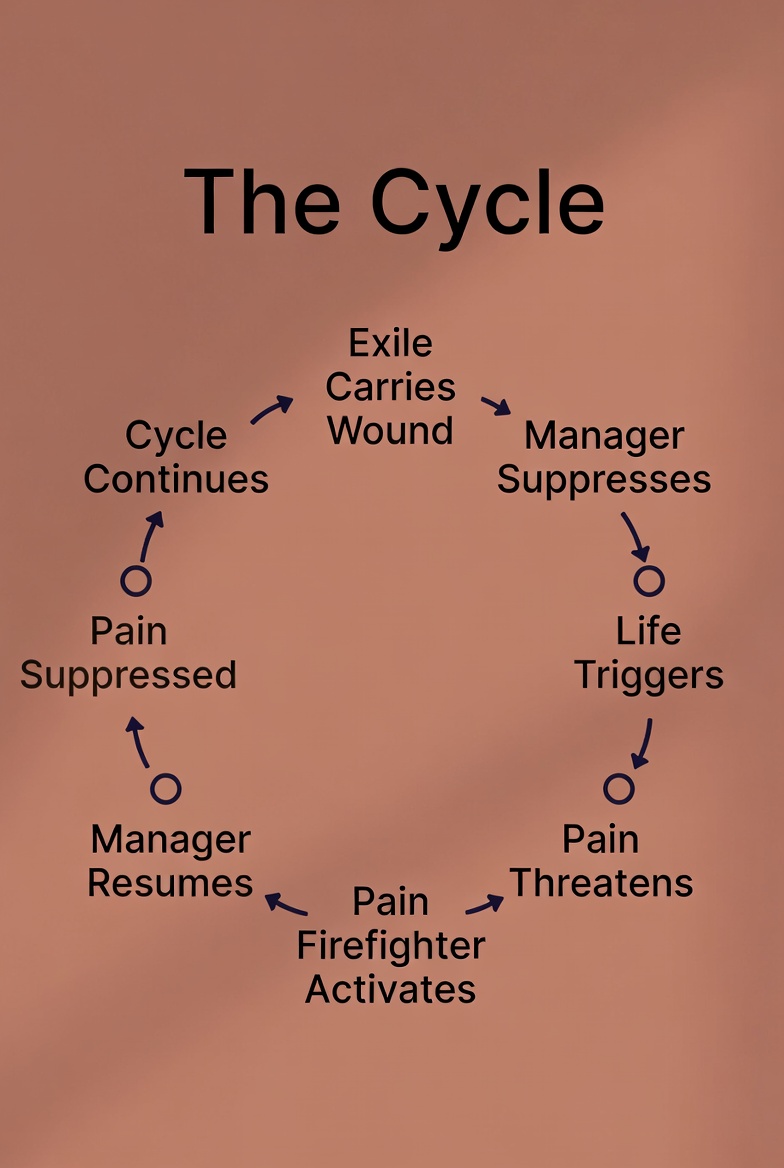
- Exile carries wound and pain (often from childhood) - Manager works to keep Exile suppressed (control, achievement, perfectionism) - Life triggers the Exile anyway (something reminds the system of the wound) - Pain threatens to surface (emotions start to rise) - Firefighter activates to extinguish pain (numbing, distraction, addiction) - Pain is temporarily suppressed (relief, but nothing healed) - Manager resumes control (back to "normal") - Cycle continues until the wound is actually healed
The Cycle — how Exiles, Managers, and Firefighters perpetuate the pattern until the wound is actually healed.
Breaking the cycle: The only way to break this cycle is to heal the Exile. When the wounded part is witnessed, unburdened, and integrated, the protectors no longer need their extreme roles. They can relax. The fire goes out, and no one needs to fight it anymore. This is why working only with Managers (trying to reduce control) or Firefighters (trying to stop behaviours) often fails — the underlying fire is still burning.
No Bad Parts
Every part has a positive intention. This is the most radical idea in IFS. The part that makes you overeat? Trying to comfort you. The part that criticises you? Trying to protect you from external criticism. The part that rages? Trying to create safety through intimidation. The part that numbs? Trying to give you relief from unbearable pain. The part that sabotages success? Trying to protect you from the fear that comes with visibility. The part that keeps you small? Trying to keep you safe from rejection.
When you can find the positive intention in even the most destructive parts, everything changes. You stop fighting yourself. You start actually working with yourself. You start working with yourself. This is not excusing harm. It is understanding it so deeply that transformation becomes possible.
What Manager parts can you identify in yourself?
How do they try to protect you?
What Firefighter strategies do you turn to when overwhelmed?
What are they extinguishing?
What might your Exiles be carrying?
(Not to process now — just to notice.) How does understanding "no bad parts" change how you relate to your most difficult patterns?
Chapter Two: The Self
“"The Self is who you are when your parts relax. It is your essential nature, undamaged and whole."”
What Is the Self?
The Self is not a part. It is something different entirely. Parts are shaped by experience. The Self exists before experience. Prior to what happened to you. Independent of it. It cannot be damaged. Only hidden. It is not created by good parenting or positive circumstances. It is inherent. Always there. Cannot be damaged or destroyed. Can only be obscured by parts that have taken over. When parts relax, Self naturally emerges — like the sun appearing when clouds part.
| Parts | Self | | --- | --- | | Have agendas | Has no agenda | | Have histories | Is timeless | | Can be wounded | Cannot be damaged | | Are partial | Is whole | | Fluctuate | Is constant | | Developed in response to experience | Exists prior to experience | | Need healing | Does the healing |
| Parts | Self |
|---|---|
| Have agendas | Has no agenda |
| Have histories | Is timeless |
| Can be wounded | Cannot be damaged |
| Are partial | Is whole |
| Fluctuate | Is constant |
| Developed in response to experience | Exists prior to experience |
| Need healing | Does the healing |
The 8 C's: Eight Qualities of Self-Energy
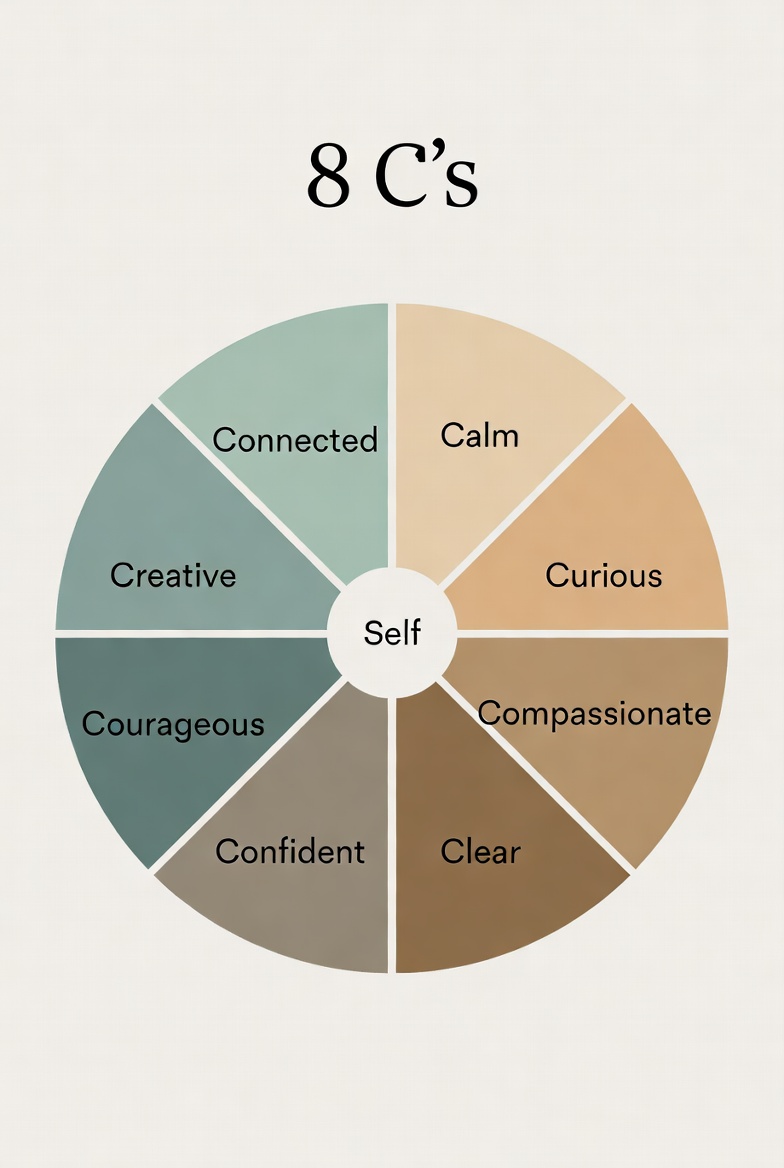
When you are in Self, eight qualities naturally emerge. These are not things you practise or cultivate. They are what arises naturally when parts are not running the show.
The 8 C's of Self-Energy — the eight qualities that arise naturally when parts step back and Self leads.
Calm A steady, grounded presence. Not suppression of feeling. Genuine peace that can hold whatever arises. From calm, you can be present with intensity without being swept away. When you are calm, your client's nervous system can borrow your regulation. In session: the calm practitioner provides a steady container. When you are calm, the client's nervous system can borrow your regulation. Curious Genuine interest with no agenda. Wonder instead of judgment. The curious Self asks "What is this?" not "How do I fix this?" When you are curious about a part, it feels safe enough to show itself. In session: curiosity replaces diagnosis. "I'm curious about that anxiety — what is it trying to do for you?"
Compassionate Warmth that naturally extends toward suffering. Your own and others'. Not pity, which looks down. Compassion, which meets pain as an equal. Your compassionate presence is often more healing than any technique. In session: compassion allows you to sit with difficult material without needing to fix it. Your compassionate presence is often more healing than any intervention. Clear The ability to see things as they actually are, without parts distorting your view. Clarity includes knowing what you do not know. It is honest without being harsh. In session: helps you see what is actually happening, not what you (or the client) want to be happening. Allows accurate assessment and appropriate intervention.
Confident A quiet trust in your ability to handle what comes. Not arrogance. That is usually a part. Genuine faith that whatever arises, you can meet it. In session: allows you to stay with difficult material. You do not panic when things get intense. You trust the process. Courageous Willingness to move toward difficulty rather than away from it. Courage is not fearlessness. It is acting with integrity even when you are afraid. Following the client into territory you would rather avoid. In session: allows you to follow the client into difficult territory without shying away from the pain they need to face.
Creative When parts step back, creativity flows naturally. Problems that seemed completely stuck reveal unexpected options. The creative Self can see what the frightened parts cannot. Problems that seemed stuck reveal unexpected options. In session: allows you to find new approaches when the obvious ones are not working. Connected A sense of relationship with yourself, with others, with something larger. Connection is what happens naturally when parts are not creating separation. The client feels you are with them, not observing them. In session: the client feels you are with them, not separate from them. This connection is often the most healing element of the work.
The 5 P's of Self-Energy
Recognising Self vs. Parts
You Are in Self When You are in Self when: you feel calm even with difficult material. You are genuinely curious about the part, even a difficult one. You feel compassionate rather than judgmental. There is space around everything. You are clear about what is happening. You feel spacious, like there is room for everything. You Are in a Part When You are in a part when: you feel urgent or pressured. You are judging. You are overwhelmed or flooded. You feel numb. You want to fix or stop something immediately. You are certain you are right. You are driven to fix something immediately. You feel certain you are right. You feel small, young, or helpless.
The most important question in IFS: "How do I feel toward this part?" If you feel curious, compassionate, or caring: you are in Self, proceed. If you feel frustrated, scared, annoyed, or judgmental: a part is activated. Ask that part if it would be willing to step back. Never skip this check. Never proceed from a part when working with another part — parts do not trust other parts. They trust Self.
Practice: Accessing Self-Energy
Through the Body Self has a felt sense in the body. Notice what calm, curious, compassionate actually feel like physically. Often: relaxed shoulders. Easy breath. Settled belly. Open chest. Soft eyes. Feet on the ground. That is Self. When you feel these physical qualities, you are likely in Self. Through Asking Parts to Step Back You can simply ask: "Would all my parts be willing to step back so I can be present?" Most parts will. Some may need a little reassurance. "I'm not trying to get rid of you. I just need some space." Some may need reassurance: "I'm not trying to get rid of you. I just need some space to be present with what is here."
Through Breath Extended exhale breathing activates ventral vagal, the physiological home of Self-energy. A calm body supports a calm Self. This is why the breath is so useful. You can shift the state, and the state shifts access to Self. Simple box breathing or extended exhale breathing can shift the nervous system into the conditions for Self to emerge. Through Grounding and Stillness Feel your feet on the floor. Feel your weight. Come into your body and the present moment. In stillness, parts quiet down naturally. What remains when the noise settles is Self. Even a few minutes of sitting quietly helps Self emerge naturally.
Daily Life Laboratory — Self-Access Practice
Morning (5 min): Ask parts to step back. Notice what remains. Feel the qualities of Self. Set intention to stay in Self today.
Throughout the day: Notice when parts take over. Ask: "How do I feel toward this?" If a part has blended, ask it to step back. Return to Self and respond from there.
Evening (5 min): When were you in Self today? When in parts? What helped you access Self? What pulled you out?
In pairs. Round 1 (Accessing Self, 5 min each): Partner A closes eyes, takes extended exhale breaths, asks internally "Would all my parts be willing to step back?" notices what remains, shares the qualities that emerged. Partner B witnesses silently. Switch. Round 2 (Recognising Self vs Parts, 5 min each): Partner A talks about something mildly challenging. Partner B notices: Self or a part? Shares observation. Partner A reflects. Switch. Group share: what helped you access Self?
When do you most naturally feel the 8 C's?
What circumstances bring you into Self-energy?
How do you recognise when you have been hijacked by a part?
What are your signals?
What would your life be like if you lived more consistently from Self?
Chapter Three: Parts in the Body
“"Parts do not just exist as mental constructs. They live in the body, in specific nervous system states."”
The Correlation
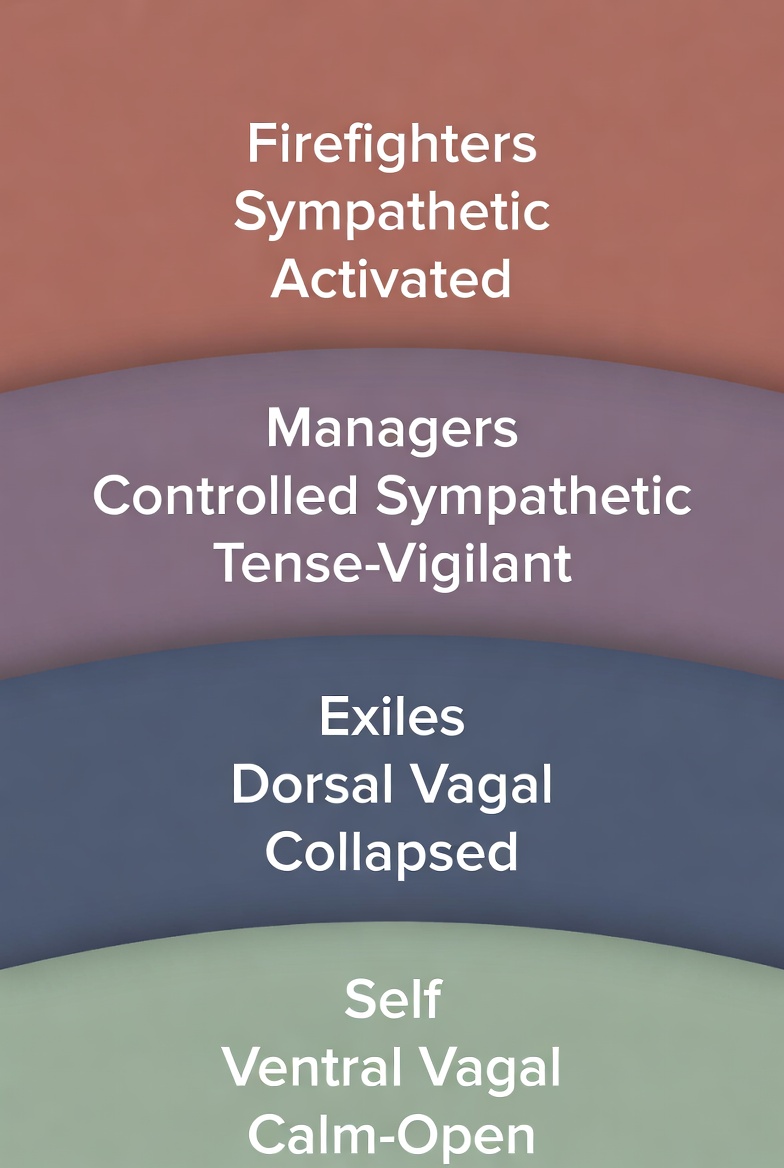
| Part Type | Nervous System State | Body Expression | | --- | --- | --- | | Firefighters | Sympathetic (fight/flight) | Activated, urgent, reactive | | Managers | Controlled Sympathetic | Tense, vigilant, braced | | Exiles | Dorsal Vagal (freeze/collapse) | Collapsed, numb, dissociated | | Self | Ventral Vagal (safety) | Calm, connected, present |
Parts and the Nervous System — from Firefighters (sympathetic/activated) through Managers and Exiles, down to Self (ventral vagal/calm-open).
Firefighters and Sympathetic Firefighters are sympathetic activation turned inward. Emergency energy managing an internal threat. Body signs: rapid heart rate, fast shallow breath, heat, flushing, restlessness, clenched muscles, scanning eyes. Do not try to reason with this state. Regulate first. DO NOT try to talk them down with logic. Regulate the nervous system first: extended exhale, grounding, slow pace. Once calmer, approach with curiosity. Managers and Controlled Hypervigilance Managers are controlled hypervigilance. Always scanning, always bracing, but not reacting. Body signs: chronic tension in the shoulders, jaw, face. Controlled, restricted breathing. A held, braced quality that never quite rests. Body signs: chronic tension (shoulders, jaw, face), controlled restricted breathing, holding patterns and bracing, busy mind visible in eyes, fatigue from constant vigilance, "put together" appearance.
Exiles and Dorsal Vagal Exiles live in dorsal vagal shutdown. Frozen in time. Collapsed and disconnected from the present. Body signs: numbness, collapsed posture, very shallow breath, feeling cold, pale skin, dissociation. Body signs: numbness and disconnection, collapsed posture, weak shallow breathing, feeling cold, pale skin, dissociation, glazed distant eyes, feeling small and young, low energy. When exiles surface: overwhelming floods, regression, intense shame, flashbacks, desire to disappear. Self and Ventral Vagal Self-energy and nervous system regulation work together in both directions. When you regulate the body, Self comes forward. When Self leads, the body regulates. Use this. If you cannot access Self, start with the body. If the body will not settle, try accessing Self first. Body signs of Self-leadership: relaxed open posture, full easy breathing, warm present gaze, grounded centred feeling, fluid natural movement.
Use the bidirectional relationship: If you cannot access Self, work with the body first. If the body will not regulate, try accessing Self and letting it guide the body. Breathwork that creates ventral vagal activation helps Self come forward. This is why breath is so powerful — it creates the conditions for Self to emerge.
| Part Type | Nervous System State | Body Expression |
|---|---|---|
| Firefighters | Sympathetic (fight/flight) | Activated, urgent, reactive |
| Managers | Controlled Sympathetic | Tense, vigilant, braced |
| Exiles | Dorsal Vagal (freeze/collapse) | Collapsed, numb, dissociated |
| Self | Ventral Vagal (safety) | Calm, connected, present |
Chapter Four: The 6 F's Protocol
“"The 6 F's provide a systematic approach to working with protective parts. Build relationship before asking for change."”
The 6 F's give you a clear path through working with protective parts. The whole thing rests on one idea: build the relationship before you ask for anything. The whole approach rests on one idea: build the relationship before you ask for anything to change. A part that feels genuinely seen and appreciated will relax on its own. A part that feels cornered or judged will dig in harder. Every time.
| Step | Question | Purpose | | --- | --- | --- | | F1: Find | "Where do you feel this part in your body?" | Locate and concretize the part | | F2: Focus | "Can you give this part your full attention?" | Turn toward it with genuine interest | | F3: Flesh Out | "What does it look like? How old? What's its job?" | Get to know the part as a person | | F4: Feel Toward | "How do you FEEL toward this part?" | Check for Self-energy — NEVER skip this | | F5: Befriend | "Can you appreciate its protective efforts?" | Build genuine relationship | | F6: Fears | "What is it afraid would happen if it stopped?" | Understand what it protects against |
The 6 F's Protocol — locate the part, focus attention, flesh it out, check how you feel toward it (the essential step — never skip it), befriend it, discover its fears.
Each Step in Depth
F1: Find "Is there a part that feels anxious right now?" "Where do you notice this perfectionism in your body?" Parts often have a location: tight throat, heavy chest, clenched stomach, tension in shoulders. Finding the part makes it concrete and workable. You cannot work with what you cannot locate. F2: Focus Turn your attention toward the part with genuine interest. Not analysing. Not trying to fix. Simply turning to face it. Like turning toward someone who has been waiting for you to notice them. "Just be with it for a moment." Focusing gives the part your presence. Many parts have never received genuine attention.
F3: Flesh Out "What does this part look like?" "How old does it seem?" "What's its job?" "When did it first start doing this?" You are getting to know the part the same way you would get to know a person. It is building a relationship, not gathering data. You are getting to know the part as you would get to know a person. Get specific — age, appearance, job description. F4: Feel Toward This is the step you never skip. "How do you feel toward this part?" If the answer is curious, compassionate, caring: you are in Self. Proceed. If the answer is frustrated, annoyed, wanting to get rid of it: a different part has taken over. Work with that first. If blended: "I notice there's frustration here. Can we ask that frustrated part to step back?" NEVER SKIP THIS STEP.
F5: Befriend "Thank you for working so hard to protect me." "I can see you've been doing this a long time." "What would you like me to know about you?" This is the heart of parts work. Genuine relationship. Not technique. Parts that feel appreciated and understood are willing to change. Parts that feel attacked defend themselves. The befriending is not technique — it is genuine relationship. F6: Fears "What are you afraid would happen if you stopped?" "What are you protecting me from?" When you understand the fear, you understand the wound. The fear always points toward the exile that needs attention. Often the fear is about an Exile being overwhelmed, the system being destroyed, or something catastrophic happening. These fears point toward the wound that needs attention.
Getting Permission from Protectors
Before you go anywhere near Exile material, you need the protectors to actually agree. Not just quiet. Willing. There is a big difference. Without that, they will find a way to shut things down: the client checks out, the conversation goes sideways, something in the body closes up. The protectors are not obstacles — they are guardians. Work with them, not around them.
- Acknowledge the protector: "I notice there's a part that doesn't want us to go there." - Validate its concern: "That makes sense — it's protecting something important." - Ask about its fears: "What is it afraid might happen if we proceeded?" - Offer reassurance: "I/we will go slowly. The goal isn't to overwhelm anyone." - Request permission: "Would it be willing to let us get to know what it's protecting, just a little?" - Respect the answer. If no: work with the protector more. Pushing past protectors causes harm.
Never Bulldoze Past Protectors Protectors protect for good reason. If you push past them without permission, they will sabotage the work, the client may flood or dissociate, and the therapeutic relationship is damaged. When in doubt, wait. More relationship with the protector. More trust. More permission. This is the work.
In pairs, practice the 6 F's with a mild protective pattern (perfectionism, people-pleasing, worrying — something manageable). Partner A guides: (1) Find: "Where do you notice it in your body?" (2) Focus: "Let your attention rest there." (3) Flesh out: "What does it look like? How old? What's its job?" (4) Feel toward: "How do you feel toward this part?" (5) Befriend: "Can you thank it for its protective efforts?" (6) Fears: "What is it afraid would happen if it stopped?" 15 minutes per person then switch. Debrief: what shifted through the 6 F's?
Choose one protective part and apply the 6 F's to it in writing. What do you discover?
What parts in you are most resistant to being befriended?
What might they fear?
How does understanding the body-parts connection change how you think about tension and symptoms?
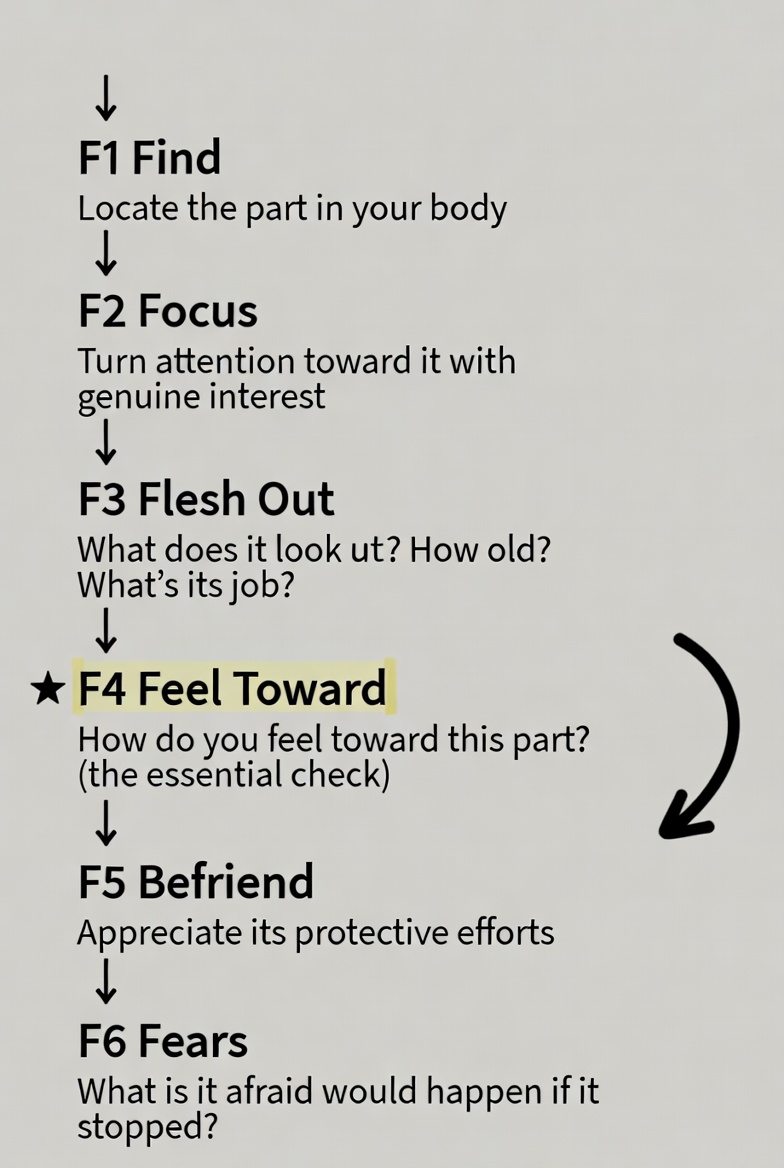
| Step | Question | Purpose |
|---|---|---|
| F1: Find | "Where do you feel this part in your body?" | Locate and concretize the part |
| F2: Focus | "Can you give this part your full attention?" | Turn toward it with genuine interest |
| F3: Flesh Out | "What does it look like? How old? What's its job?" | Get to know the part as a person |
| F4: Feel Toward | "How do you FEEL toward this part?" | Check for Self-energy — NEVER skip this |
| F5: Befriend | "Can you appreciate its protective efforts?" | Build genuine relationship |
| F6: Fears | "What is it afraid would happen if it stopped?" | Understand what it protects against |
Chapter Five: Working with Exiles
“"Exiles have been waiting, sometimes for decades, to be witnessed. They need your presence more than your intervention."”
A Note Before We Go Deeper Exile work is the deepest level of this practice — and it needs to be approached with real care. Before you go near exile material, you want protector permission, solid Self-energy, the ability to witness without getting swept away yourself, and honestly, your own deep healing work already underway. In breathwork, exiles will surface whether you invite them or not — breath goes places that words cannot reach. So you need to know what you are looking at when they do. But deliberately going in to work with exiles? That belongs with IFS-specific training or alongside an IFS-trained therapist. For now: learn to recognise, learn to hold, learn to refer when needed. That is enough, and it is important.
When Exiles Surface in Breathwork
In breathwork, exiles often surface without being invited. The breath goes directly to where things live, underneath the stories, underneath the protective patterns. This is its power. And the responsibility that comes with it. Breath goes directly to where things live — underneath the stories, underneath the protective layers. You will see it in the room: a sudden wave of emotion that surprises even the client, a voice that shifts younger, a body that curls, a quality of something very old finally being close to the surface. This is not a problem. It is exactly what the process can do. Your job is to know how to meet it.
Your Response When an Exile Surfaces
- Stay in YOUR Self-energy. Your regulated presence is the container. If you lose Self, the container breaks. The Exile needs to feel that someone is present and safe. - Assess capacity. Is the client able to witness this, or are they drowning in it? There is a crucial difference between feeling the pain and being overwhelmed by it. - If capacity exists: Witness. Be present. "I see you. I'm here with you." Your presence is the healing. Do not rush to fix. - If flooding: "Can you find some distance from this feeling while still knowing it's there?" "Can you sense me here with you?" Slow down the breath. - Regulate. Use breath, grounding, your voice. Extended exhale. Feet on floor. Your calm presence. - Do not rush. Exiles have waited a long time. They do not need you to fix them immediately. They need your presence first.
The Unburdening Process
Unburdening is where the deepest shift happens. It is not always dramatic. Often it is quiet. A release. A relaxation. A sense of something finally putting down a very heavy load. It is not dramatic in the way you might expect. It is quiet, often — a release, a relaxing of something that has been held for a very long time. The exile lets go of what it has been carrying: the pain, the shame, the beliefs that formed in the wound. What was heavy becomes lighter. What was frozen begins to move. This is the change that actually lasts.
Step 1: Witnessing The exile needs to be witnessed. Not fixed. Not explained. Not minimised. Just seen. "I see what happened to you." That sentence alone can be more healing than anything else you do. "I understand how painful that was." "That was real. It happened." Being witnessed breaks the isolation they have carried. Many Exiles have never been truly seen. Step 2: Reparenting Self gives the exile what it needed but never got. If the child needed protection, Self provides it now. If the child needed to hear "it wasn't your fault," Self says it now. This is not pretending the past was different. It is giving now what was missing then. If the child needed comfort, Self offers it now. "What did you need that you didn't get?" "Can I give that to you now?" This is not pretending the past was different — it is providing now what was missing then.
Step 3: Retrieving If the exile is frozen in the past, stuck in the memory of the original event, Self can invite it to leave. "Would you like to come out of there? You do not have to stay there anymore." Sometimes the exile needs to see that time has actually passed. "Would you like to come out of there? You don't have to stay there anymore." "Can you see that time has passed? You're safe now." The Exile may need to see that they are now safe, that Self is here. Step 4: Releasing the Burden The exile can release what it has been carrying. Through invitation, never through force. "Where do you feel that burden in your body?" "Are you ready to let it go?" "How would you like to release it?" Let the exile choose how. "Where do you feel that burden in your body?" "Are you ready to let it go?" "How would you like to release it?" Exiles often have creative ways to release: fire, water, earth, air, light. Let them choose.
Step 5: Inviting Qualities After the release, there is space. Invite something in. "What would you like to feel instead?" Exiles often want safety, love, worthiness, freedom, peace. Let them choose. "Now that you've released that, what would you like to invite in?" "What quality would you like to fill that space?" Exiles often want safety, love, worthiness, freedom, peace. Step 6: Integration Welcome the transformed exile back. "How do you feel now?" "Where would you like to be in the system?" The exile, unburdened, often becomes a source of the very quality it was protecting against: joy, innocence, playfulness, vulnerability. "How do you feel now?" "Where would you like to be?" The Exile, unburdened, often becomes a source of the very qualities they once lacked — joy, innocence, playfulness, vulnerability, creativity.
Physical: deep exhale or sigh, spontaneous tears (of relief, not just pain), body relaxation, temperature change (often warming), colour returning to face, posture opening, breath deepening. Emotional: relief, lightness, gratitude, peace, sometimes laughter, a sense of something shifting, freedom. The shift is often subtle — do not look for fireworks. Look for genuine shift.
Questions for Working with Exiles
Gentle Opening "I'm here with you." "Can you feel me here?" "I see you. You're not alone anymore." "Take your time. I'm not going anywhere." "You don't have to face this alone." Understanding and Validation "What happened to you?" "How old were you?" "What did you need that you didn't get?" "That wasn't your fault." "You didn't deserve that." "You were just a child." "Your feelings make complete sense."
When to Stop or Not Start There are moments to pause, close gently, and not go further: when protectors have not given permission. When the client cannot access any Self-energy. When flooding cannot be contained. When the session is near ending — do not open what cannot be closed in the time remaining. When suicide risk is present. When the client is in crisis outside the session. When in doubt, contain and refer. It is always better to be cautious than to cause harm.
Breath and Exile Work
Breath Bypasses Protectors Conscious connected breathing can reach exile material that talk therapy cannot. This is its power. And the caution that comes with it. The protectors may not have agreed. But the breath goes there anyway. This is one reason why practitioner Self-energy and skill in containing is essential. Breath Supports the Process Breath can regulate when flooding threatens: the extended exhale calms the system. Breath can carry the release: "breathe out what you're releasing." And breath supports integration after the work: slow and full, giving the body time to reorganise. Do not rush the integration phase.
In pairs, practice simple witnessing. Person A: share something mildly difficult (not your deepest wound — something with some charge but manageable). 3-5 minutes. Person B: simply witness. Do not advise, fix, or interpret. Offer only: "I hear you." "I'm here." "That sounds hard." Eye contact and presence. Switch. Debrief: what was it like to be witnessed without advice? What was it like to witness without fixing? How is this different from typical conversation?
Chapter Six: IFS in Breathwork Sessions
How Parts Show Up Through the Session
Before the Session Before the session even begins, parts are already active. Managers are anxious about what might happen. Firefighters are planning escape routes. Maybe checking the phone. Maybe considering cancelling. The system is deciding whether it is safe enough to be here. Parts that control the narrative are preparing their story. During Breathwork During breathwork: protectors may resist deeper breathing. Breath stays shallow. Exiles may surface with sudden tears or flooding. Parts express through sounds, movements, tension. And if things go well: Self-energy emerges as breath deepens and parts begin to relax.
After Breathwork After breathwork: Managers rush to analyse or dismiss what happened. Integration needs Self-energy. Parts need reassurance. "What surfaced is normal. You did not break. Something important moved." The meaning-making part wants to understand. Give it time, then language. Astrology as a Parts Map For practitioners who work with astrology: the natal chart is a parts blueprint. The elemental balance. The wounds Chiron carries. The emotional style of the Moon. Astrology shows you not just which parts are active, but why they formed the way they did. It is a parts blueprint: the part that learned love comes with conditions, the part that is fiercely self-protective. Astrology gives context for why parts formed as they did.
Common Scenarios and Responses
What's happening: A protector is preventing deeper access. The protector believes that deeper breath = danger. Response: Don't push. Acknowledge: "I notice the breath wants to stay shallow. There might be a good reason for that. What might happen if the breath went deeper?" This respects the protector while inviting curiosity. Often the part will reveal its fear: "If I breathe deep, I'll cry" or "I'll lose control." Work with the fear before pushing deeper.
What's happening: An Exile has surfaced. The breath bypassed protectors and touched the wound. Response: Stay calm. Your regulation is the container. "I'm here with you. You're safe." "Can you feel the mat beneath you?" "Let's slow the breath." Help them stay present while feeling. Do not try to stop the emotion — help them have it without drowning in it.
What's happening: A Firefighter has activated to stop the overwhelm. This is protection, not a problem. Response: Don't try to push through. "I notice things got quiet. That makes sense — something protective came in." "Let's just breathe gently together." "Feel the mat. Feel my hand (if touch is consented)." Ground and regulate before considering whether to proceed or close the session.
What's happening: A part is requesting an exit. Honor it. Response: "Okay, let's slow down. That part that wants to stop — it's taking care of you. Let's just breathe naturally and be here." Never override a stop request. The part has information. Explore what the part fears — but always respect the request first.
What's happening: Parts expressing through the body — shaking, sounds, movements. The body is completing what was incomplete. Response: Allow it with containment. "Let it move. You're safe. I'm here." "Let your body do what it needs to do." The body is often completing survival responses that were interrupted. This is healing. Do not stop it — contain it with your calm, regulated presence.
IFS-Informed Language
| Instead of | Try | | --- | --- | | "Relax" | "See if that tense part would be willing to soften a little." | | "Let go" | "Would that part be willing to let go, or does it need something first?" | | "Don't think" | "See if the thinking parts would be willing to step back and let the body lead." | | "You're safe" | "Can you check — does your body feel safe enough right now?" | | "Stop worrying" | "I notice a worrying part is active. What is it concerned about?" | | "Just feel it" | "Would you be willing to let this feeling be here, or is there a part that objects?" |
When to Use IFS vs. Other Approaches
Use IFS / Verbal When Use IFS when: the client is very much in their head and needs a framework. When parts are actively blocking the work. When you are integrating after body-based work. When the client needs understanding. Protectors need negotiation before body work. Processing what emerged from breathwork. Use Breathwork / Body When Use breath and body when: the client is disconnected from feeling. When talking has become a way to avoid feeling. When you need to access something pre-verbal. When parts need to express through movement rather than words. Nervous system needs direct regulation. When talking protectors are managing too tightly.
System is overwhelmed. Window of tolerance is narrow. Nervous system needs regulation first. After intense work, for integration. Client needs resourcing, not processing. Building capacity before deeper work. The Decision Tree (Part 8) will elaborate this fully — it is where all the knowledge comes together into practical wisdom.
In triads. Person A is "client," Person B is "practitioner," Person C observes. Round 1 (10 min): Person A breathes and explores. Person B guides using IFS-informed language: "I notice..." "There seems to be a part..." "How do you feel toward..." "Would this part be willing to..." Person C notes what language worked and what didn't. Rotate roles. Debrief: how did IFS language feel different from regular guidance?
| Instead of | Try |
|---|---|
| "Relax" | "See if that tense part would be willing to soften a little." |
| "Let go" | "Would that part be willing to let go, or does it need something first?" |
| "Don't think" | "See if the thinking parts would be willing to step back and let the body lead." |
| "You're safe" | "Can you check — does your body feel safe enough right now?" |
| "Stop worrying" | "I notice a worrying part is active. What is it concerned about?" |
| "Just feel it" | "Would you be willing to let this feeling be here, or is there a part that objects?" |
Chapter Seven: The Practitioner's Own Work
“"Your own IFS work is not optional. It is essential. You can only hold space for parts you have met in yourself."”
Here is the honest truth. When a client's rage comes up, something in you responds. When someone's grief floods the room, your own system reacts. If you have not met your own parts, they will interfere. There is no way around this., something in you responds. When someone's grief floods the room, your own system reacts. If you have not met your own parts, they will show up in your sessions uninvited — the one that rushes to fix, the one that goes quiet when things get intense, the one that needs the client to be okay so you can feel okay. Your capacity to hold space for someone is genuinely limited by how far you have been willing to go in yourself. Not as a judgment — just as a fact. Your Self-energy is your primary instrument. It needs tending.
Common Practitioner Parts
The Fixer Wants to solve the client's problem. Cannot tolerate sitting with their pain. Jumps to intervention. This part needs to learn one thing: presence is more powerful than fixing. When activated: you are talking too much, offering too many techniques, unable to simply sit with difficulty. The Expert Wants to demonstrate knowledge. Uses IFS language to show off rather than to serve. Lectures instead of listens. Needs to learn that not-knowing is not only okay, it is often where the real work begins. Needs to learn that not-knowing is okay. When activated: you are explaining rather than asking, performing rather than being present.
The Rescuer Wants to save the client from their pain. Over-gives. Takes on responsibility for their healing. Burns out. Needs to learn that the client has their own capacity to heal. Your job is to support it, not carry it. Needs to learn that clients have their own healing capacity. When activated: you are working harder than the client, feeling responsible for their progress. The Judge Evaluates the client internally. Thinks they "should" be further along. Gets frustrated with the same patterns recurring. Needs to learn what genuine compassion feels like, not just what it looks like. Needs to learn genuine compassion. When activated: subtle impatience, comparing this client to others, frustration with protectors.
The Avoider Stays away from the deep material. Keeps sessions comfortable. Steers around the difficult things. Needs to learn that the depth is exactly where the healing is. Needs to learn that depth is where healing happens. When activated: you are steering away from difficult material, focusing on cognitive content. The Overwhelmed Gets flooded by client material. Loses Self-energy. Cannot hold space. Needs resourcing and clear boundaries. When activated: you are dreading sessions, feeling drained, bringing client material home.
Building Your Self-Access Capacity
- 1 Pause and breathe. Full exhale. Settle.
- 2 Check: What parts are active right now? Name them.
- 3 Ask parts to step back: "Would you be willing to give me some space for this session?"
- 4 Access Self-energy. Notice the 8 C's available.
- 5 Set intention to stay in Self and welcome the client from Self.
- 1 Check: What parts got activated during this session?
- 2 Clear any material that is not yours — it belongs to the client, not to you.
- 3 Appreciate your parts for their help during the session.
- 4 Return to Self. Ground and transition before your next engagement.
- 5 Note: if you find yourself repeatedly losing Self with a particular client, bring this to supervision.
Explore your practitioner parts: (1) Which of these do you recognise in yourself: Fixer, Expert, Rescuer, Judge, Avoider, Overwhelmed, others? (2) For each you identify: what triggers it, what is it trying to protect, what does it need from you, how can you work with it rather than against it? (3) Which part is most likely to take over in sessions? Share with group: your most active practitioner part and your plan for working with it.
Your IFS Development Path
Foundation (This Training) You finish this training with a solid foundation: understanding parts, Self, and protectors. The ability to recognise what is happening in a session. And the language to work with it. IFS-informed language and approach. Your own daily parts awareness practice. Next Level (IFS Level 1 Training) IFS Level 1 training takes you deeper. Supervised practice. Exile work. Your own Exiles. Integration with your other modalities. Highly recommended as the next step. Integration with your breathwork modality. Highly recommended as the next formal training step.
Advanced (IFS Level 2 and Beyond) Advanced IFS goes further: complex systems, legacy burdens, specialised populations. This is a multi-year path. Not because IFS is complicated. Because the deepening never really ends. Ongoing (Forever) Personal IFS therapy. Peer consultation. Supervision. Continuing education. The practitioners who do the best work are the ones who never stop being clients themselves.
Red Flags and Scope of Practice
Red Flags in Client Red flags in the client: dissociation that will not resolve. Active suicidality or self-harm. Psychotic symptoms. Addiction that needs medical support. Trauma beyond your training level. Trauma too complex for your training level. Unable to access any Self-energy. Flooding that cannot be contained. Red Flags in Yourself Red flags in yourself: you keep losing Self-energy with this particular client. Your own parts are strongly activated. You feel overwhelmed after sessions. You find yourself dreading the work. You're avoiding certain topics. You're working harder than the client. You dread sessions with this person. Your own wounds are too close to their material.
Building a referral network of IFS-trained therapists is part of being a good practitioner, not a sign of your limits. Knowing when to pass someone to someone better placed is one of the wisest things you can do. Have two or three IFS Level 1+ therapists you genuinely trust. Know how to make a referral warmly — so it feels like being handed to someone who can help, not being let go.
This week, apply IFS in daily life: Conflict application — notice when you are in conflict, identify the activated part, try to step back into Self, notice what changes. Decision application — face a decision with IFS, notice all parts' perspectives, access Self, decide from Self. Emotion application — when difficult emotion arises, turn toward with curiosity, ask what the part needs, offer Self-compassion. Report to group: what happened when you applied IFS in daily life?
What is the most important insight from the IFS material for your development?
Which of your parts needs the most appreciation right now?
How will understanding IFS change how you work with clients?
What areas of IFS work feel like your growing edge?
What training or support do you need?
Extended Case Examples
Context: Professional woman, 42, presenting with "wanting to be more present." Session excerpt: She notices a buzzing in her head and tightness in her shoulders. A planning part. The practitioner asks how she feels toward it. She says "frustrated" — another part. The practitioner asks that frustrated part to step back. She returns to the planning part with more softness: "I see how hard it's working." Tears. "It never stops. It's exhausted." The practitioner asks what it fears. "Everything would fall apart. I would fall apart." Then: "It's been doing this since I was eight. When my parents' marriage fell apart." The practitioner: "This eight-year-old part has been managing for 34 years. Can you let it know you see how hard it's worked?" She communicates internally. "It's crying. It's so tired." What this demonstrates: The 6 F's in practice. Identified a Manager, found it in the body, noticed a blended part and asked it to step back, accessed Self (appreciation, curiosity), befriended the Manager, discovered its fear, found the origin, began reparenting. Notice how the practitioner never fought the part, never tried to stop the planning, never told the client to "just relax." Instead: relationship, understanding, appreciation — then natural softening.
Context: Man, 35, in the middle of connected breathwork. Breathing intensifies, then suddenly stops. Face crumples. Voice becomes small and childlike: "I can't... I can't..." Practitioner response: Calm, present: "I'm here. What's happening?" Client: "He's going to hurt me." Practitioner recognises exile. "You're safe here. I'm with you. Can you feel the mat?" Helps client move fingers, return slightly to present. "That was then. This is now. Can you feel the difference?" Adult voice returns. "When I was seven. My uncle. I never told anyone." Practitioner: "You didn't have anyone to tell. That young part has been holding this alone." "For almost 30 years." Reparenting: "He doesn't have to be alone anymore. Can you let him know you're here now?" What this demonstrates: Practitioner stayed regulated throughout (the container held). Helped client stay present without forcing return. Oriented to present ("that was then, this is now"). Named what happened without diagnosing. Validated the experience. Connected Self to Exile. Began reparenting. This is not complete unburdening — it is compassionate, stabilising work with a surfacing Exile.
Clinical Reference: Session Protocols
- 1 Close eyes and turn attention inward.
- 2 "Notice what parts are present right now — parts that have thoughts about being here, feelings, nervousness or excitement."
- 3 "Just notice who's there, without trying to change anything."
- 4 "Are there any parts that want your attention? Any that feel particularly activated?"
- 5 "How do you feel toward these parts?" (Check for Self-energy.)
- 6 If blended: "There seems to be a part that has a strong feeling. Can we ask it to step back a little?"
- 7 "From Self, is there anything any of these parts need before we begin?"
- 1 "I notice something might be hesitant. Is there a part that has concerns?"
- 2 "Can you find where that hesitant part lives in your body?"
- 3 "Focus on it. Just be with it for a moment."
- 4 "What does this part look like? How old is it? What's its role?"
- 5 "How do you feel toward this resistant part?" (Check for Self.)
- 6 "Can you let it know you appreciate that it's trying to protect you?"
- 7 "What is it afraid would happen if we went there?"
- 8 "What does this part need to feel safe enough to allow us to proceed?"
- 9 "Would it be willing to let us take one small step, knowing we'll stop if it gets to be too much?"
- 1 "I notice something young and vulnerable is coming up. Let's slow down."
- 2 "Can you feel the ground beneath you? The support of the mat?"
- 3 "Let's take some slow breaths together." (Extended exhale.)
- 4 "You're here, now, in this room. You're safe."
- 5 "Can you find some distance from this feeling while still acknowledging it's there?"
- 6 "Imagine you can see this part from across the room, rather than being inside its experience."
- 7 "From that distance, how do you feel toward this part?"
- 8 "Can you let it know you see it, and you'll come back to it when it's the right time?"
- 9 "What does this part need to know right now to feel a little safer?"
- 10 "Let's stay here for a moment, grounding, before we decide how to proceed."
- 1 "Let's take a moment to check in with the parts we worked with today."
- 2 "How is the part we worked with doing right now? Is there anything it needs before we close?"
- 3 "Are any other parts activated that need attention?"
- 4 "Take a moment to appreciate all your parts for their willingness to show up today."
- 5 "What would help you integrate what happened?"
- 6 "Is there anything you want to remember or practise between now and next time?"
- 7 "Let's take a few grounding breaths before we close."
Clinical Reference: IFS Language Bank
Opening Phrases Opening phrases you can use: "I'm noticing there might be a part that..." "It sounds like a part of you feels..." "Is there a part that has feelings about this?" "What part of you is speaking right now?" "What part of you is speaking right now?" Locating Parts "Where do you feel that in your body?" "Can you find where this part lives?" "What sensations go with this part?" "If this part had a location, where would it be?"
Checking for Self "How do you feel toward this part?" "What's your relationship to this part right now?" "Are you curious about this part, or does it trigger something?" "Can you feel some compassion for this part?" Asking Parts to Step Back "Would that part be willing to step back so you can be present?" "Can we ask that part to give us some space?" "Would it trust you to handle this for a moment?" "Can you let that part know you'll come back to it?"
Befriending Parts "What would you like this part to know?" "Can you appreciate what it's been trying to do?" "What does this part need from you?" "How might you show this part you understand its efforts?" Exploring Fears "What is this part afraid would happen if..." "What's the worst-case scenario it imagines?" "What is it protecting you from?" "What does it believe would happen if it relaxed even a little?"
Working with Exiles "Can you feel me here with you?" "What happened to you?" "What did you need that you didn't get?" "It wasn't your fault." "You don't have to carry this alone anymore." Common IFS Challenges Client says "I can't find any parts" use body ("where do you feel that?") or conflict ("you want X but keep doing Y — two parts"). Client is flooded ground first, create distance ("can you see this part from across the room?"). Protector won't give permission respect the no, build more relationship, ask "what would you need to feel safe enough?"
Final exercise for Part 7. Personal Inventory: (1) What are your dominant Manager parts? (2) What Firefighter strategies do you use? (3) What do you sense your Exiles carry? (4) How reliably can you access Self? Development Plan: (1) What is your growing edge with IFS? (2) What training or support do you need? (3) What personal work will you commit to? Commitment: write a commitment statement for your IFS journey. Share with the group.
Part 7 Completion Checklist
Knowledge
☐ The three part categories: Managers, Firefighters, and Exiles
☐ The concept of Self and the 8 C's and 5 P's that characterize it
☐ "No bad parts" principle and what it means in practice
☐ How parts correlate with nervous system states (Polyvagal connection)
☐ The 6 F's protocol and the essential "Feel Toward" check
☐ Why protector permission is required before Exile work
☐ The five steps of unburdening (witnessing, reparenting, retrieving, releasing, integrating)
☐ How IFS shows up in breathwork sessions (5 common scenarios)
☐ IFS-informed language and how it differs from standard guidance
☐ Scope of practice and red flags in both client and practitioner
☐ The practitioner parts that interfere with sessions
☐ The role of your own IFS work in your professional effectiveness
Practice
☐ Identified my own Manager parts and their protective functions
☐ Identified my own Firefighter strategies and what they extinguish
☐ Practised Self-access and can notice when a part has blended
☐ Applied the 6 F's to a protective part in my own system
☐ Identified my primary practitioner parts and my plan for working with them
☐ Completed all 10 community exercises and daily life laboratories
☐ Watched all 9 video companions
Summary of Key Principles
- Everyone has parts and a Self. Multiplicity is normal. Self is always present, cannot be damaged, only obscured. - There are no bad parts. Every part has a positive intention. Goal: help parts find non-extreme roles, not eliminate them. - The 8 C's define Self-energy. Calm, Curious, Compassionate, Clear, Confident, Courageous, Creative, Connected. - Parts live in nervous system states. Firefighters in sympathetic, Managers in controlled hypervigilance, Exiles in dorsal vagal, Self in ventral vagal. - The 6 F's guide protector work. Find, Focus, Flesh out, Feel toward, Befriend, Fears. Build relationship before requesting change. Never skip "Feel toward." - Exile work requires caution. Get protector permission. Maintain Self-energy. Witness rather than fix. Know when to stop and refer. - Unburdening transforms. Witnessing, reparenting, retrieving, and releasing burdens allows Exiles to return to wholeness. This is where lasting change happens. - Your Self-energy is primary. You can only take clients as deep as you have gone yourself. Your own IFS work is essential, not optional.
Part 7 Video Library
7.1 — 15 min
Introduction to Parts Awareness
7.2 — 20 min
Recognising Your Parts
7.3 — 18 min
Accessing Self-Energy
7.4 — 22 min
The 6 F's in Practice
7.5 — 20 min
When Exiles Surface
7.6 — 25 min
The Unburdening Process (Demonstration)
7.7 — 18 min
IFS Language in Sessions
7.8 — 20 min
IFS in Breathwork Sessions
7.9 — 20 min
The Practitioner's Own Work
7.10 — 15 min
Red Flags and Scope of Practice
Essential Reading "No Bad Parts" — Richard Schwartz (start here) "Internal Family Systems Therapy" — Richard Schwartz "Self-Therapy" — Jay Earley (for self-guided practice) Deeper Study "IFS Skills Training Manual" — Anderson, Sweezy, Schwartz "You Are the One You've Been Waiting For" — Schwartz "Many Minds, One Self" — Schwartz & Falconer IFS and the Body "Somatic Internal Family Systems Therapy" — Susan McConnell "Unburdened" — Susan McConnell These connect IFS directly with body-based work. IFS Training IFS Institute: ifs-institute.com IFS Level 1 Training is highly recommended as your next formal step. Online and in-person options available worldwide.?
IFS and Other Modalities
IFS + Breathwork Breath can surface parts that talk cannot reach. IFS provides the framework for what emerges. Use breath to access; use IFS to integrate. The combination is more powerful than either alone. IFS + Somatic Work Parts live in the body. Somatic work can release what parts hold. IFS provides the why; the body provides the how. Combine parts dialogue with body process for the deepest access.
IFS + Energy Work Parts have energetic signatures — they have locations, colors, textures in the field. Energy work can shift the patterns parts create. Chakra work and parts work inform each other. IFS + Movement Parts express through movement. Let them. Combine parts awareness with expressive movement. The body can complete what parts have been holding frozen. The body finishes what the mind cannot.
IFS in Daily Life
IFS in Conflict When in conflict: pause. A part is activated. Identify which part it is. Step back into Self. Then respond. Conflicts escalate when parts fight parts. They resolve when Self speaks to Self, or at least when one person is in Self. Conflicts escalate when parts fight parts. They resolve when Self speaks to Self — or at least when one person is in Self. IFS in Decision-Making When facing a decision: notice all the parts and what they want. Thank each one. Then access Self and decide from there. Good decisions include all the parts' perspectives but are not controlled by the loudest one. Good decisions integrate multiple perspectives but are made from Self, not from the loudest part.
IFS in Difficult Emotions When difficult emotion arises: recognise that a part is activated. Turn toward it. "Hello. I notice you." Be curious. "What do you need?" Offer compassion. This is different from drowning in the emotion or suppressing it. It is being with the part that carries it. This is different from suppressing or drowning. It is being with the part that carries it. IFS in Self-Care Self-care through an IFS lens means checking in with your parts. What do they need right now? Tend to your Managers, they need rest and recognition. Tend to your Firefighters, they need better strategies. Tend to your exiles, they need attention and compassion. Care for all of them like a good parent would. (what do my parts need right now?), tend to Managers (they need rest and appreciation), tend to Firefighters (they need healthier strategies), tend to Exiles (they need attention and compassion). Care for all parts like a good parent would.
The Healthy Internal System
Self-Leadership Self is in the executive role. Parts contribute their perspectives but defer to Self for decisions. There is a sense of "I" that is not any single part but can hold all parts. Parts Have Non-Extreme Roles The inner critic becomes discernment. The perfectionist becomes genuine care for quality. The people-pleaser becomes real care for others, not fear-driven compliance. The controller becomes appropriate planning. The achiever becomes healthy ambition.
Exiles Are Unburdened The exiles have been witnessed and unburdened. They return to the system as sources of the very qualities they once lacked. Joy. Innocence. Playfulness. The capacity to feel without being overwhelmed. Integrated back into the system, they become sources of qualities they once lacked: joy, innocence, playfulness, vulnerability, creativity. Protectors Are Relaxed Managers and Firefighters no longer need extreme strategies. They trust Self. They can rest. Not retired. Transformed. Still present. Just no longer running everything from a place of fear. Not gone — at peace. This is the goal: not perfection, but integration.
Part 7 Glossary
Blending When a part merges with Self so that you lose access to Self-energy. You become the part rather than being with the part. The essential check ("How do I feel toward this part?") reveals blending. Burden The pain, shame, beliefs, and sensations that Exiles carry from the original wounding. These can be released through the unburdening process. 8 C's The qualities that characterize Self-energy: Calm, Curious, Compassionate, Clear, Confident, Courageous, Creative, Connected. Exile A wounded part carrying pain from the past. Called "exile" because it has been pushed out of consciousness by protectors. Usually young — frozen at the age of the original wounding. Firefighter A reactive protector that activates when Exile pain threatens to surface. Uses numbing, distraction, or discharge to extinguish the pain immediately. Manager A proactive protector that works to prevent Exile pain from surfacing. Uses control, perfectionism, caretaking, intellectualising, etc.
Parts Sub-personalities or aspects of the psyche that have their own feelings, beliefs, and agendas. Natural and normal, not pathology. Protector General term for Managers and Firefighters — parts whose role is to protect the system from Exile pain. Self The core of a person — who they are when parts step back. Characterized by the 8 C's. The healer within. Always present, cannot be damaged. 6 F's Protocol for working with protectors: Find, Focus, Flesh out, Feel toward, Befriend, Fears. Unburdening The process by which Exiles release the burdens they carry — the pain, shame, beliefs from the original wounding — and are transformed. Window of Tolerance The range of activation within which a person can remain functional, present, and able to integrate experience. IFS work occurs within this window.
Personal Development Plan
My current understanding of IFS (1-10): ___ — What I most want to deepen: My ability to recognise parts in myself (1-10): ___ — Which parts are clearest to me: My ability to access Self reliably (1-10): ___ — What most reliably brings me into Self: The practitioner part most likely to interfere with my sessions: ___ — My plan for working with it: The training or support I will pursue next (IFS Level 1, personal therapy, supervision): My commitment to my own IFS practice from today forward:?
How Far You Have Come
Return to your pre-assessment at the start of Part 7. Compare your ratings. Then use these prompts to reflect on your journey through this material.
What shifted in how you understand your own internal landscape through this material?
Which principle of IFS has been most transformative for you personally? Why?
How will working with a "no bad parts" orientation change how you sit with clients?
What is your commitment to your own ongoing IFS practice from this point forward?
Save Reflection
Saved — carry this understanding into Part 8.