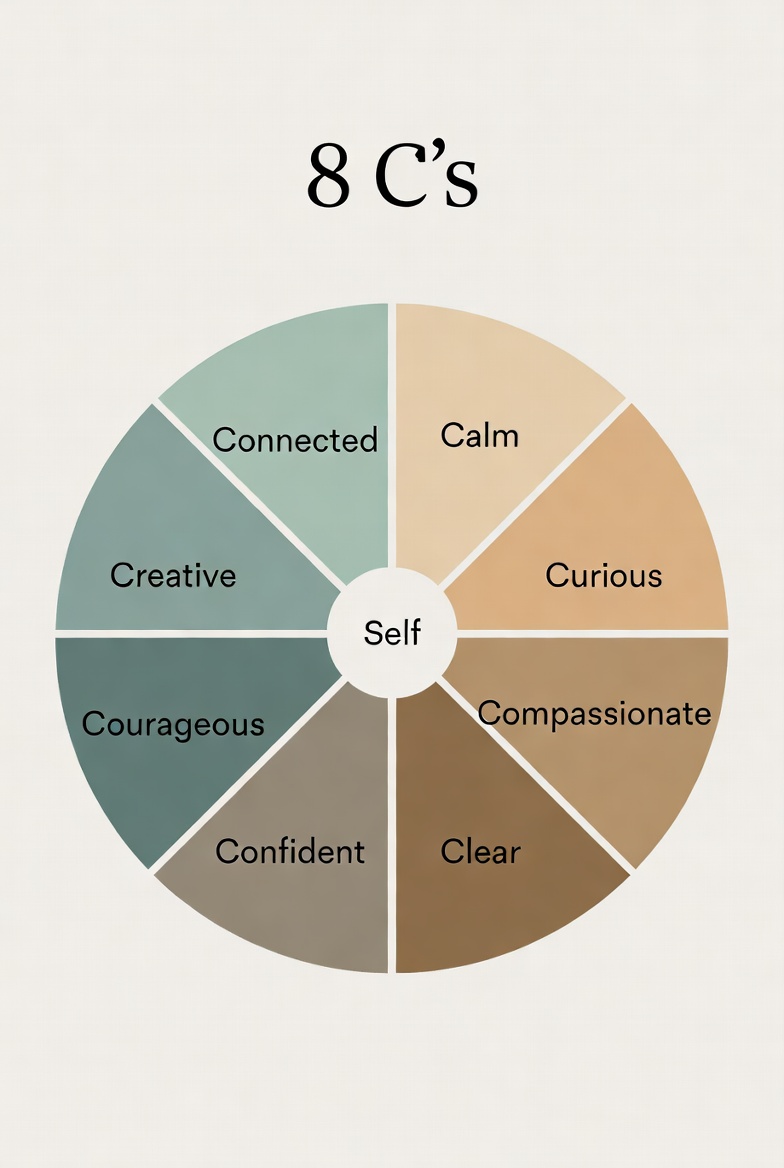
The 8 C's: Eight Qualities of Self-Energy
When you are in Self, eight qualities naturally emerge. These are not things you practise or cultivate. They are what arises naturally when parts are not running the show.
The 8 C's of Self-Energy — the eight qualities that arise naturally when parts step back and Self leads.
Calm A steady, grounded presence. Not suppression of feeling. Genuine peace that can hold whatever arises. From calm, you can be present with intensity without being swept away. When you are calm, your client's nervous system can borrow your regulation. In session: the calm practitioner provides a steady container. When you are calm, the client's nervous system can borrow your regulation. Curious Genuine interest with no agenda. Wonder instead of judgment. The curious Self asks "What is this?" not "How do I fix this?" When you are curious about a part, it feels safe enough to show itself. In session: curiosity replaces diagnosis. "I'm curious about that anxiety — what is it trying to do for you?"
Compassionate Warmth that naturally extends toward suffering. Your own and others'. Not pity, which looks down. Compassion, which meets pain as an equal. Your compassionate presence is often more healing than any technique. In session: compassion allows you to sit with difficult material without needing to fix it. Your compassionate presence is often more healing than any intervention. Clear The ability to see things as they actually are, without parts distorting your view. Clarity includes knowing what you do not know. It is honest without being harsh. In session: helps you see what is actually happening, not what you (or the client) want to be happening. Allows accurate assessment and appropriate intervention.
Confident A quiet trust in your ability to handle what comes. Not arrogance. That is usually a part. Genuine faith that whatever arises, you can meet it. In session: allows you to stay with difficult material. You do not panic when things get intense. You trust the process. Courageous Willingness to move toward difficulty rather than away from it. Courage is not fearlessness. It is acting with integrity even when you are afraid. Following the client into territory you would rather avoid. In session: allows you to follow the client into difficult territory without shying away from the pain they need to face.
Creative When parts step back, creativity flows naturally. Problems that seemed completely stuck reveal unexpected options. The creative Self can see what the frightened parts cannot. Problems that seemed stuck reveal unexpected options. In session: allows you to find new approaches when the obvious ones are not working. Connected A sense of relationship with yourself, with others, with something larger. Connection is what happens naturally when parts are not creating separation. The client feels you are with them, not observing them. In session: the client feels you are with them, not separate from them. This connection is often the most healing element of the work.
The 5 P's of Self-Energy
Recognising Self vs. Parts
You Are in Self When You are in Self when: you feel calm even with difficult material. You are genuinely curious about the part, even a difficult one. You feel compassionate rather than judgmental. There is space around everything. You are clear about what is happening. You feel spacious, like there is room for everything. You Are in a Part When You are in a part when: you feel urgent or pressured. You are judging. You are overwhelmed or flooded. You feel numb. You want to fix or stop something immediately. You are certain you are right. You are driven to fix something immediately. You feel certain you are right. You feel small, young, or helpless.
The most important question in IFS: "How do I feel toward this part?" If you feel curious, compassionate, or caring: you are in Self, proceed. If you feel frustrated, scared, annoyed, or judgmental: a part is activated. Ask that part if it would be willing to step back. Never skip this check. Never proceed from a part when working with another part — parts do not trust other parts. They trust Self.