Lineage & Philosophy
THE RIVER YOU'RE ENTERING HAS FLOWED FOR 1000 OF YEARS
The Cocoon Method — Practitioner Training Manual
Contents
- 01Why Lineage Matters
- 02Pranayama: The Yogic Science of Breath
- 03Qi Gong: The Taoist Approach
- 04Indigenous and Sufi Traditions
- 05The Modern Pioneers
- 06The Somatic Therapy Lineage
- 07The Cathartic vs Integration Models
- 08TCM, Ayurveda, and the Cocoon Synthesis
- 09The Journey Ahead
Why Lineage Matters
You are about to enter a river that has been flowing for thousands of years. Every practitioner who came before you, every client who has breathed consciously, every ancient yogi who mapped the territories of prana — all of them are part of this lineage. And now, so are you.
Understanding where this work comes from does three things. It gives you credibility — you can speak with authority about a tradition tested across millennia. It gives you humility — you understand that you are not inventing anything, you are inheriting something precious. And it gives you discernment — when you know the rivers that feed this work, you can navigate their currents rather than being swept by them.
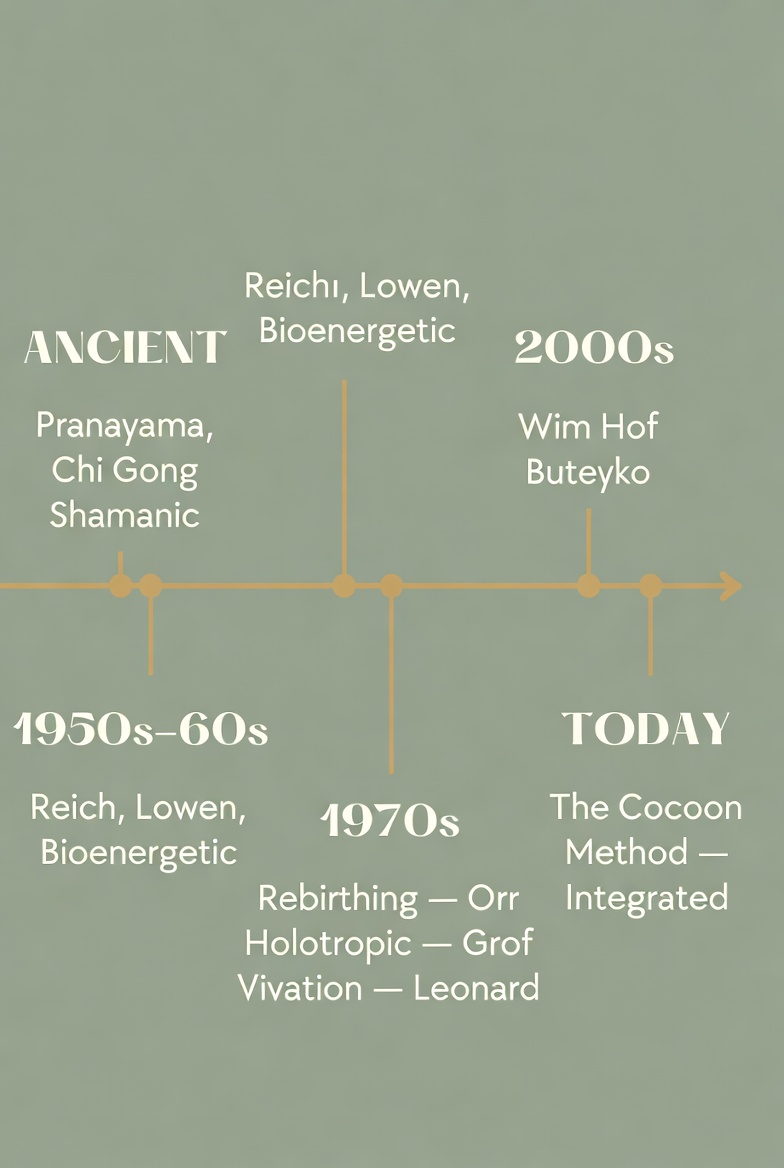
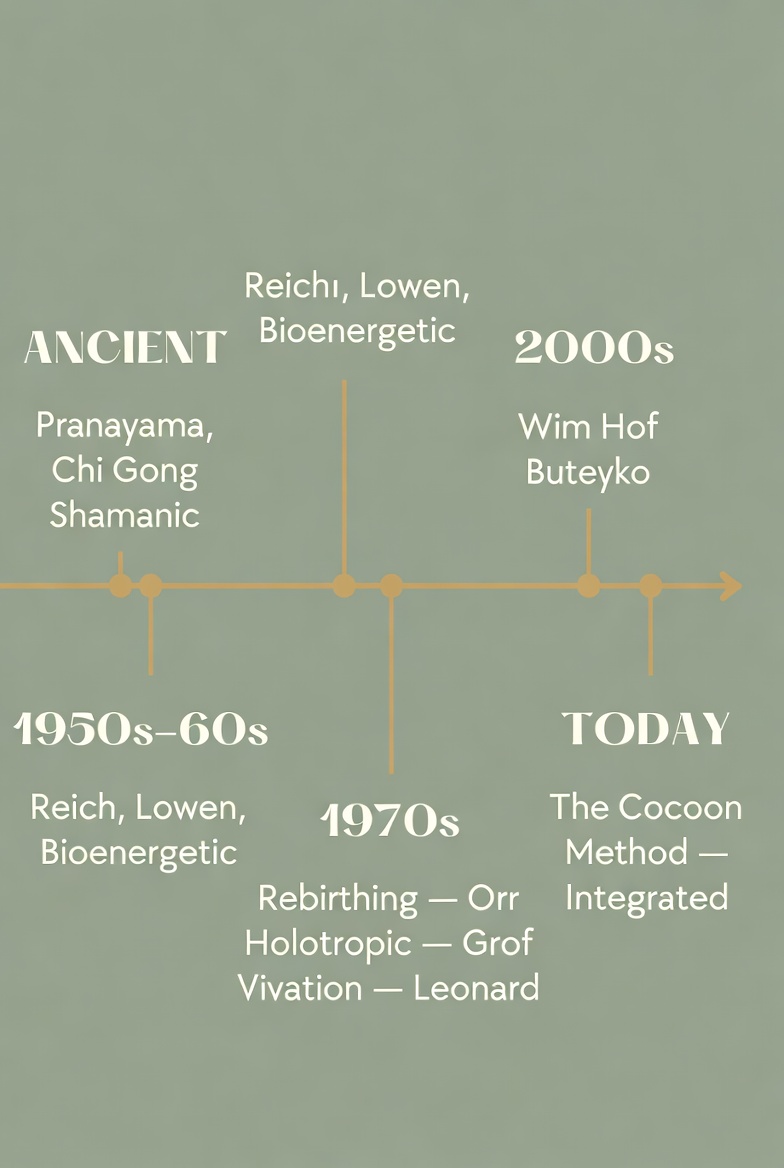
The two streams
The yogic science of pranayama, Taoist qi gong, indigenous shamanic breathing, and the Sufi breath traditions. Thousands of years of direct observation and refinement, passed through unbroken lineages of practice.
Wilhelm Reich, Alexander Lowen, Peter Levine, and the somatic pioneers who discovered that the body holds trauma, and that working directly with the body — through breath, touch, and movement — reaches what words cannot.
These two streams look very different on the surface. One is sacred, ancient, spiritual. The other is clinical, modern, scientific. But they were mapping the same territory from different starting points. The Cocoon Method is where they meet.
Which of the ancient traditions — pranayama, qi gong, indigenous, Sufi — do you feel most drawn to, and why?
What healing tradition or lineage, if any, do you already feel part of?
Pranayama: The Yogic Science of Breath
Origin: India, Rig Veda, approximately 1500 BCE. The word Pranayama combines two Sanskrit terms. Prana means life force, vital energy, or breath of life. Ayama means extension, control, or expansion. Pranayama is literally the extension and control of life force through breath.
Pranayama is the fourth limb of Patanjali's eight-fold path — sitting between the physical postures and the deeper meditative practices. The body first, then breath, then mind. Breath is the bridge.
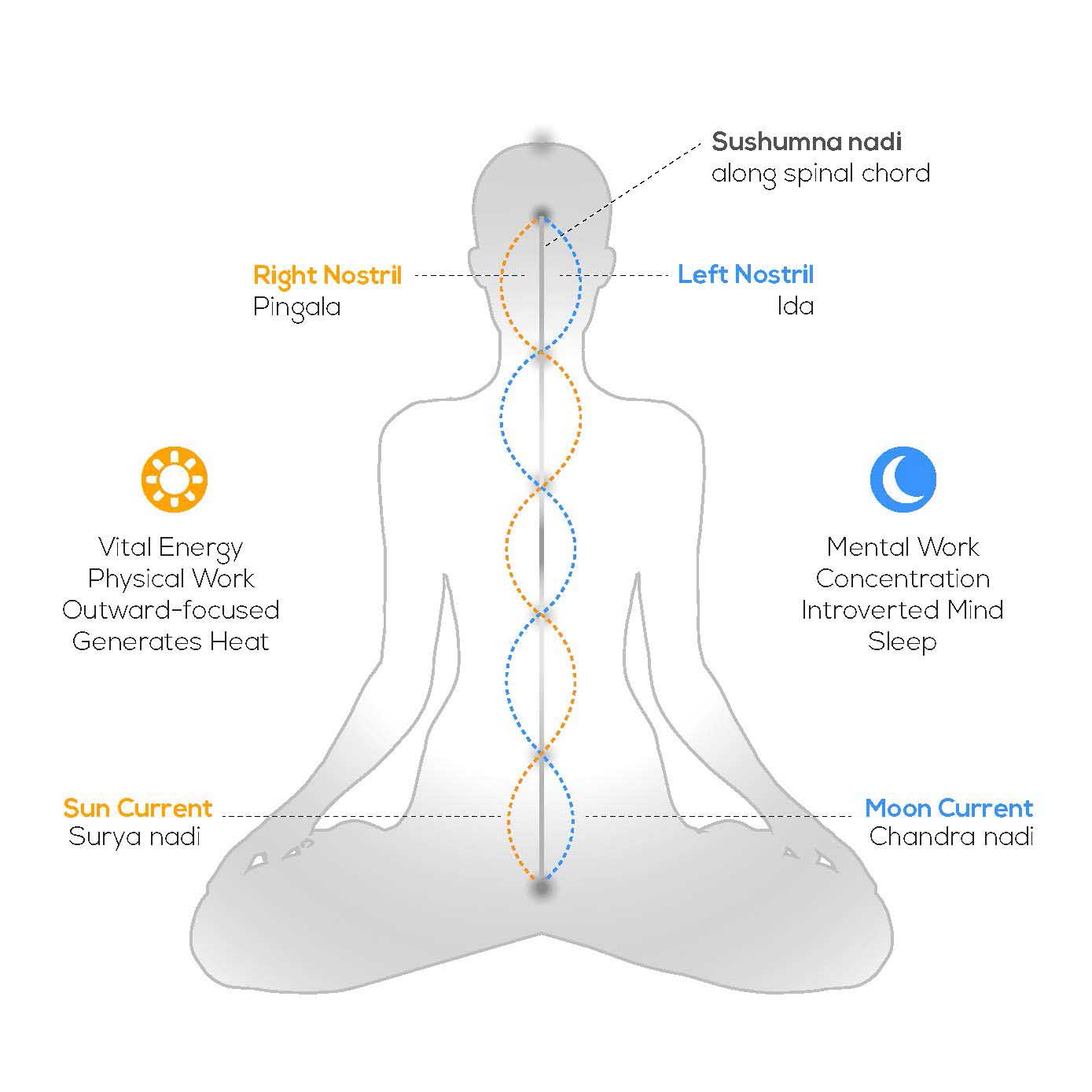
Notice: pranayama sits between the physical preparation and the deeper meditative practices. Breath is the bridge — you cannot master the mind without first mastering the breath.
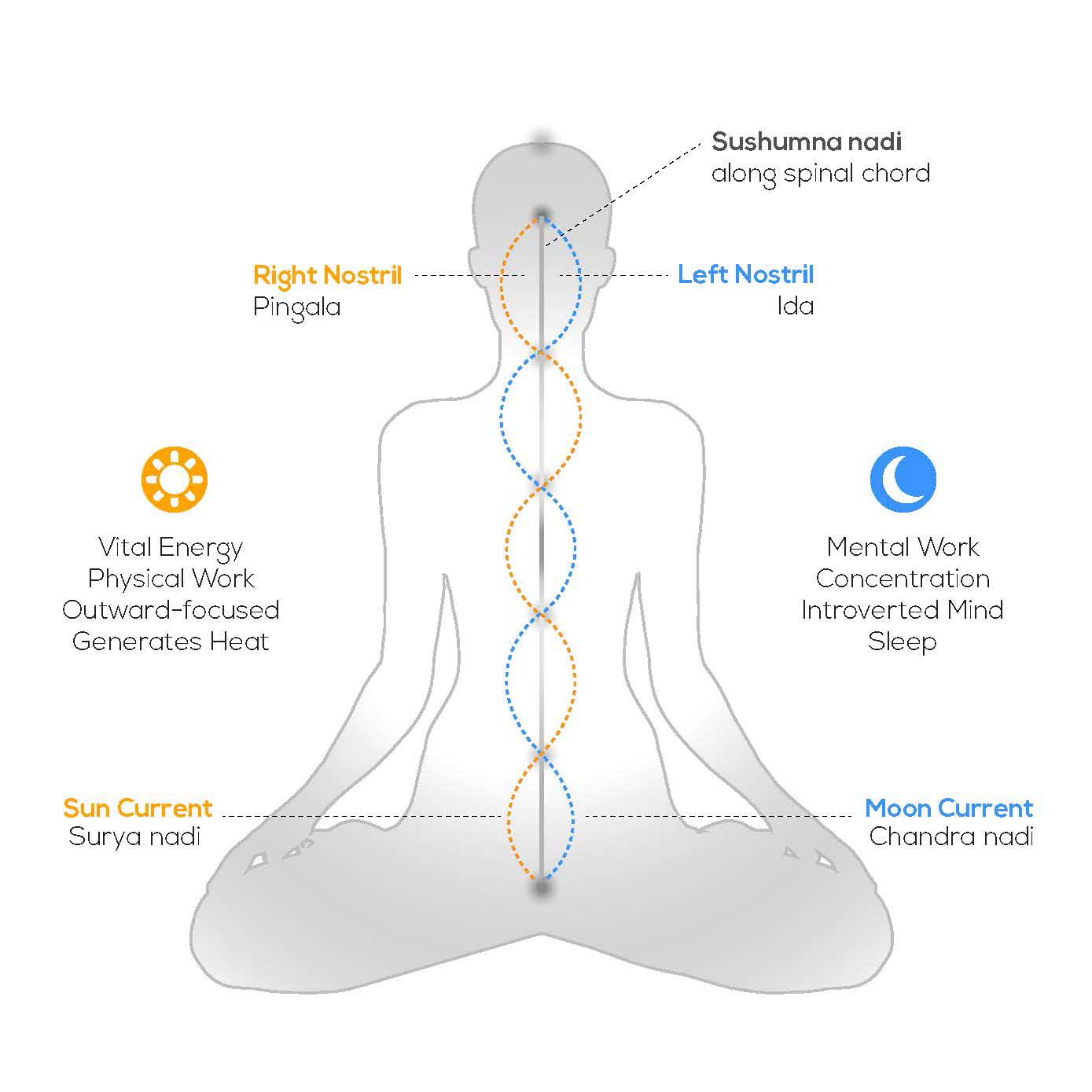
The three primary nadis
The yogic system mapped 72,000 subtle energy channels (nadis) throughout the body. Three are primary. Ida — the lunar channel, left side, cooling and calming. Pingala — the solar channel, right side, activating and warming. Sushumna — the central channel, through the spine. When prana flows through sushumna, states of balance and integration become available. Most transformative breathwork experiences involve the activation of sushumna.
The six key techniques and what they do
Alternate nostril breathing. Balances ida and pingala, harmonising the two hemispheres. Calming without sedating. Use when a client is stuck between activation and collapse.
Skull shining breath. Rapid forceful exhale, passive inhale. Energising and clearing. Raises prana. Use in the early activation phase when more energy is needed.
Bellows breath. Forceful in and out. More intense than kapalabhati. Use sparingly and with care — it can push past the window of tolerance quickly.
Victorious breath. Slight throat constriction creates an ocean sound. Simultaneously calming and warming. This is close to what we use in connected conscious breathing.
Humming exhale. Vibration throughout skull. Deeply calming for anxiety. Activates the parasympathetic system. Excellent for integration after activation.
Cooling breath through curled tongue. Reduces heat, calms anger. The counter to bhastrika. When a session runs too hot, sitali brings the temperature down.
The Five Pranas — Clinical Reading Guide
Prana is not a single undifferentiated energy. It manifests in five forms called vayus, each governing different functions. Understanding these gives you a more precise internal map of what the breath is doing — and what a client's breathing pattern is saying about how they move through life.
Chest region, moves inward and upward. Governs the drawing in of energy on all levels. Clinical sign: clients who struggle to receive — love, help, compliments — often show shallow, incomplete inhalation. The breath stops before it can fill them.
Lower abdomen and pelvis, moves downward and outward. Governs all letting go and elimination. Clinical sign: clients who hold on — to the past, resentments, relationships — often show incomplete, held exhalation. The breath never fully surrenders.
Navel centre, moves in a churning spiral. Governs digestion of all kinds — food, experience, emotion. Clinical sign: when a client cannot metabolise what has arisen in a session, samana vayu is deficient. Integration practices work here.
Throat and head, moves upward. Governs expression, growth, speech, and access to higher states. Clinical sign: when a client cannot find words, or when expansion feels ungrounded, udana vayu is at play.
Pervades the whole body, moves in all directions. Governs the distribution of energy everywhere. Clinical sign: when one area stays numb while others activate, vyana is blocked there. The whole-body aliveness clients report in deep breathwork involves vyana vayu flowing freely.
You do not need to use vayu language with clients. But this map gives you more precision — a vocabulary for your own internal understanding of what is happening breath by breath in any session.
If you have ever practised any pranayama technique, what did you notice? If not, which technique most interests you and why?
The yogis placed pranayama after the body and before the mind. What does this sequencing tell you about how healing works?
Qi Gong: The Taoist Approach
While the yogis in India were developing pranayama, the Taoists in China were mapping their own understanding of breath and life force. They called it Qi — the vital energy that animates all living things, flowing through channels they called meridians. Qi Gong literally means "energy cultivation." What is remarkable is how precisely the Taoist and yogic maps correspond — different languages describing the same underlying reality.
The Three Treasures
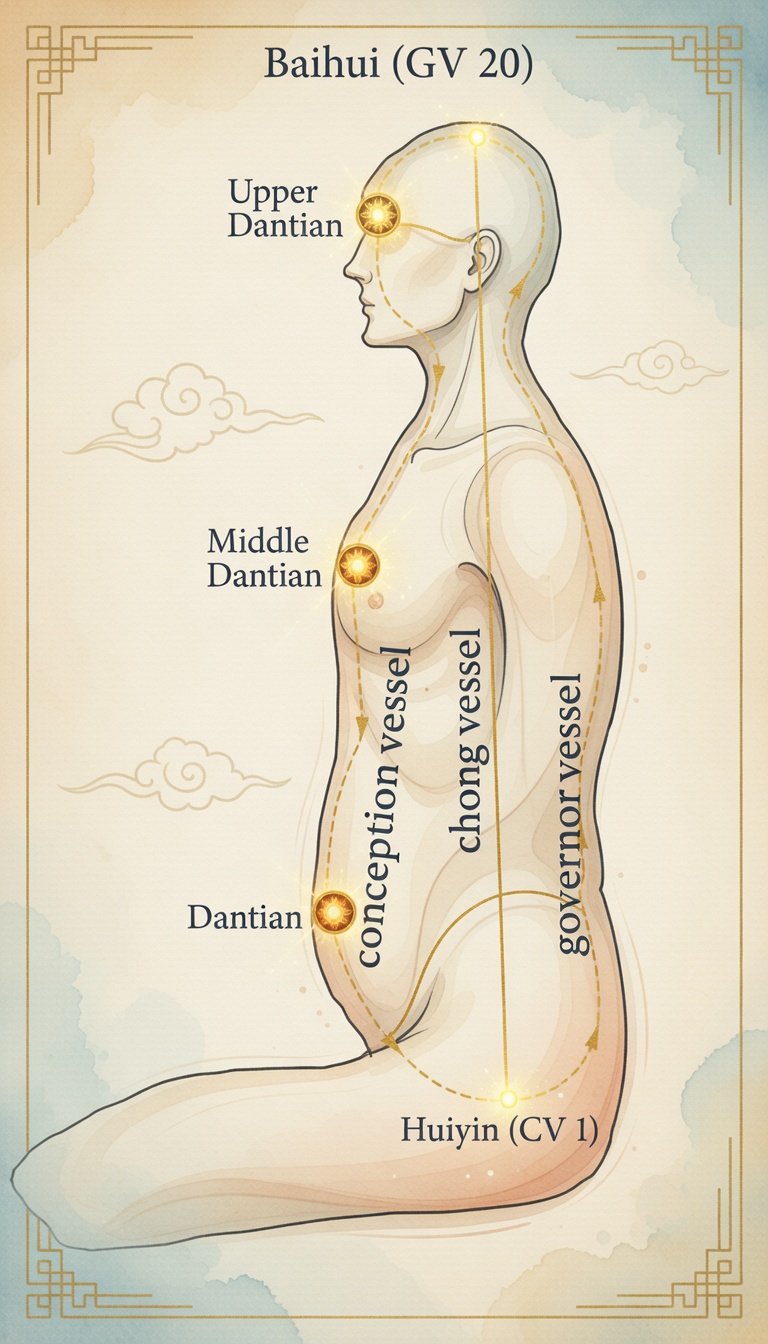
The foundational energy inherited from parents and stored in the kidneys. Jing is like a battery that depletes over a lifetime. Conservation of jing is why Taoists emphasise moderation and sustainable practice.
The dynamic force that animates us day to day. Qi is replenished through breath, food, and connection with nature. It flows through the meridians and can be cultivated through practice. This is what we work with most directly in breathwork.
Shen — Spirit: The most refined energy, associated with consciousness and spiritual development. When jing and qi are abundant and balanced, shen naturally flourishes. The expanded states that can arise in deep breathwork are often described as shen becoming available.
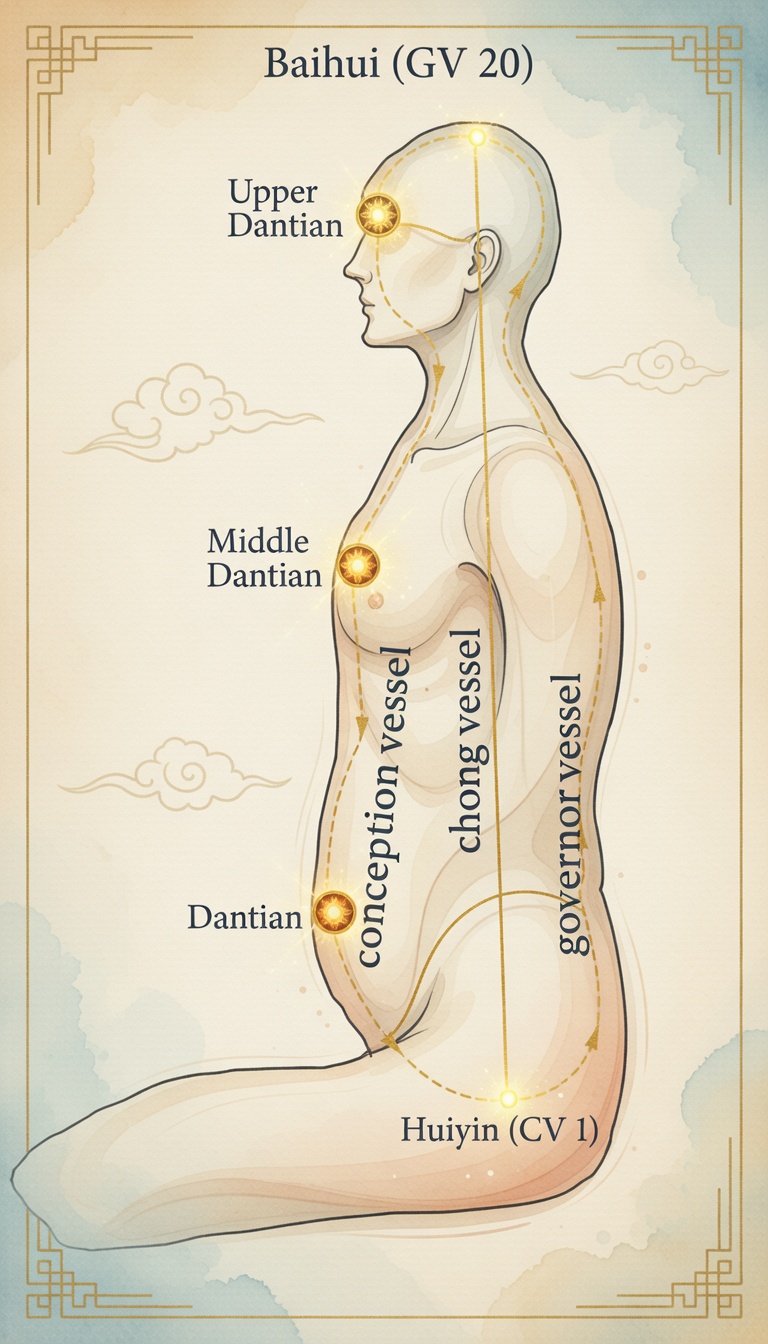
The Three Dantians
In sessions: we typically begin with the lower dantian — establishing ground, stability, and presence. As the session deepens, energy naturally rises to the middle dantian where emotional processing happens. In rare, profound sessions, energy reaches the upper dantian and the client may report insights or expanded clarity that persist beyond the session.
When a client reports feeling 'ungrounded' or 'floaty' after breathwork, they have likely moved energy up without establishing the lower dantian first. The clinical response is always the same: bring them back to the belly, to the floor beneath them, to the weight of the body. Ground before you go up.
Taoist Breathing Principles
Before learning advanced techniques, return to natural breathing. Many Qi Gong practices begin simply by observing breath without trying to change it — letting the body's innate wisdom restore healthy patterns. Observation before intervention.
Like the yogis, the Taoists emphasised breathing into the lower belly, engaging the diaphragm fully and massaging the internal organs with each cycle. The belly leads; the chest follows.
An advanced technique — the belly draws in on inhale and expands on exhale. The opposite of natural breathing. Creates strong internal pressure, used in martial arts and for moving energy up the spine. Not introduced to clients without preparation.
The most subtle form — breath becomes almost imperceptible, as gentle as a baby breathing in the womb. The return to original nature. In deep breathwork states, clients sometimes enter this naturally. It is a sign of profound settling, not something to interrupt.
Place both hands on your lower belly right now. Take three slow breaths into that space. What do you notice? Where does the breath go?
Which dantian feels most alive in you right now? Which feels most absent or hard to access?
- Pranayama — Nadi Shodhana (5 min): Sit upright. Close right nostril with thumb, inhale left for 4 counts. Close both, brief pause. Open right, exhale for 4. Inhale right 4. Close, pause. Exhale left 4. Repeat 8 rounds. Notice the quality that emerges.
- Qi Gong — Lower Dantian Breathing (5 min): Stand with feet shoulder-width, knees soft. Both hands on belly three fingers below navel. Breathe slowly through nose, directing breath into your hands. Imagine filling a warm golden sphere at your centre. Stay here for 5 full minutes.
- Connected Conscious Breath (5 min): Lie down. Full circular breath — inhale into belly and chest, exhale without pause, immediately back in. No gap between exhale and inhale. Let the breath move you. Notice what arises.
What was different between the three? Which one opened something? Which felt most natural?
Indigenous and Sufi Traditions
Indigenous breath practices
Across every continent, indigenous cultures developed sophisticated understanding of breath as a gateway to altered states and healing. The common threads are striking: breath as a bridge between ordinary and non-ordinary reality, breath as a way of communicating with the unseen world, breath as medicine that requires proper ceremonial container to be safe and effective.
What we inherit from indigenous traditions: the understanding that breathwork requires a proper container, that intention and preparation matter, and that integration is as important as the experience itself. These are not ideas arrived at through clinical research alone — they are ancient knowledge.
The Sufi tradition
The mystical branch of Islam developed its own sophisticated understanding of breath and presence. The Sufi practice of Dhikr — remembrance through rhythmic breath, movement, and sound — creates altered states through sustained practice. The whirling dervishes combine continuous rotation with specific breath patterns to access states of union. What we inherit: the understanding that rhythm, repetition, and breath combined create something more than the sum of their parts. And that the goal is not drama but union — with the self, with the present moment, with something larger.
Every tradition that worked with breath understood the same things. Breath is not just air — it is life force. Different breathing patterns create different states of consciousness. The work requires a container. Integration matters as much as the experience.
The Modern Pioneers
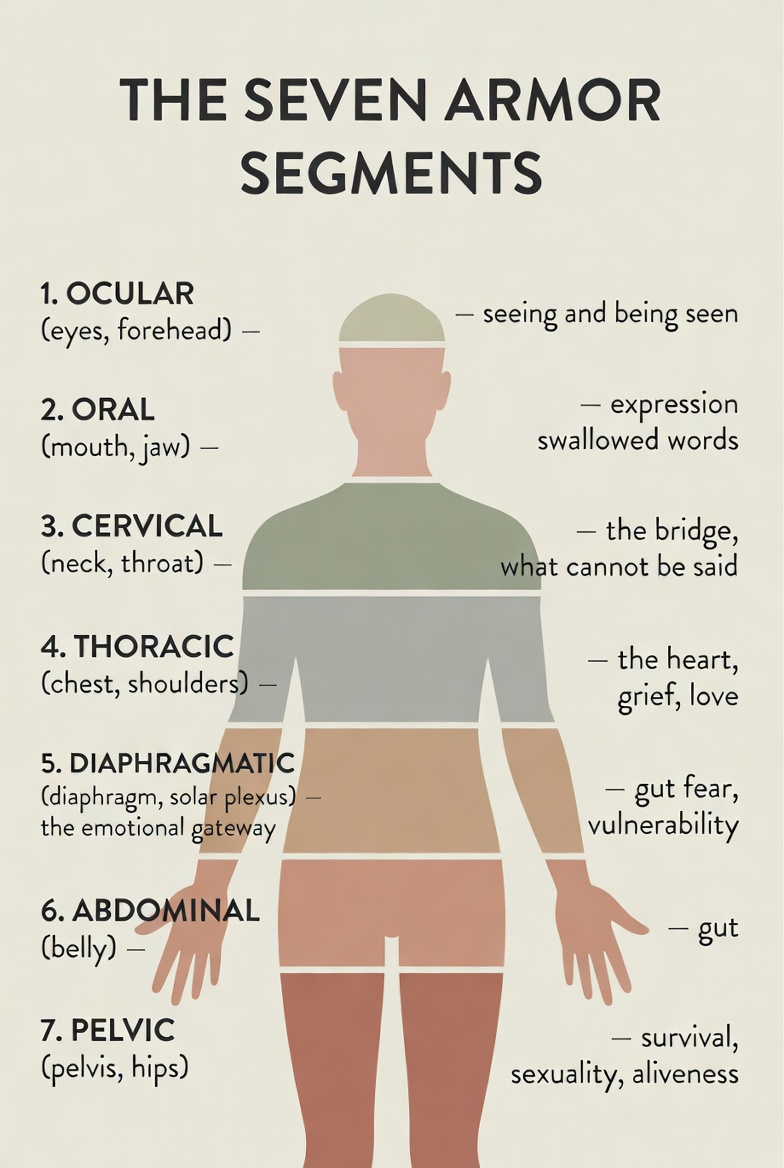
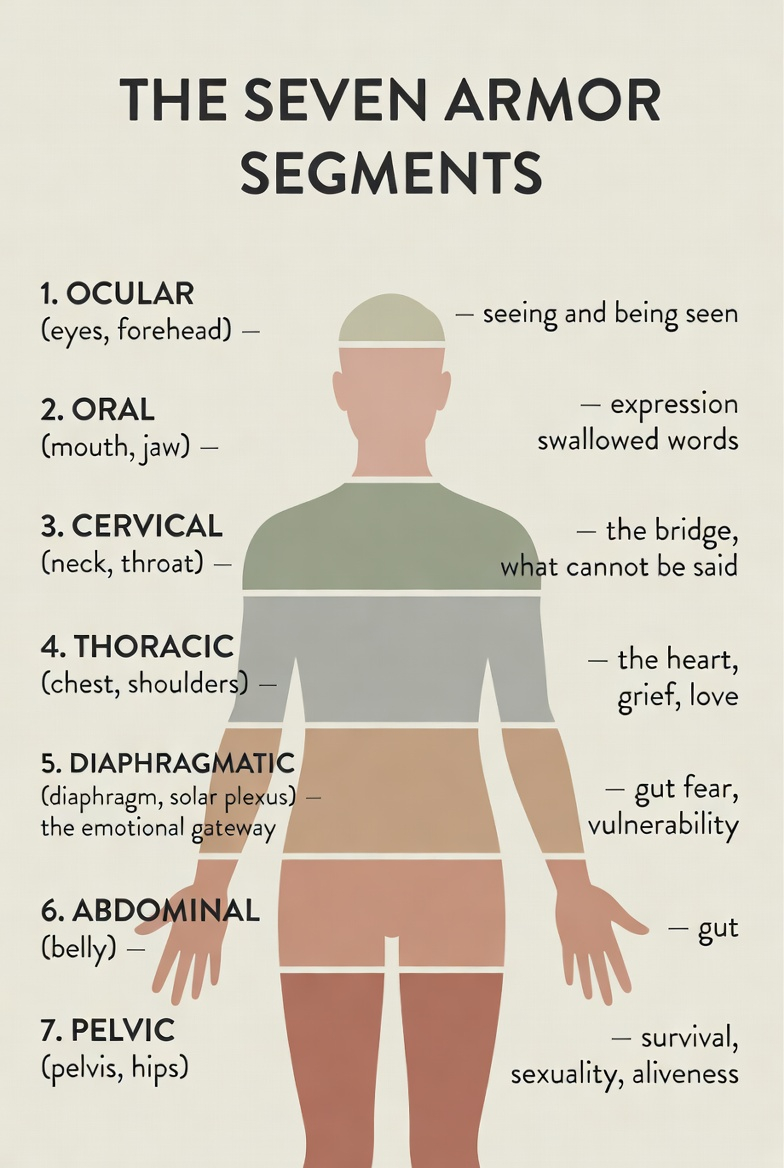
The Father of Body Psychotherapy Wilhelm Reich was a student of Freud who broke dramatically from his teacher's focus on the mind. Reich's central insight: the body is not just a vehicle for the mind — it is itself a record of everything the psyche has experienced. Where Freud saw repression as psychological, Reich saw it as physical. He discovered body armor — the chronic muscular tension patterns that develop as defenses against emotional pain. And he observed something crucial: breath is always the first thing restricted when armoring forms. When a person learns to suppress a feeling, they first hold their breath. What we draw from Reich: the understanding that chronic tension patterns tell a story, that working with breath and body can access what talk alone cannot, and the map of seven armor rings that still guides somatic work today.
Bioenergetic Analysis — Grounding and Character Structures Alexander Lowen was Reich's student who developed his discoveries into a more complete system. Lowen's greatest contribution was the concept of grounding — the importance of the body's connection to the earth as the foundation of all psychological health. Lowen also mapped character structures — the five patterns in which bodies organise themselves in response to early wounding. Each has a characteristic posture, breath pattern, way of holding energy, and set of psychological themes. Recognising these structures helps a practitioner understand the entire system of a person before they have said a word. What we draw from Lowen: grounding as a clinical priority, character structure as a map for reading the whole person, and the understanding that the body's shape tells the story of the life lived inside it.
Lowen's Five Character Structures
Building on Reich, Lowen mapped five patterns in which the body organises itself in response to early wounding. These are tendencies, not diagnoses — most people carry elements of several. Their value is understanding the logic of defense .
Wound: Threat to existence. Body: Thin, contracted, disconnected. Breath: Minimal, barely there. Psychology: Withdrawn, intellectual, split between mind and body.
Wound: Deprivation and abandonment. Body: Collapsed chest, weak legs, needy reaching. Breath: Incomplete inhale, always wanting more. Psychology: Dependent, yearning, never feeling full.
Wound: Seduction and manipulation. Body: Inflated upper, diminished lower. Breath: Strong in chest, disconnected from belly. Psychology: Need to control, difficulty with vulnerability.
Wound: Controlling, smothering love. Body: Thick and compressed — especially neck and pelvis. Breath: Effortful, struggling against its own restriction. Psychology: Suppressed aggression, chronic suffering.
Wound: Rejection of heart feelings. Body: Held and armored — looks good but lacks aliveness. Breath: Controlled, regular, without genuine depth. Psychology: Ambitious, achieving, difficulty with surrender.
Rebirthing and Connected Conscious Breathing In the late 1960s, Leonard Orr discovered what he called Rebirthing — the practice of connected conscious breathing, where the inhale and exhale are joined without pause. He found that this continuous circular breath, sustained over time, produced profound physiological and psychological shifts. What we take from Orr: the connected breath pattern itself, and the recognition that sustained conscious breathing accesses material unavailable through normal respiration. What we leave: the rebirther philosophy that specific breath patterns inevitably produce birth-related experiences. The Cocoon Method does not make this claim.
Holotropic Breathwork Stanislav Grof was a psychiatrist who conducted extensive research with LSD therapy, then — when LSD became illegal — developed Holotropic Breathwork as a non-pharmacological way of accessing similar states. Holotropic literally means 'moving toward wholeness.' Grof's contributions: the transpersonal map of consciousness, the recognition that breathwork can access perinatal material, and the importance of set and setting. Where Cocoon differs: Grof's approach uses intense hyperventilation for extended periods and encourages dramatic catharsis. We work within the window of tolerance, without tetany, with integration as the primary goal.
Functional Breathing and CO₂ Tolerance Buteyko was a Russian doctor who made a counter-intuitive discovery: most people breathe too much, not too little. Chronic over-breathing lowers CO₂ levels, which paradoxically reduces oxygen delivery to cells and triggers the sympathetic nervous system. What we draw from Buteyko: the importance of nasal breathing, the BOLT score as a practical assessment of CO₂ tolerance, and the understanding that functional breathing is the foundation for all other breath work. You cannot build on a dysfunctional foundation.
Bringing Breathwork Mainstream Wim Hof has done more than perhaps anyone else to bring breathwork into mainstream awareness. His protocol has generated significant scientific interest and demonstrated measurable effects on the immune system. What we take: the scientific validation that conscious breathing affects physiology in measurable ways, and the cultural work of making breathwork accessible to people who would never have encountered it otherwise. What we note: the Wim Hof method is designed for physiological performance, not psychological healing. The two overlap but are not the same.
Which of the modern pioneers resonates most with where you are in your development, and why?
What does it tell you that Reich, Lowen, and Levine all independently arrived at the same conclusion — that the body holds what the mind cannot process?
The Somatic Therapy Lineage
Peter Levine and the gazelle
Peter Levine brought a revolutionary observation that changed trauma treatment forever. He studied how animals in the wild respond to threat and noticed something remarkable: when a gazelle escapes a lion and is safe, it does not simply return to grazing. First it stops. Then it begins to shake — tremoring involuntarily, sometimes violently, for several minutes. Then the tremoring stops, and the gazelle walks away as if nothing happened.
Levine's insight: the tremor is not a symptom — it is the cure. The gazelle is completing the physiological cycle that the threat initiated. The survival energy that flooded its body is being discharged through the tremor. The nervous system completes what it started, and then it returns to baseline.
Human beings have the same capacity. But we suppress it. We are taught not to shake, not to cry, not to tremble. We are taught to control the body's responses rather than to follow them to completion. And so the survival energy remains in the body, chronically activated, becoming what we call trauma.
Reichian armor rings — what the body holds
Reich's map of seven horizontal armor rings gives practitioners a clinical reading tool. When you meet a client, you are looking at all seven simultaneously. Restricted breathing in the thoracic ring tells a different story than restricted breathing in the diaphragmatic ring. The ocular ring (eyes, forehead) tells you about what this person has learned to see or not see. The oral ring tells you about nourishment, crying, speaking.
Breath is always the first thing restricted when armoring forms. Before the jaw tightens, before the shoulders rise, before the chest freezes — the breath changes. Reading breath patterns is reading the armor map.
Titration and pendulation
Titration: working in small doses, approaching difficult material in tiny increments rather than diving in. Like adding acid to base drop by drop rather than all at once. The nervous system can metabolise what comes in small amounts. Flooding overwhelms.
Pendulation: the natural rhythm between activation and settling. The nervous system moves between charge and discharge, contraction and expansion, activation and rest. Supporting this natural rhythm is more effective than trying to maintain a single state.
Both concepts are central to the Cocoon Method. We work in doses. We follow the natural rhythm. We do not push past the window of tolerance. The body knows where it needs to go — our job is to create the conditions for that to happen safely.
The SIBAM Model — Five Channels of Tracking
Levine developed the SIBAM model to track the different channels through which trauma manifests and resolves. A skilled practitioner tracks all five simultaneously, noticing which needs attention at any given moment.
Physical sensations: tension, temperature, pressure, tingling, numbness. This is the primary channel for somatic work. Always start here.
Visual imagery, memories, dreams. Images often arise spontaneously during somatic work and can guide without needing interpretation.
Actions, movements, impulses, gestures. Incomplete defensive movements often underlie trauma — the punch never thrown, the flight never completed.
Emotions, feelings, moods. Not chased, not suppressed — welcomed as part of the process when they arise organically.
Thoughts, beliefs, narratives. Meaning often shifts naturally as somatic processing occurs — without being directly addressed. When the body resolves something, the story about it often changes by itself.
The Two Vortexes
A downward spiral of activation, fear, helplessness, and overwhelm. When we get too close to unprocessed trauma without adequate resource, we can be pulled in — losing access to present-moment awareness and the capacity to process.
A counterbalancing spiral of resource, safety, completion, and integration. By building resources first, we create a healing vortex strong enough to approach the trauma vortex without being swept into it.
We do not dive into trauma. We build resource until we can touch trauma without being overwhelmed, process one piece at a time, return to resource, and repeat. The healing vortex must be stronger before we approach the trauma vortex.
The Felt Sense
Central to somatic work is the felt sense — a concept from philosopher Eugene Gendlin, developed by Levine into a clinical tool. It is not emotion, not thought, not a specific physical sensation. It is the overall, holistic, bodily sense of a situation before it becomes clear.
When you walk into a room and sense that something is wrong — before you know what or why — that is felt sense. When you have a gut feeling about a decision that your mind cannot yet articulate — that is felt sense. When you sense what a client is carrying before they have said anything — that is felt sense.
This capacity requires slowing down enough to notice subtle internal experience — dropping out of thinking and into sensing. Your own daily practice is how this develops. You cannot read felt sense in a client if you cannot access it in yourself.
Incomplete Survival Responses
Many survival responses get interrupted before completion. The punch never thrown. The run never completed. The scream never voiced. These remain in the body as frozen potential energy — like a spring compressed but never released. Somatic work often involves helping these complete.
Hands might push away. Legs might run. Body might curl into protection. Allowing the body to make the movements it could not make during the original event.
The scream that could not emerge. The "no" that could not be said. The growl of rage that had to be swallowed. Allowing vocalization that was suppressed.
The tremoring and shaking that should have happened after the event but was interrupted. When completions happen, there is often profound relief — as if something that has been waiting for decades finally gets to happen.
The Cathartic vs Integration Models
Two fundamentally different philosophies have shaped how practitioners approach emotional release and trauma resolution. Understanding both — and why the Cocoon Method makes its choice — is essential to becoming a masterful practitioner.
Why catharsis alone does not work
Catharsis can become retraumatising . If someone accesses overwhelming material without adequate resources, they are not healing — they are reliving overwhelm. The discharge happens but the nervous system floods rather than completing.
Catharsis can become addictive . The dramatic release feels like something profound is happening. The client returns again and again for the same experience. But nothing in daily life changes. The sessions have become a pressure valve rather than a doorway.
Catharsis without integration changes nothing permanent . The discharge is real. But without integration, the nervous system returns to the same baseline. The pattern continues. The change is temporary.
When you extend the exhale, you trigger a specific neurochemical event. During exhalation the vagus nerve releases acetylcholine — what early researchers called vagusstoff , vagus substance — directly to the sinoatrial node of the heart. This slows the heart. A 2022 meta-analysis of 223 studies on slow breathing confirmed measurable increases in vagally-mediated HRV during slow breathing, immediately after a single session, and after multi-session interventions.
Every time you say "breathe out slowly," you are facilitating this release. Know what that is — it changes how you teach it.
“A small clean fully integrated release is worth infinitely more than a massive cathartic experience the system cannot hold.”
Have you had an experience — as client or observer — of catharsis that felt incomplete or left someone more destabilised than they began? What happened?
What changes in how you would facilitate a session if integration rather than intensity is the goal?
TCM, Ayurveda, and the Cocoon Synthesis
Traditional Chinese Medicine — the Five Elements
Traditional Chinese Medicine maps the body's energy systems through the Five Elements — Wood, Fire, Earth, Metal, Water. Each element corresponds to organs, emotions, seasons, and specific types of imbalance. For the breathwork practitioner, this gives a precise language for what you feel in sessions.
The generating cycle (outer ring): Wood feeds Fire, Fire creates Earth (ash), Earth holds Metal, Metal carries Water, Water nourishes Wood. This is the natural flow of support between elements.
The controlling cycle (inner star): Wood controls Earth, Earth controls Water, Water controls Fire, Fire controls Metal, Metal controls Wood. This prevents any element from becoming excessive. The whole system maintains itself through this double cycle.
The emotion-organ connections
When a client consistently presents with grief, look to the Lung (Metal). When you see chronic fear and depletion, look to the Kidney (Water). When there is rage and frustration, the Liver (Wood) is signalling. When there is anxiety and scattered thinking, the Heart (Fire) needs grounding. When there is worry and overriding mental activity, the Spleen (Earth) is overloaded.
This is not diagnosis. It is a reading tool — one more lens through which to understand what a person is carrying and where in the body it lives.
The Cocoon Synthesis — where all rivers meet
The Cocoon Method does not belong entirely to any single tradition. It is a synthesis — a distillation of what works, from ancient and modern sources, held together by a clear philosophy.
The nervous system the neuroscientist studies and the energetic matrix the Taoist healer perceives are the same system seen through different instruments. The ancient practitioners were mapping nervous system states without the vocabulary of modern science. The modern researchers are confirming ancient maps without the wisdom of lineage. Neither is complete alone. Together, they give us the most comprehensive map available of what happens when a human being breathes consciously in the presence of a skilled practitioner.
Breath as life force. Strategic use of different patterns for different purposes. Nasal breathing as foundation. The energy channel framework.
The three dantians as a map for working with energy centres. Jing, qi, shen. Grounding before elevation.
Emotion-organ correlations. Five elements as a reading map. Understanding what the body is signalling through which element is dominant.
The importance of container. Preparation and integration as equally important as the experience. Breath as bridge between ordinary and non-ordinary consciousness.
Body armor as readable map. Character structures as window into the whole person. Grounding as clinical priority.
Titration and pendulation. Working within the window of tolerance. Completion as the goal, not discharge.
You are now part of this lineage. What do you carry into it from your own history and wounds? What unique thread does your life add to this river?
What from the ancient traditions do you find most alive and relevant? What from the modern lineage changes how you think about healing?
“Co-regulation is the most fundamental somatic reality of this work. Your nervous system and your client's are in constant dialogue. When yours is regulated, theirs can borrow from yours. When yours is dysregulated, theirs will feel it — even if you say nothing.”
Your morning practice, the breath you take before a client arrives, the moment you ground yourself before they walk in — these are not personal indulgences. They are clinical preparations. The most important somatic preparation for any session is the regulation of your own nervous system.
The Journey Ahead
You have completed Part 2. You understand where this work comes from — the ancient breath traditions stretching back thousands of years, the modern pioneers who brought breath and body into Western psychology, and the synthesis that creates the Cocoon Method.
Part 3 brings the scientific foundation: the nervous system, polyvagal theory, the window of tolerance, and the neuroscience of why conscious breathing changes everything. Everything you learned about lineage in Part 2 will find its scientific grounding there.
Speaking to Different Audiences
Understanding lineage is not merely academic — it informs how you explain your work. Different people need different framings. Your knowledge of lineage lets you meet each authentically.
"This work is grounded in research on the nervous system, trauma, and the body-mind connection. I draw on Polyvagal Theory, Somatic Experiencing, and evidence-based breathing research. The mechanisms can be explained through a scientific lens." Then introduce other framings as the relationship develops.
"This work draws on wisdom traditions thousands of years old — pranayama from the yogic tradition, qi gong from the Taoist tradition, indigenous practices worldwide. The breath has always been understood as a bridge between the physical and the subtle, between ordinary and expanded awareness."
"The Cocoon Method synthesises multiple streams — ancient breath traditions, body psychotherapy from Reich through Levine, modern breathwork from Orr and Grof, functional approaches from Buteyko. We integrate cathartic and containment models based on what each client actually needs. Our No-Tetany Philosophy prioritises staying within the window of tolerance."
"This work combines ancient wisdom about breath with modern understanding of how trauma and stress affect the body. We work gently within your comfort zone, building capacity gradually. Many people find relief from chronic anxiety, stored tension, and emotional patterns that have not responded to talk therapy alone."
- Close your eyes and take several breaths to arrive. Feel your sitting bones. Feel your spine lengthen.
- Imagine yourself in a long line of practitioners stretching back through time. Directly behind you, sense the pioneers of the last century — Reich, Lowen, Orr, Grof, Levine. They discovered principles you will use. Feel their presence.
- Further back, sense the yogis and Taoists of centuries past — in ashrams and temples, refining practices that now come to you. Feel their dedication.
- Further still, sense the ancient practitioners — shamans in caves, wisdom keepers in forests, those who first discovered that breath opens doorways. Feel their pioneering spirit.
- Let yourself feel held by this vast lineage. You are not alone. Now sense forward in time — future practitioners who will learn from you. Rest in this awareness of being part of something larger than yourself.
- Take a deep breath and open your eyes when ready.
What did you sense? Who felt most present? How does knowing this lineage change how you hold your role?