The Somatic Therapy Lineage
Peter Levine and the gazelle
Peter Levine brought a revolutionary observation that changed trauma treatment forever. He studied how animals in the wild respond to threat and noticed something remarkable: when a gazelle escapes a lion and is safe, it does not simply return to grazing. First it stops. Then it begins to shake — tremoring involuntarily, sometimes violently, for several minutes. Then the tremoring stops, and the gazelle walks away as if nothing happened.
Levine's insight: the tremor is not a symptom — it is the cure. The gazelle is completing the physiological cycle that the threat initiated. The survival energy that flooded its body is being discharged through the tremor. The nervous system completes what it started, and then it returns to baseline.
Human beings have the same capacity. But we suppress it. We are taught not to shake, not to cry, not to tremble. We are taught to control the body's responses rather than to follow them to completion. And so the survival energy remains in the body, chronically activated, becoming what we call trauma.
Reichian armor rings — what the body holds
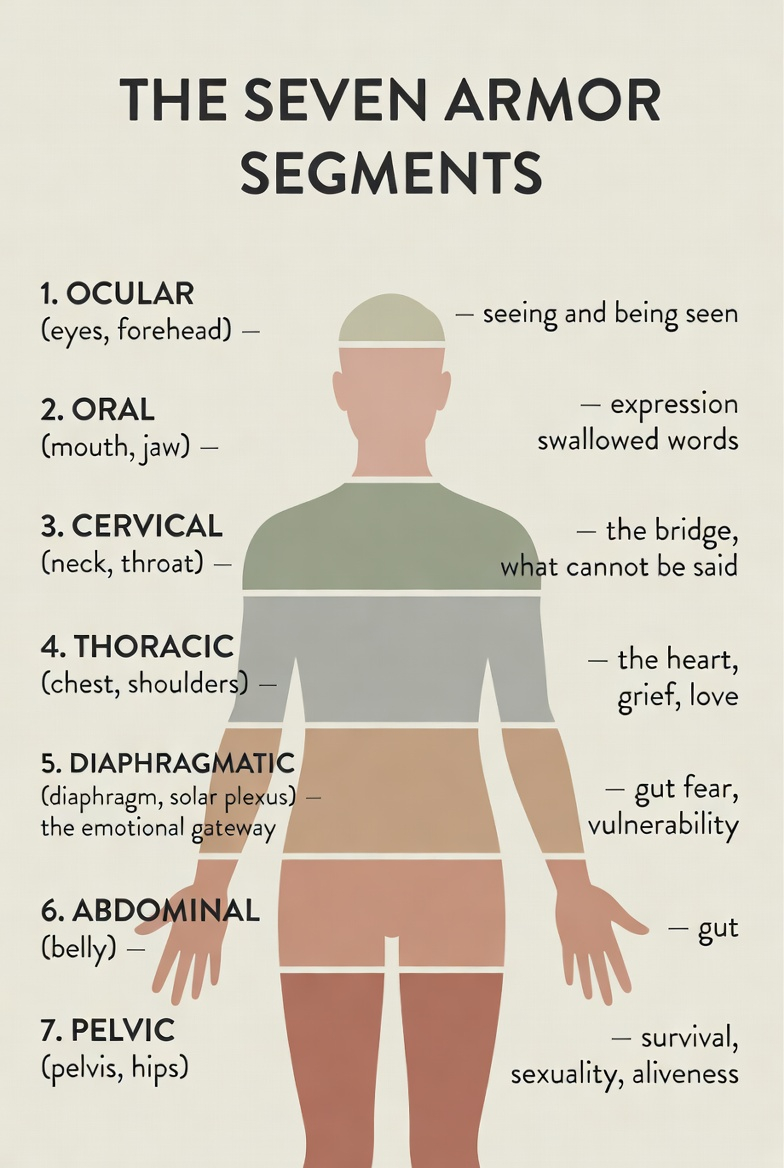
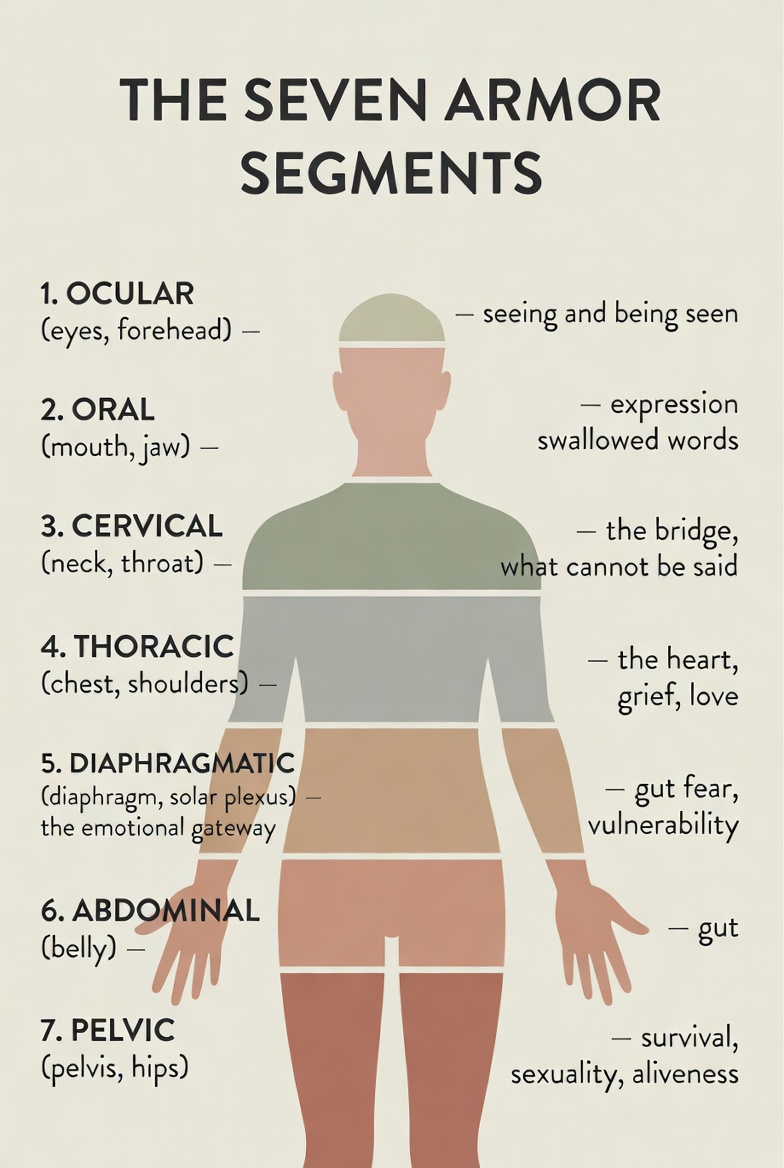
Reich's map of seven horizontal armor rings gives practitioners a clinical reading tool. When you meet a client, you are looking at all seven simultaneously. Restricted breathing in the thoracic ring tells a different story than restricted breathing in the diaphragmatic ring. The ocular ring (eyes, forehead) tells you about what this person has learned to see or not see. The oral ring tells you about nourishment, crying, speaking.
Breath is always the first thing restricted when armoring forms. Before the jaw tightens, before the shoulders rise, before the chest freezes — the breath changes. Reading breath patterns is reading the armor map.
Titration and pendulation
Titration: working in small doses, approaching difficult material in tiny increments rather than diving in. Like adding acid to base drop by drop rather than all at once. The nervous system can metabolise what comes in small amounts. Flooding overwhelms.
Pendulation: the natural rhythm between activation and settling. The nervous system moves between charge and discharge, contraction and expansion, activation and rest. Supporting this natural rhythm is more effective than trying to maintain a single state.
Both concepts are central to the Cocoon Method. We work in doses. We follow the natural rhythm. We do not push past the window of tolerance. The body knows where it needs to go — our job is to create the conditions for that to happen safely.
The SIBAM Model — Five Channels of Tracking
Levine developed the SIBAM model to track the different channels through which trauma manifests and resolves. A skilled practitioner tracks all five simultaneously, noticing which needs attention at any given moment.
Physical sensations: tension, temperature, pressure, tingling, numbness. This is the primary channel for somatic work. Always start here.
Visual imagery, memories, dreams. Images often arise spontaneously during somatic work and can guide without needing interpretation.
Actions, movements, impulses, gestures. Incomplete defensive movements often underlie trauma — the punch never thrown, the flight never completed.
Emotions, feelings, moods. Not chased, not suppressed — welcomed as part of the process when they arise organically.
Thoughts, beliefs, narratives. Meaning often shifts naturally as somatic processing occurs — without being directly addressed. When the body resolves something, the story about it often changes by itself.
The Two Vortexes
A downward spiral of activation, fear, helplessness, and overwhelm. When we get too close to unprocessed trauma without adequate resource, we can be pulled in — losing access to present-moment awareness and the capacity to process.
A counterbalancing spiral of resource, safety, completion, and integration. By building resources first, we create a healing vortex strong enough to approach the trauma vortex without being swept into it.
We do not dive into trauma. We build resource until we can touch trauma without being overwhelmed, process one piece at a time, return to resource, and repeat. The healing vortex must be stronger before we approach the trauma vortex.
The Felt Sense
Central to somatic work is the felt sense — a concept from philosopher Eugene Gendlin, developed by Levine into a clinical tool. It is not emotion, not thought, not a specific physical sensation. It is the overall, holistic, bodily sense of a situation before it becomes clear.
When you walk into a room and sense that something is wrong — before you know what or why — that is felt sense. When you have a gut feeling about a decision that your mind cannot yet articulate — that is felt sense. When you sense what a client is carrying before they have said anything — that is felt sense.
This capacity requires slowing down enough to notice subtle internal experience — dropping out of thinking and into sensing. Your own daily practice is how this develops. You cannot read felt sense in a client if you cannot access it in yourself.
Incomplete Survival Responses
Many survival responses get interrupted before completion. The punch never thrown. The run never completed. The scream never voiced. These remain in the body as frozen potential energy — like a spring compressed but never released. Somatic work often involves helping these complete.
Hands might push away. Legs might run. Body might curl into protection. Allowing the body to make the movements it could not make during the original event.
The scream that could not emerge. The "no" that could not be said. The growl of rage that had to be swallowed. Allowing vocalization that was suppressed.
The tremoring and shaking that should have happened after the event but was interrupted. When completions happen, there is often profound relief — as if something that has been waiting for decades finally gets to happen.