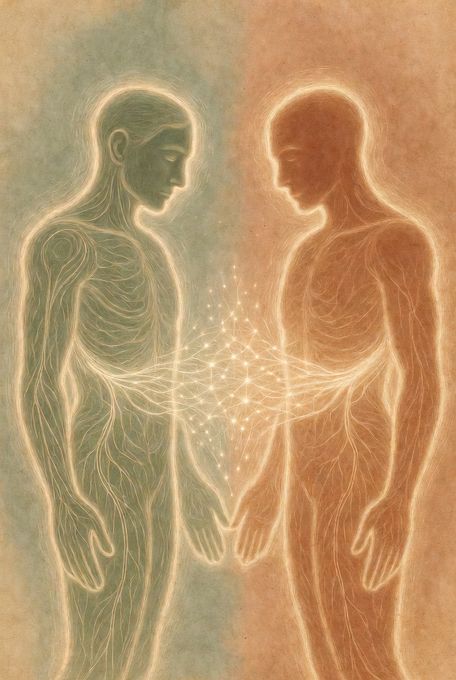
Co-Regulation: Your Nervous System as the Primary Tool
“We heal in relationship what was wounded in relationship.”
In genuine relational contact, nervous systems entrain. Heart rate, HRV, and cortical oscillations begin to move toward each other. The more regulated system tends to pull the less regulated one toward its state. This is measurable physiology, not metaphor. Your morning practice, the breath you take before the client arrives, the moment you ground before they walk in — these are clinical preparations, not personal rituals.
The Practitioner's State
Your face shows micro-expressions of tension. Your voice has qualities that signal danger. Your client's neuroception detects threat. Deep work becomes impossible. They may not be able to relax no matter what technique you use.
Your face is warm and expressive. Your voice has the melodious quality of safety. Your client's neuroception detects safety. Their nervous system can begin to relax and open. Your presence alone is therapeutic.
Sophie arrives dysregulated — cannot settle, talks rapidly, shifts position constantly. Standard relaxation techniques do not work. Her prefrontal cortex is offline.
The approach: you do not ask Sophie to do anything initially. You simply sit with her, regulated. You keep your breathing slow and visible. Your face soft. Your voice melodic. Steady, warm eye contact.
After 10–15 minutes, something shifts. Without any instruction, Sophie's breathing begins to slow. Her voice quiets. Her body settles. She is borrowing your regulation.
Six Months Later: 'I can hear your voice in my head when I'm stressed. I imagine what you would say, how you would breathe, and I can calm myself.' She has internalized the regulation. This is the long arc of co-regulation becoming self-regulation.
- 1Minutes 1–5: Arrival and assessment. Sit comfortably. Scan body systematically. Name what is present without trying to change it.
- 2Minutes 5–15: Coherent breathing. 6 breaths per minute (5 sec inhale, 5 sec exhale). Allow thoughts to pass. Feel the shift toward coherence.
- 3Minutes 15–20: Heart coherence. Shift attention to heart area. Generate genuine feeling of appreciation or love. Direct this outward.
- 4Minutes 20–25: Intention and visualization. See yourself regulated with clients. Feel the presence you want to embody. Set intention for the day.
- 5Minutes 25–30: Return and ground. Slowly open eyes. Orient to the room. Gentle movement. Carry the regulated state into your day.