The Nervous System
The living map of human experience
The Cocoon Method — Practitioner Training Manual
Contents
- 01A Letter from Nina
- 02The Architecture of Regulation
- 03Polyvagal Theory: The Revolution
- 04Nine Expert Perspectives on the Nervous System
- 05The Three States in Depth
- 06Neuroception: The Body's Safety Scanner
- 07The Vagus Nerve: The Wandering Healer
- 08The Window of Tolerance
- 09Heart Rate Variability: The Master Biomarker
- 10How Breath Changes Everything
- 11Co-Regulation: Your Nervous System as the Primary Tool
- 12Clinical Applications
- 13Advanced Concepts: Cellular Memory & Epigenetics
- 14Advanced Clinical Protocols
- 15Trauma-Informed Breath Facilitation
- 16The Body as Memory System
- 17Nervous System Across the Lifespan
- 18The Complete Observational Framework
- 19Integration and Rest: Why What Happens After Matters
A Letter from Nina
Five minutes before you read anything. Rate yourself honestly — 1 star means not at all, 5 means very much. You will return to these at the end to see how you have moved.
Your understanding of the nervous system
- I can read someone's nervous system state from their body and voice
- I understand why safety must come before deep work
- I understand how my own nervous system affects my clients
Your clinical readiness
- I know how to match an intervention to a nervous system state
- I can stay regulated while holding intense material in a session
- I understand the difference between catharsis and integration
What do you most want to understand about the nervous system after this part?
“Everything you learned in Parts 1 and 2 rests on this foundation. Without understanding the nervous system, you are working blind. With it, you become a skilled navigator of human transformation.”
Dear Practitioner in Training,
You are about to enter the territory that transforms practitioners from technique collectors into true healers: the science of the nervous system.
This is not dry academic content. This is the living map of human experience. When you understand what is happening in the nervous system, you understand why your client cannot relax, why that breathing pattern keeps returning, why some sessions catalyze transformation while others seem to go nowhere.
Stephen Porges' Polyvagal Theory, which you will study in depth here, revolutionized our understanding of trauma and healing. Dan Siegel's Window of Tolerance concept explains why some people can process intense material while others become overwhelmed. The research on Heart Rate Variability shows us how to measure the very resilience we are cultivating.
But remember: this knowledge is meant to serve, not to impress. The goal is not to sound scientific with your clients. The goal is to truly understand what is happening so you can respond with wisdom rather than guesswork.
Take your time with this material. Let it sink into your body, not just your mind. Notice how your own nervous system responds as you read. This science is not about them — it is about all of us, including you.
With deep respect for your commitment,
Nina Hinterschitt — Creator, The Cocoon Method
The Architecture of Regulation
Why This Science Matters
The nervous system cannot heal while perceiving threat. Safety is not a nice addition to your practice — it is the prerequisite for any deep work.
Chronic nervous system states are not character flaws. They are survival adaptations that made sense in context. Understanding this changes how you work with 'difficult' clients.
Of all autonomic functions, breath alone is under voluntary control. This makes it the master key. Understanding why this works deepens your capacity to use it.
Your nervous system affects your clients' nervous systems. Your state is not neutral. Your own regulated presence is the most powerful tool you have.
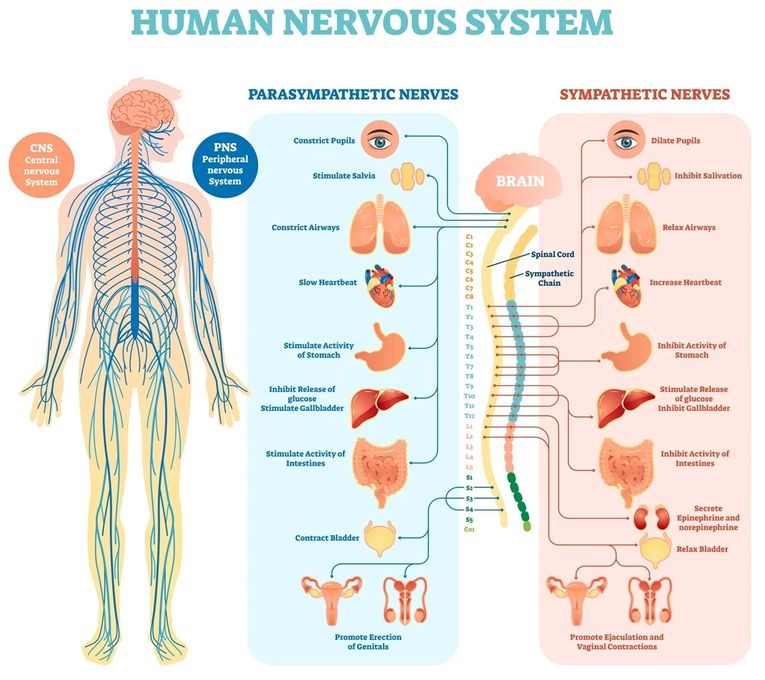
The Autonomic Nervous System: Your Gas and Brake
Rest and digest. Heart rate slows. Breathing deepens. Digestion activates. Growth and repair engage. Muscles relax. The mind becomes calm and receptive.
Fight or flight. Heart rate rises. Breathing becomes shallow. Blood flows to muscles. Stress hormones flood the system. The mind narrows to threat assessment.
Modern stressors activate the sympathetic system constantly but rarely provide physical discharge. Many clients are stuck here — unable to relax because the system perceives ongoing threat.
Marcus presents with insomnia, digestive issues, chronic neck tension, and feeling 'always on.' Classic chronic sympathetic activation: breathing rate of 18 per minute at rest, chest-dominant breathing, visible tension in neck and shoulders. BOLT score of 12 seconds. His nervous system has adapted to constant threat signals after 20 years of high-pressure work. His body has forgotten how to brake.
Cocoon Approach: Extended exhale practices, coherent breathing for daily practice, sleep hygiene, gradual caffeine reduction, BOLT score tracking. Over 12 weeks: breathing rate reduced to 10/minute, BOLT improved to 28 seconds, sleeping through the night for the first time in years.
Practitioner learning: Chronic sympathetic activation is a physiological state requiring physiological intervention. Breath is the most direct route to shifting it.
Polyvagal Theory: The Revolution
“The autonomic nervous system is not a simple on-off switch, but a hierarchical system that evolved to support increasingly complex social behaviors. — Stephen Porges”
The Evolutionary Story
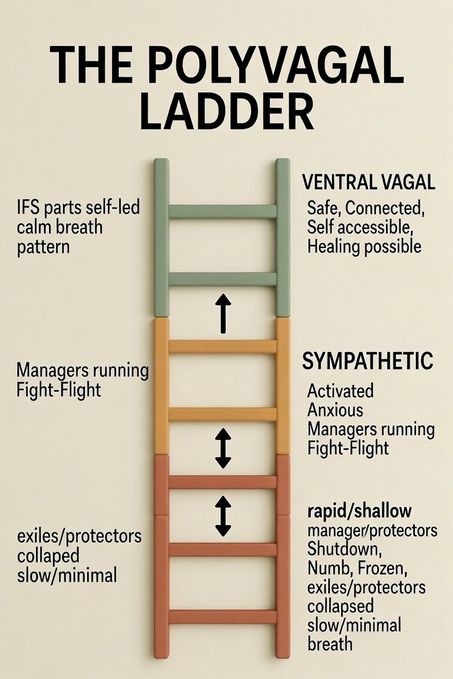
The Dorsal Vagus. The earliest vertebrates developed a simple vagal system that could slow metabolism and induce immobilization — playing dead as a survival strategy.
The Sympathetic System. As vertebrates became more mobile, they developed a system for active defense — enabling fight or flight and dramatically expanding survival options.
The Ventral Vagus. Mammals developed something entirely new: a vagal system that supports social engagement — nursing, play, bonding, and communication through facial expression and voice.
Healing always moves upward. You cannot jump from dorsal vagal collapse directly to ventral vagal safety — the system must pass through sympathetic mobilization first. We carry all three systems within us. They form a hierarchy: the newest (ventral vagal) is our default when we feel safe. Older systems activate when safety is not available.
The triune brain model is a powerful clinical map but not a precise neuroanatomical description. Modern neuroscience understands the brain as deeply interconnected — not three separate layers. What the model gets right, and what is strongly confirmed by research, is that survival-oriented circuits dominate when safety is absent, and that breath and body reach these circuits more directly than words alone. Hold the model as a map.
Nine Expert Perspectives on the Nervous System
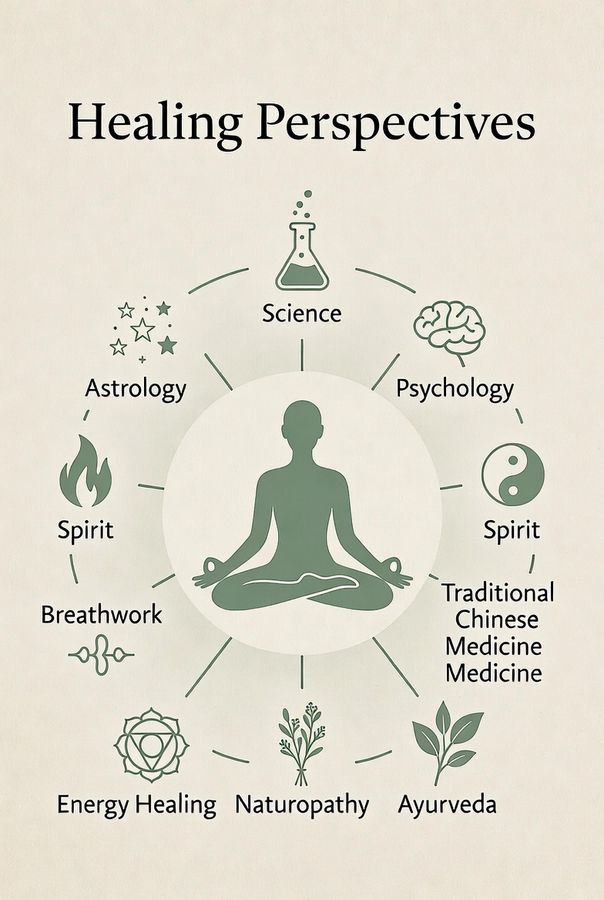
“Different maps. Same territory.”
Sees the nervous system as an electrochemical communication network. Trauma is stored in altered neural pathways. Healing involves neuroplasticity — the brain's capacity to rewire itself. Offers precise mechanisms, measurable outcomes (HRV, brain imaging), and validation of ancient practices through modern research.
Sees the nervous system as the biological substrate of experience. Early attachment shapes nervous system development. Trauma creates lasting patterns. The therapeutic relationship provides corrective experiences. Contributes understanding of development, defense mechanisms, and the healing power of relationship.
Sees the nervous system through chi — life force flowing through meridians. What Western science calls sympathetic activation, TCM describes as excess yang or liver fire. Dorsal vagal shutdown becomes chi stagnation or kidney deficiency. Connects nervous system function to organ health, seasonal rhythms, and energetic balance.
Sees the nervous system through the doshas — particularly vata, the air/space principle governing movement and communication. Nervous system dysregulation is often vata imbalance. Constitutional understanding explains why different people respond differently to the same stressors and treatments.
Sees the nervous system connected to the whole body — particularly the gut-brain axis, hormonal balance, and nutritional status. Inflammation affects the brain. Gut bacteria produce neurotransmitters. Nutritional deficiencies impair nervous system function. Physical factors support or undermine regulation.
Sees the nervous system as the densest layer of the subtle body — where energetic patterns crystallize into physical form. Chakras, meridians, and the aura are expressions of nervous system state. A blocked heart chakra and a vagally-suppressed social engagement system may be two descriptions of the same phenomenon.
Sees the nervous system as the vehicle through which consciousness experiences embodiment. Regulation is not just health — it is the foundation for spiritual development. A dysregulated nervous system cannot sustain expanded states of consciousness. A regulated one becomes capable of holding more light, more presence, more truth.
Sees breath as the primary access point to the entire autonomic system. Before any technique, reads the client's nervous system state through their breath. The entire session is a response to that reading, adjusted moment by moment. Polyvagal theory named and explained what skilled breathworkers had always done intuitively.
Sees the nervous system as shaped by both personal history and transpersonal timing. Planetary archetypes map onto nervous system patterns — Saturn placements often correspond to chronic bracing, Mars to sympathetic reactivity, Neptune to dissociation. Astrology reveals which survival states are most familiar, and what the body needs to find safety.
The Cocoon Method practitioner holds all nine perspectives simultaneously. You are not choosing one lens — you are developing fluency in all of them, using whichever serves your client in the moment. When you can see through many perspectives, you are less likely to become rigidly attached to any single one.
The Three States in Depth
State One: Ventral Vagal — Safety and Connection
Calm, variable heart rate. Slow, deep, diaphragmatic breathing. Relaxed, expressive face. Warm, melodic voice. Normal digestion. Optimal immune function. Low inflammation.
Present, safe, and grounded. Clear thinking and creativity. Full emotional range. Curious and open. Memory works normally. Within the window of tolerance.
Cultivating your own ventral vagal capacity is perhaps the most important skill you will develop. You cannot help clients access states you cannot access yourself. You cannot transmit safety you do not embody.
State Two: Sympathetic — Mobilization
Presents with anxiety, insomnia, perfectionism, and chronic tension headaches. Breathing rate 16/minute at rest. Rapid speech. Frequently checks phone during intake. BOLT score of 14 seconds. Reports feeling 'like something bad is about to happen' most of the time. Her nervous system learned that safety came from performance. Any potential failure was treated as a survival threat. In session, she tries to 'do breathing perfectly.' When relaxation begins, anxiety increases — her system interprets stillness as dangerous.
Breakthrough — Session 6: During gentle connected breathing, Priya begins to shake. Frightened, but supported by your regulated presence, she continues. The shaking intensifies, then gradually subsides. She reports feeling 'lighter than I have in years.'
State Three: Dorsal Vagal — Shutdown
Heart rate drops significantly. Breathing becomes very shallow. Muscles go slack. Pain perception decreases. Metabolic rate drops. The body conserves resources.
Numb, disconnected, 'not here.' Foggy thinking. Hopelessness. Dissociation. The 'zombie' feeling of going through the motions. Depression of the collapsed, flat variety.
Referred for 'treatment-resistant depression.' On antidepressants for 10 years with limited benefit. Describes life as 'going through the motions.' History of childhood sexual abuse ages 7–11. 'I learned to leave my body and go somewhere else.' His face is flat. Voice monotone. Eye contact minimal. He is compliant but absent. Traditional relaxation techniques do nothing — he is already too 'relaxed' (collapsed). Deep breathing feels unsafe — it brings him into his body, where the trauma lives.
Dorsal vagal clients need activation before they need calming. They need to come UP before they can come down to a healthy baseline. Begin with gentle activation — small movements, finger tapping, foot pressing against floor — before any breathing work.
We cannot jump from dorsal vagal shutdown directly to ventral vagal safety. We must pass through sympathetic mobilization first. This is why trauma recovery often involves periods of anxiety before peace — the system is moving up the ladder. When shutdown clients begin to feel anger or fear, this is progress, not regression.
- Upon waking: What state do you start in? What is your default morning nervous system tone?
- During the day: What shifts you toward sympathetic activation? What helps you return to ventral vagal?
- In social situations: Do you ever notice dorsal vagal responses — wanting to disappear or go blank?
- At night: What cues of safety help you wind down? What cues of danger keep you awake?
What did you notice about your own nervous system today?
Which of the three states is most familiar to you? Which is most foreign?
Can you recall a time when you experienced dorsal vagal shutdown? What was happening? How did it feel?
How might your personal nervous system patterns affect your work with clients?
Neuroception: The Body's Safety Scanner
The Three Domains of Neuroception
Is this place safe? Familiar or unfamiliar? Are there escape routes? What sounds, smells, and visual cues are present? Extreme lighting, loud sounds, or confined spaces activate threat responses.
Is this person safe? What does their face say? Their voice? Their body language? Do they remind us of anyone who has hurt us? Are they attuned or dismissive? Predictable or erratic?
Is my body okay? Am I sick, injured, or in pain? Do I have enough resources? Am I hungry, tired, or depleted? What is my gut telling me?
Trauma distorts neuroception. Safe situations may trigger threat responses. Intimacy may feel threatening. Kindness may feel suspicious. The body itself may feel dangerous.
Safety Signals You Send
Soft eyes, relaxed forehead, gentle smile when appropriate. Avoid furrowed brow or tense jaw — these signal concern or threat even when your words are reassuring.
Warm, melodic, with varied prosody. Monotone signals dorsal vagal shutdown. Rapid pressured speech signals sympathetic activation. Neither transmits safety.
Relaxed shoulders, open posture, comfortable stillness. Avoid tension, fidgeting, or closed posture. Your body language speaks louder than your words.
Slow, visible belly breathing. Your breath literally sets the rhythm your client's system may entrain to. Your exhale is medicine.
The Vagus Nerve: The Wandering Healer
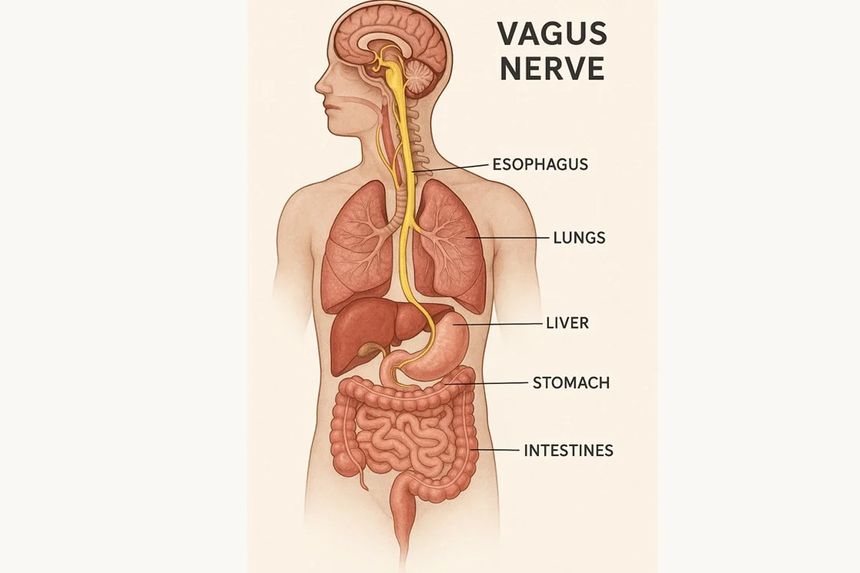
This ratio is crucial. It means that changing the body's state — through breath, movement, temperature, or touch — directly informs the brain about safety or danger. This is why bottom-up approaches (working with the body) are often more effective than top-down approaches (working with thoughts) for nervous system regulation.
How to Tone the Vagus Nerve
When you exhale longer than you inhale, you engage the vagal brake. Inhale 4 counts, exhale 8 counts. This directly stimulates the vagus on the exhale phase.
The vagus passes through the throat and vocal cords. Humming, chanting, and singing vibrate these muscles and stimulate the vagus. This is why chanting appears in every major spiritual tradition.
Cold water on the face triggers the 'dive reflex' — an ancient mammalian response that activates the vagus. Even splashing cold water on the face creates measurable vagal stimulation.
Warm, attuned relationships literally tone the vagus through the Social Engagement System. Attuned eye contact, warm conversation, and physical affection all stimulate the ventral vagal pathway.
Vigorous gargling activates the muscles of the throat that are innervated by the vagus. Gargle water vigorously for 30–60 seconds until your eyes water slightly — this indicates vagal activation.
Any form of slow, diaphragmatic breathing stimulates the vagus. The diaphragm has direct vagal connections, and deep belly breathing activates them throughout every breath cycle.
- Extended exhale: Inhale for 4 counts through the nose, exhale for 8 counts. Continue for 3 minutes. Notice the shift toward calm.
- Humming: Hum continuously for 1 minute on a single breath where possible. Feel the vibration in your chest and throat.
- Cold water: Optional — splash cold water on your face or hold a cool cloth to your cheeks for 30 seconds. Notice the immediate state shift.
What did you notice in your body before and after this practice?
The Window of Tolerance
“Within the window, we can think and feel at the same time. Outside the window, we lose one or the other. — Dan Siegel”
Anxiety, panic, racing heart, rapid breathing, emotional flooding, impulsive behavior, flashbacks. The prefrontal cortex goes offline. We react rather than respond.
Regulated, present, can think and feel simultaneously. Processing and integration are possible. Growth happens here. The edge of the window is where we work.
Numbness, flatness, foggy thinking, dissociation, depression, collapsed posture, difficulty engaging with life. Protected from overwhelm but disconnected from vitality.
The Window and Our No-Tetany Philosophy
Some clients have what might be called a 'false window' — they appear regulated but are actually dissociated. They can talk about traumatic material without apparent distress. They are not processing it; they are in a dorsal vagal numbed state that mimics regulation.
Signs of the False Window:
- Discussing traumatic content with no emotional affect
- Reporting 'fine' while body language shows otherwise
- History of bypassing emotions through intellectualization
- Very low reactivity to anything — even things that should move them
- Describing horrific events as if reading from a newspaper
With these clients, the goal is not calming — it is careful activation. Help them come up into feeling without flooding.
Heart Rate Variability: The Master Biomarker
<20 ms — Low, compromised vagal tone: Gentle work only; extensive resourcing first.
20–40 ms — Below average, room for improvement: Progressive approach; track over time.
40–60 ms — Average, normal range: Can do most practices with good pacing.
60–100 ms — Above average, good vagal tone: Ready for deeper work; monitor edges.
>100 ms — High, excellent resilience: Full capacity; use as practitioner benchmark.
Coherent Breathing: The Magic Number
- Inhale: Through the nose for approximately 5 seconds — smooth, even, diaphragmatic.
- Exhale: Through the nose for approximately 5 seconds — complete, relaxed, no forcing.
- Continue: For 10–20 minutes. Notice the body settling into coherence around minutes 4–6.
- Daily practice: Regular practice has greater effect on HRV than occasional intensive sessions.
Describe your experience of coherent breathing after 10 minutes.
| RMSSD (ms) | Interpretation | Clinical Implication |
|---|---|---|
| <20 | Low — compromised vagal tone | Gentle work only; extensive resourcing first |
| 20–40 | Below average — room for improvement | Progressive approach; track over time |
| 40–60 | Average — normal range | Can do most practices with good pacing |
| 60–100 | Above average — good vagal tone | Ready for deeper work; monitor edges |
| >100 | High — excellent resilience | Full capacity; use as practitioner benchmark |
How Breath Changes Everything
Researchers identified the specific brain circuit by which conscious breathing can override anxiety. Neurons in the anterior cingulate cortex — involved in attention and self-awareness — connect directly to the medullary breathing centre. When you consciously slow your breath, this circuit activates and modulates the amygdala's threat signal. This is not a general relaxation effect. It is a specific neural mechanism with a confirmed anatomical pathway. Every slow exhale you teach is activating this circuit in your client.
The Six Mechanisms of Breath
The diaphragm has direct connections to the vagus nerve. Deep belly breathing physically stimulates the vagus. Extended exhales engage the vagal brake and activate parasympathetic response.
Carbon dioxide levels directly affect nervous system state. Low CO₂ from over-breathing makes the nervous system more excitable. Optimal CO₂ from calm breathing maintains stability and efficiency.
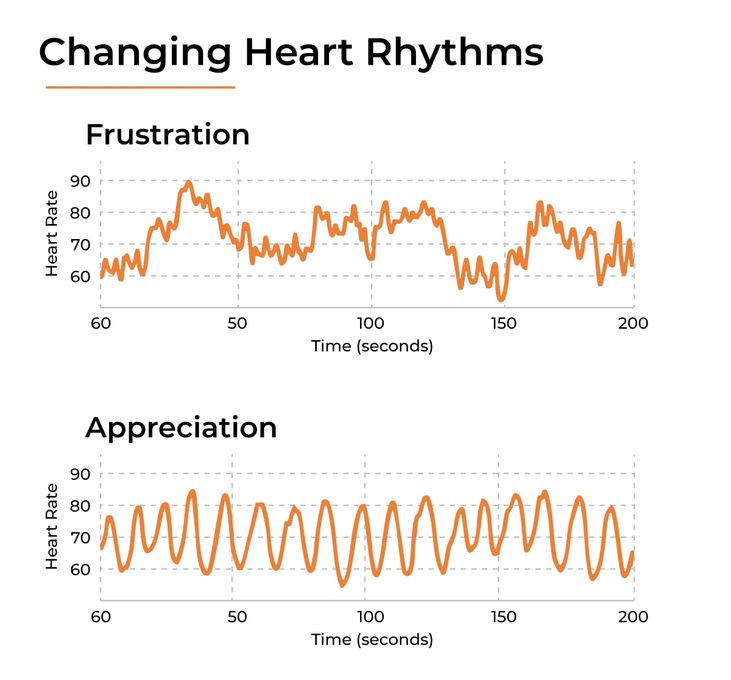
Slow rhythmic breathing entrains heart rate variability. At approximately 5.5 breaths per minute, the cardiovascular and respiratory systems enter coherence, maximizing vagal tone.
Slow breathing reduces cortisol levels — the primary stress hormone. Regular practice appears to reset the HPA axis toward a lower baseline stress response over time.
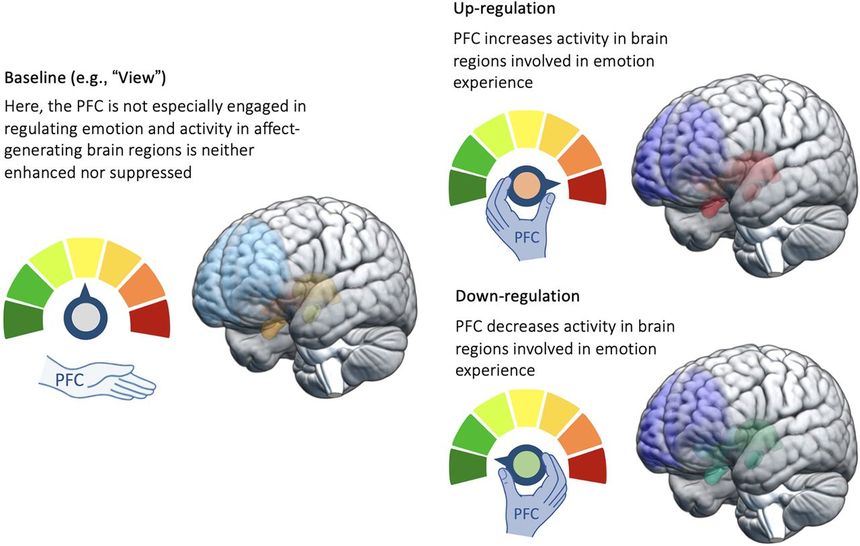
Conscious intentional breathing engages the prefrontal cortex — the brain region responsible for executive function and emotional regulation. This strengthens top-down regulation capacity.
Breath awareness is a form of interoception. Regularly attending to breath trains interoceptive capacity — greater emotional awareness, improved regulation, and deeper body-mind connection.
Different Breaths for Different States
The goal: activate the parasympathetic, engage the vagal brake.
- Extended exhales — 4:8 or similar ratios (inhale half as long as exhale)
- Slow, deep belly breathing — emphasize diaphragmatic expansion
- Coherent breathing — 5.5 breaths per minute
- Focus on the pause after exhale — this is where the vagal brake engages most fully
- Nasal breathing only — slows the pace and filters the air
The goal: bring energy UP without triggering anxiety.
- Slightly faster breathing — above their baseline but not rapid
- Emphasis on the inhale — the activating phase of breath
- Movement combined with breath — arms lifting on inhale, releasing on exhale
- May temporarily use mouth breathing for gentle activation
- Frequent stops to check in — the window can change quickly
Co-Regulation: Your Nervous System as the Primary Tool
“We heal in relationship what was wounded in relationship.”
In genuine relational contact, nervous systems entrain. Heart rate, HRV, and cortical oscillations begin to move toward each other. The more regulated system tends to pull the less regulated one toward its state. This is measurable physiology, not metaphor. Your morning practice, the breath you take before the client arrives, the moment you ground before they walk in — these are clinical preparations, not personal rituals.
The Practitioner's State
Your face shows micro-expressions of tension. Your voice has qualities that signal danger. Your client's neuroception detects threat. Deep work becomes impossible. They may not be able to relax no matter what technique you use.
Your face is warm and expressive. Your voice has the melodious quality of safety. Your client's neuroception detects safety. Their nervous system can begin to relax and open. Your presence alone is therapeutic.
Sophie arrives dysregulated — cannot settle, talks rapidly, shifts position constantly. Standard relaxation techniques do not work. Her prefrontal cortex is offline.
The approach: you do not ask Sophie to do anything initially. You simply sit with her, regulated. You keep your breathing slow and visible. Your face soft. Your voice melodic. Steady, warm eye contact.
After 10–15 minutes, something shifts. Without any instruction, Sophie's breathing begins to slow. Her voice quiets. Her body settles. She is borrowing your regulation.
Six Months Later: 'I can hear your voice in my head when I'm stressed. I imagine what you would say, how you would breathe, and I can calm myself.' She has internalized the regulation. This is the long arc of co-regulation becoming self-regulation.
- Minutes 1–5: Arrival and assessment. Sit comfortably. Scan body systematically. Name what is present without trying to change it.
- Minutes 5–15: Coherent breathing. 6 breaths per minute (5 sec inhale, 5 sec exhale). Allow thoughts to pass. Feel the shift toward coherence.
- Minutes 15–20: Heart coherence. Shift attention to heart area. Generate genuine feeling of appreciation or love. Direct this outward.
- Minutes 20–25: Intention and visualization. See yourself regulated with clients. Feel the presence you want to embody. Set intention for the day.
- Minutes 25–30: Return and ground. Slowly open eyes. Orient to the room. Gentle movement. Carry the regulated state into your day.
What state did you arrive in? What state did you leave in?

Clinical Applications
Reading Nervous System States — Quick Reference
Face warm and responsive. Eye contact comfortable. Voice has natural prosody. Breathing slow and easy. Body relaxed but alert. Person is present and engaged.
Face tense or guarded. Eye contact intense, darting, or avoidant. Voice fast, pressured, or high-pitched. Breathing fast, shallow, or erratic. Body tense, restless, fidgety.
Face flat or absent expression. Eye contact vacant or impossible. Voice monotone or barely audible. Breathing very shallow. Body collapsed, heavy, immobile. Person absent.
Breathing becoming faster or shallower. Increased muscle tension. Voice becoming higher or faster. Eyes widening. Flushing. Restlessness. Emotional intensity rising.
Breathing becoming barely visible. Body becoming slack. Voice fading or becoming monotone. Eyes becoming unfocused or glassy. Pallor. Stillness becoming collapse.
1. Observe state. 2. Choose intervention. 3. Implement. 4. Observe response. 5. Adjust. 6. Return to Step 1. You are always reading, responding, and adjusting.
Matching Intervention to State
- Do NOT add more activation - Use grounding techniques first - Slow your voice, deepen your breath - Extended exhale practices - Orient to present-moment safety - Physical grounding (feet on floor) - Resource before going deeper
- Do NOT try to relax them further - Gentle activation is needed - Slightly faster, energizing breath - Movement, even small movements - Engaging questions requiring presence - Eye contact and social engagement - Sensory stimulation (cold water)
- Opening (5–10 min): Arrival and settling. Check-in on current state. Assess nervous system presentation. Establish connection. Set intention if appropriate.
- Resourcing (5–10 min): Grounding practices. Breath awareness. Body awareness. Build capacity for what follows. More extensive for more challenged clients.
- Deepening (20–40 min): Connected breathing or other activation. Work at the edge of the window. Allow emergence. Support processing. Track continuously.
- Integration (10–15 min): Gentle return to baseline. Rest and absorb. Coherent breathing. Process verbally if needed. Ground before leaving.
- Closing (5 min): Reorient to present. Check state before leaving. Homework if appropriate. Ensure they are safe to drive and function.
How do your sessions currently follow — or resist — this rhythm?
Advanced Concepts: Cellular Memory & Epigenetics
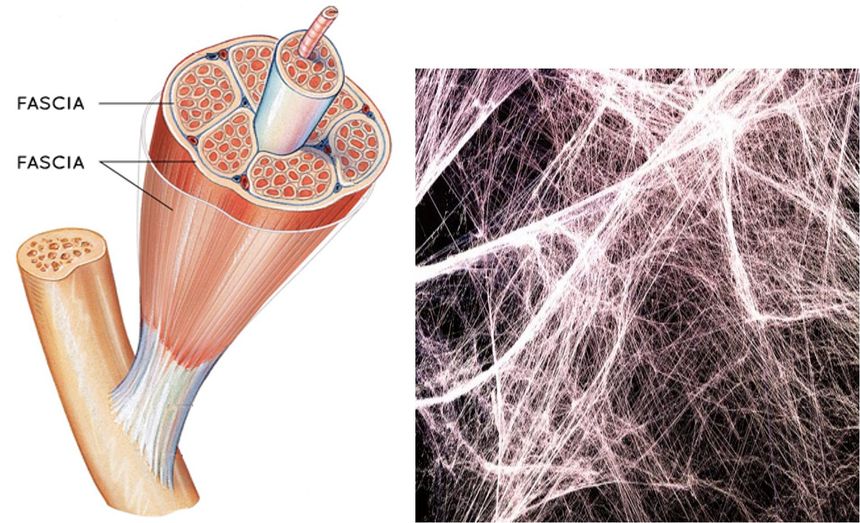
The connective tissue wrapping every muscle, organ, and nerve has been called the body's 'information highway.' Richly innervated, with memory-like properties. Restrictions in fascia often correlate with emotional holding.
Chronic muscle tension is often held emotional material. Wilhelm Reich mapped the body's 'armor' — patterns of muscular tension that defend against feeling, persisting long after the original threat has passed.
A primary site of emotional holding. Connects to the vagus nerve and to our capacity to feel. Unlocking the diaphragm often unlocks stored emotion — sometimes suddenly and profoundly.
Trauma affects gene expression, and these changes can be inherited across generations. Healing work may literally change gene expression. When we heal ourselves, we may be healing patterns that extend back generations and forward to those not yet born.
Presents with chronic anxiety and hypervigilance she cannot explain — a stable, loving childhood with no obvious trauma. Her parents were Holocaust survivors who never spoke about their experiences, but the family atmosphere was permeated by unspoken grief and fear.
During a connected breathing session, Miriam begins to sob. She reports feeling 'grief that is not mine but is also mine.' Afterward, she reports feeling 'lighter than I have ever felt.' Over months of work, her baseline anxiety significantly decreases.
Practitioner Learning: Some of what our clients carry is not theirs alone. Intergenerational trauma is real — it lives in the nervous system, potentially in the cells, passed down through epigenetics and early co-regulation. Healing these patterns heals more than one person.
Advanced Clinical Protocols
Protocol 1: The Hypervigilant Client
Cannot relax, constantly scanning, startles easily, reports anxiety and vigilance.
First 10 min: Meet them where they are. Do not ask them to relax. Match their energy slightly, then gradually lead slower. Talk while walking if they cannot sit still. Use orienting exercises to the room.
Next 15 min: Grounding before breathing. Feet firmly on floor, feel the support. Five senses orientation. Cold water on wrists or face. Only then introduce breath — extended exhale focus only.
Main work: Very gentle connected breathing through nose. Slower than typical (12–15 breaths/minute). Stop frequently to ground. Watch for overwhelm. Celebrate any moments of settling.
Expected timeline: Initial sessions focus almost entirely on safety and grounding. Deep work may not be appropriate until session 8–10 or beyond.
Protocol 2: The Disconnected Client
Flat, numb, reports feeling disconnected from life, history of significant trauma.
First 10 min: Gentle activation. Do NOT try to relax them further. Small movements — wiggle fingers and toes. Gentle attention to sensation. Orienting to colors, shapes, textures in the room.
Next 15 min: Coming into the body. Slightly deeper breathing (not forced). Movement with breath — arms lifting on inhale. Engaging curiosity about sensations. Presence-requiring questions.
Main work: Connected breathing — gentler version. Through nose, slightly fuller than their baseline. Watch for first signs of feeling. Small is significant. Do not rush.
Expected timeline: These clients often take 10–20 sessions before significant shift. Progress may be invisible initially — measure by slight increases in presence, expression, and engagement.
Protocol 3: The Oscillating Client
- Shorter activation periods — build slowly
- Frequent grounding between any intensity
- Pendulation: touch activation, return to ground, touch again — teaching the system it can move and return
- Normalize the oscillation — name it as nervous system behavior, not character
- Celebrate any moments of stability, no matter how brief
- Trust the gradual process — this is long-term work (20+ sessions)
Protocol 4: The Bypasser
Direct confrontation of the defense will not work — they will simply intellectualize your confrontation. Instead, focus on body, not story. 'What do you notice in your body as you say that?' Make space for what is under the calm. Breathing work can activate what talk suppresses — watch for cracks in the defense and welcome any emotion as significant.
Practitioner Self-Regulation: Your Nervous System Journey
Focused on understanding theory, learning techniques, remembering what to do. Your own nervous system may be quite activated during sessions as you try to 'get it right.'
You know the material well enough that it no longer requires all your attention. You can begin to actually be present with clients. Your regulation during sessions improves.
The knowledge has integrated into your being. You are not thinking about what to do — you are responding from embodied knowing. Your regulation is stable even with intense material.
You can hold the most intense material without losing your center. You know your limitations and work within them. You continue to grow and learn while resting in solid competence.
Check each item as you genuinely feel ready to affirm it — not aspirationally, but actually.
Theoretical Knowledge
- I can explain the autonomic nervous system to a client
- I understand Polyvagal Theory's three states
- I can describe the vagus nerve and its function
- I understand HRV and what it indicates
- I can explain the window of tolerance concept
- I understand how breath affects the nervous system
Assessment Skills
- I can recognize ventral vagal presentation
- I can recognize sympathetic activation
- I can recognize dorsal vagal shutdown
- I can identify mixed and blended states
- I can track state changes in real time
- I can use HRV and BOLT data clinically
Clinical Application
- I can match interventions to nervous system states
- I can work at the edge of the window of tolerance
- I know when to ground and when to activate
- I can prevent and respond to overwhelm
- I can titrate appropriately for different clients
Self-Regulation
- I maintain a daily regulation practice
- I can regulate myself before sessions
- I can stay regulated during intense sessions
- I know my own triggers and edges
- I seek appropriate support for my own growth
Trauma-Informed Breath Facilitation
“Trauma is not what happened to you. Trauma is what happens inside of you as a result of what happened to you. — Gabor Maté”
Why Breathwork Is Trauma-Relevant
No pause between breaths can rapidly alter CO₂ levels, producing altered states, tingling, and emotional intensity — sometimes faster than the client is prepared for.
Activate the parasympathetic system, which can cause previously held tension to release — sometimes more than the client is ready to process in that moment.
Can bring a client into contact with body sensations that have been dissociated for years. Even gentle attention to breath can open unexpected doors.
Creates a field effect — the nervous systems of multiple people activating simultaneously can amplify individual experience unpredictably. Requires additional facilitation skill.
The Trauma-Informed Intake
- Trauma history — type, duration, and when it occurred
- Dissociation history — depersonalization, derealization, or gaps in memory
- Current medication — some medications significantly affect nervous system responsiveness
- Cardiovascular history — breathwork changes blood pressure and heart rate; certain conditions require medical clearance
- Mental health history — active psychosis, severe bipolar disorder, and certain personality disorders require modified or contraindicated approaches
- Relationship to the body — chronic pain, body dysmorphia, or eating disorders
- Previous breathwork experience — what happened? Was it supportive or activating?
Red Flags and Contraindications
Active psychosis or recent psychotic episode · Severe dissociative disorders without specialist support · Cardiovascular conditions without medical clearance · Epilepsy without medical clearance · Active suicidality · Unprocessed acute grief less than a few weeks old
Complex PTSD with frequent flashbacks · Active eating disorders · Significant history of dissociation · Pregnancy (some practices are contraindicated) · Clients currently in crisis, even if stable at intake
It means you work differently — with more grounding, slower activation, more frequent check-ins, and close coordination with other practitioners when appropriate. These are calibration guidelines, not closed doors.
Titration: The Core Safety Principle
Pendulation: Moving Between Resource and Activation
- 5 min — Gentle coherent breathing. Resource the system before any activation.
- 10 min — Connected breathing. Activate, touch the edge of the window.
- 5 min — Slow extended exhale breathing. Regulate and return to safety.
- 5 min — Rest with awareness of body sensations. Allow integration.
- Ongoing — Return to resource any time intensity rises above the window. The oscillation itself is therapeutic — it expands the window session by session.
How does your body respond to intentional oscillation between activation and rest?
When Trauma Emerges Mid-Session
Sudden intensification of breath beyond what was guided · Eyes clamping shut or rolling back · Voice becoming childlike or disappearing · Body freezing mid-movement · Client reporting being 'somewhere else' · Sudden flooding of emotion with loss of orientation
1. Slow everything down with your voice and breath
2. Orient to present: name, room, your presence
3. Anchor in body: feet on floor, hand on sternum
4. Reduce breath intensity immediately
5. Stay regulated — you are the reference point
6. Ground first. Process later, if at all.
The Body as Memory System
Stores facts and autobiographical narrative. Conscious, language-based, accessible to rational thought. Stored in the hippocampus. Can be retrieved and retold. Talk therapy works here.
Stores patterns, skills, and survival responses. No narrative form — lives in the body as automatic pattern. How to freeze when you smell a particular cologne. How to brace before impact. Trauma is predominantly stored here. Words do not reach it. The body does.
The Role of Fascia in Emotional Memory
Approach fascial work slowly and with attention. Stay in verbal contact during bodywork. Treat unexpected emotional responses as information, not problems. Never rush a release. Follow the tissue, not your agenda.
The Diaphragm: The Emotional Center
Tremoring and the Discharge Cycle
Stay regulated. Do not react with concern. Normalize it verbally: 'This is your nervous system releasing — you can let it happen.' Do not try to stop it. Allow it to complete its natural cycle. Track it — when it begins to slow on its own, it is completing.
Give the client time to rest and orient before speaking. Supported tremoring leaves clients feeling significantly lighter and more present. Tremoring interrupted by practitioner anxiety leaves unfinished charge in the system.
Where in your own body do you most consistently hold tension? Consider that place as a site of intelligence, not dysfunction.
What has that holding been protecting? What might it need in order to begin releasing?
Notice whether this place changes after a breathing practice, movement, or a difficult conversation that went well.
Nervous System Across the Lifespan
The First Three Years and Attachment
Caregiver consistently attuned and available. The child learns: 'When I am distressed, help will come.' Produces a wider window of tolerance, better self-regulation, and greater capacity for relationship in adulthood.
Caregiver inconsistently available. The child learns: 'I must escalate to be sure I am seen.' Produces hypervigilance to relationship, difficulty with self-regulation, often chronic sympathetic activation in adulthood.
Caregiver consistently unresponsive to emotional need. The child learns: 'I am on my own.' Produces self-sufficiency as defense, emotional suppression, and often disconnection from body signals in adulthood.
Caregiver is simultaneously source of comfort and fear. No coherent strategy is possible. Most strongly associated with complex trauma, dissociation, and very narrow window of tolerance.
Adolescence: The Second Window
Adult Capacity and the Aging Nervous System
Neuroplasticity is among the most replicated findings in neuroscience. Attachment patterns can be reworked through corrective relational experiences. Window of tolerance can expand through practice. Vagal tone can improve at any age. This is the foundation of hope in this work.
Vagal tone tends to decrease with age, resulting in lower HRV and reduced stress resilience. Recovery time from acute stressors lengthens. Work may need to be gentler and more gradual. But many older clients bring decades of self-knowledge that gives them extraordinary capacity. Never assume based on age.
Parents with unresolved trauma transmit their nervous system states to their children through the same co-regulation processes that normally build healthy regulation. A depressed parent provides a dorsal vagal field as the primary relational environment. An anxious parent creates chronic sympathetic activation in the household. This is not blame — it is information. When a client's nervous system makes no sense in the context of their stated history, the history may extend further back than their own biography.
The Complete Observational Framework
The Five Channels of Assessment
Rate, depth, location, quality. Nasal or oral? Thoracic or diaphragmatic? Does the exhale complete or get cut short? Is there holding or restriction? The breath tells you the state of the entire autonomic system in real time — before the client says a word.
Facial expression, skin tone, muscle tension around eyes and jaw. Voice prosody, pace, volume. The social engagement system — controlled by the ventral vagal pathway — expresses itself through these channels. Reading them gives you direct access to vagal state.
Postural tone, weight distribution, movement quality. Is stillness relaxed or frozen? Is movement fluid or guarded? Where does the body compress, brace, or collapse? These patterns are the body's procedural history made visible.
Not just what the client says, but how. Do they speak in sensations or abstractions? Present or past tense when describing current experience? Do their words match their body? Mismatch between verbal content and body state is one of the most clinically important signals you will learn to track.
How does the client relate to you? Do they check your face? Are they performing or present? The quality of the relational field tells you about attachment pattern, trust, and the client's capacity for co-regulation. This is the attachment pattern made visible in real time.
Four Common Misreadings
A client who sits quietly and says they feel fine may be regulated — or dissociated. Regulated clients have warmth, responsiveness, and easy access to both thought and feeling. Dissociated clients have a flat quality — calm on the surface with an absence beneath. Learn to feel the difference.
A client who arrives agitated or tearful is not having a crisis. They are showing you their state. This is information, not a problem to fix immediately. Match them first. Regulate from there.
Clients who do everything you ask, never push back, and always report positive experiences may be showing you a fawn response — pleasing as protection. True progress looks less uniform. It includes moments of resistance, confusion, and genuine encounter.
Some clients shift rapidly. Others require months before significant shift occurs. Both are normal. Slow, steady expansion of the window of tolerance is often more durable than rapid dramatic release.
Documentation and Case Notes
Integration and Rest: Why What Happens After Matters
The Neuroscience of Integration
Adequate sleep (memory consolidation occurs during deep sleep and REM) · Reduced stimulation — media and cognitive demands compete with the processing the body needs · Gentle movement — walking, light yoga · Journaling without forcing conclusion · Nature contact · Adequate nutrition and hydration
Returning immediately to high cognitive demands or stressful environments · Alcohol (suppresses REM sleep and the processing that occurs during it) · Social overstimulation · Premature analysis of what happened · Intense physical training within 24 hours
What to Give the Client Before They Leave
- A brief description of what integration is and why it matters
- Specific guidance for the next 24–48 hours (less is more)
- A simple anchoring practice — coherent breathing, a body scan, or a specific phrase
- Permission to feel whatever arises without needing to understand or fix it
- Your availability if something unexpected and difficult arises
A session without integration guidance is a meal without digestion. The food was eaten but not absorbed.
Occasionally, clients experience intensification in the days following a significant session — intense unexpected emotion, vivid dreams, temporary physical symptoms, or a temporary resurgence of old patterns. This is not damage. It is a sign that significant material was accessed and the system is processing it. Clients who know this in advance are far more able to tolerate the process. Those who are unprepared may interpret these responses as harm and not return. Follow up within 48 hours after significant sessions.
The Real Outcome: Long-Term Change
Gradually expanding capacity for arousal without dysregulation. The client can handle more without flooding or collapsing.
The slow recalibration of what the nervous system reads as safe. The alarm system becomes more accurate.
Patterns of self-regulation stored in the body. The client no longer has to think about regulating — it begins to happen automatically.
Your voice, your presence, carried into their daily life. 'I can hear you in my head when I'm stressed.' This is the real outcome of the work.
Return to your answers from the beginning of this part. What has shifted? What do you now understand that you did not before?
Rate yourself again (1–5):
- I can read someone's nervous system state from their body and voice
- I understand why safety must come before deep work
- I understand how my own nervous system affects my clients
- I know how to match an intervention to a nervous system state
- I can stay regulated while holding intense material in a session
- I understand the difference between catharsis and integration
What was the most important insight for you in this part?
How will this science change how you work with clients?
What aspect of your own nervous system do you most want to develop?