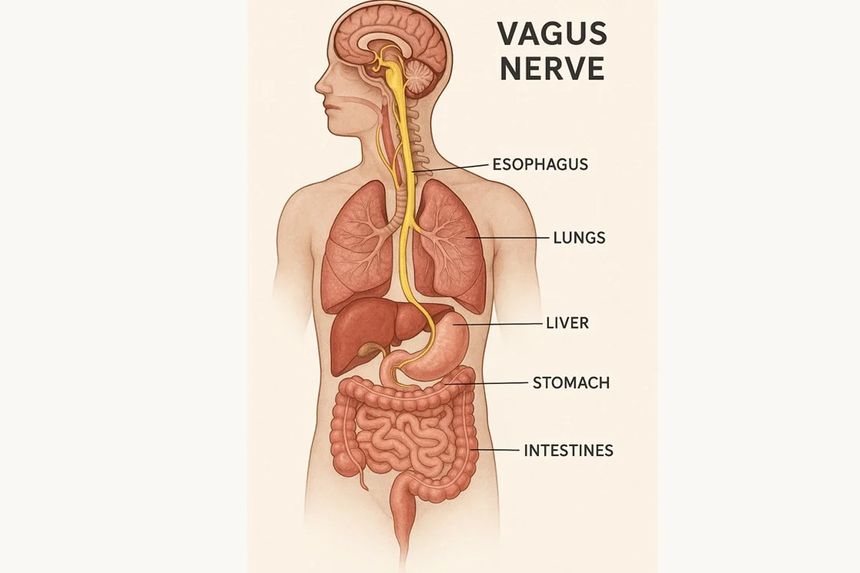
The Vagus Nerve: The Wandering Healer
This ratio is crucial. It means that changing the body's state — through breath, movement, temperature, or touch — directly informs the brain about safety or danger. This is why bottom-up approaches (working with the body) are often more effective than top-down approaches (working with thoughts) for nervous system regulation.
How to Tone the Vagus Nerve
When you exhale longer than you inhale, you engage the vagal brake. Inhale 4 counts, exhale 8 counts. This directly stimulates the vagus on the exhale phase.
The vagus passes through the throat and vocal cords. Humming, chanting, and singing vibrate these muscles and stimulate the vagus. This is why chanting appears in every major spiritual tradition.
Cold water on the face triggers the 'dive reflex' — an ancient mammalian response that activates the vagus. Even splashing cold water on the face creates measurable vagal stimulation.
Warm, attuned relationships literally tone the vagus through the Social Engagement System. Attuned eye contact, warm conversation, and physical affection all stimulate the ventral vagal pathway.
Vigorous gargling activates the muscles of the throat that are innervated by the vagus. Gargle water vigorously for 30–60 seconds until your eyes water slightly — this indicates vagal activation.
Any form of slow, diaphragmatic breathing stimulates the vagus. The diaphragm has direct vagal connections, and deep belly breathing activates them throughout every breath cycle.
- 1Extended exhale: Inhale for 4 counts through the nose, exhale for 8 counts. Continue for 3 minutes. Notice the shift toward calm.
- 2Humming: Hum continuously for 1 minute on a single breath where possible. Feel the vibration in your chest and throat.
- 3Cold water: Optional — splash cold water on your face or hold a cool cloth to your cheeks for 30 seconds. Notice the immediate state shift.