The Practitioner's Seeing
Learning to read what lies beneath — the art that separates a technician from a healer
The Cocoon Method — Practitioner Training Manual
Contents
- 01A Letter From Nina
- 02Introduction: Beyond the Surface
- 03Framework: Why Four Lenses
- 04Chapter One: The Body Lens
- 05The Five-Point Body Assessment
- 06Clinical Framework: Green, Yellow, and Red Flags
- 07Chapter Two: The IFS Lens
- 08Chapter Three: The Astrological Lens
- 09Chapter Four: The Energetic Lens
- 10Chapter Five: Common Presenting Issues
- 11Extended Case Studies: Seeing in Practice
- 12Clinical Reference: The Assessment Protocol
- 13Clinical Skill: Tracking and Titration
- 14Ethics: The Ethics of Seeing
- 15Part 6 Completion
A Letter From Nina
Dear Practitioner in Training,
You have learned the science. You understand the nervous system, the brain, the anatomy of breath. Now comes something different. Now comes the art. Learning to see.
I remember the moment I understood this. A woman came to me with chronic shoulder pain. She had seen doctors, physical therapists, massage therapists. Nothing helped for long. As she spoke, I watched her body. When she mentioned her mother, her shoulders rose. When she spoke of her father, they dropped and collapsed. Her shoulders were holding a story her words were not telling. We never talked about the pain directly. We worked with what lived beneath. The pain released when the grief and the anger found their expression. Her body had been holding what her heart could not speak.
This part gives you multiple lenses. Not because any one lens is wrong. Each one is true. And each one is partial. Together they show you what no single lens ever could. When you can truly see someone, you know how to help them. Not from technique. From understanding.
With deep respect for the art of seeing,
Introduction: Beyond the Surface
Before You Begin
Rate yourself honestly before reading. Return after completing Part 6 to see how far you have come.
The Four Lenses
I can read nervous system state from body cues alone, before anyone speaks
I can identify Manager, Firefighter, Exile, and Self energy in a session
I understand the four elements and can observe elemental balance in a person
I know all seven chakras and what blocked or excessive energy looks like in each
I can see beneath presenting issues to understand what actually drives them
I understand spiritual bypass and how to work with it compassionately
I can track a client's state continuously and titrate intensity throughout a session
Self-Awareness
I have applied all four lenses to myself and know my dominant and deficient areas
I practise regular self-observation and can track my own nervous system state
““Whatever they come with, we do not judge. We want to know how to go deeper into the full truth, to go beyond the mind and what we think we or they know.””
What Clients Bring vs. What They Need
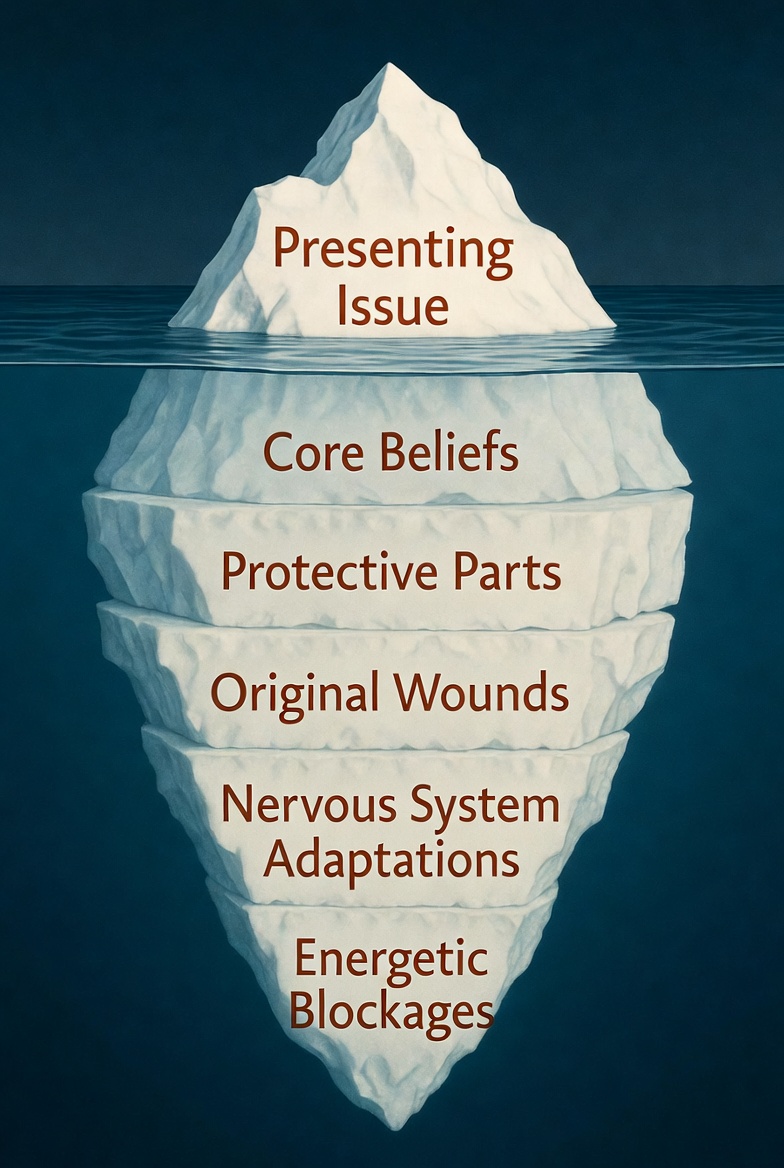
Every client arrives with a reason they booked a session. They say something like: They might say: "I'm anxious all the time." "I feel stuck." "I keep sabotaging everything." These are real. And they are almost never the actual issue. The presenting issue is the smoke. Your job is to find the fire.
The Iceberg Principle — the presenting issue is only what shows above the waterline. Your work is the whole structure beneath.
What Lies Beneath the Surface
Core Beliefs "I'm not safe." "I'm not enough." "I don't belong." These core beliefs, usually formed very early, generate the symptoms that bring people to your door. Protective Parts Protective parts work hard to keep pain away. Even when their strategies create more suffering than they prevent. A part that numbs. A part that controls. A part that hides. Every pattern is trying to solve something. Every pattern is serving a purpose. The symptom is not the problem. It is the solution to something deeper.
Nervous System Adaptations The body learned to respond to threat in a particular way. Fight. Flight. Freeze. Fawn. Collapse. The nervous system is still responding to danger that may be long past. The Soul's Deeper Calling Sometimes the symptom is a guide. The breakdown is calling for a breakthrough. The crisis is calling for a change. What is the soul asking for that the personality cannot yet hear?
When you only work with the tip of the iceberg, you get temporary relief. When you see and work with the whole structure beneath, real transformation becomes possible.
Framework: Why Four Lenses
We use four lenses in the Cocoon Method. Each one is true. And each one is partial. Together they show you the whole person. Together they show you something no single lens ever could.
An Example: Chronic Anxiety Through All Four Lenses
Body Lens Shallow breathing, tight diaphragm, elevated shoulders, sympathetic dominance, scattered eye contact. Hyperactive nervous system stuck in fight-or-flight. IFS Lens A hypervigilant Manager constantly scanning for threat, protecting terrified Exiles who learned the world is dangerous. A young part frozen in fear.
Elemental Lens Air dominance (overthinking). Earth deficiency (ungrounded, no stability). Fire may be excess. Water may be blocked — cannot feel through to the fear beneath. Energetic Lens Overactive third eye (constant thinking). Blocked root chakra (no ground, no safety). Energy moves up and out, nothing settling down. Solar plexus weak.
Each lens is accurate. Together, they reveal the complete picture of this human being — not a diagnosis, not a label, but a living soul with patterns that make perfect sense once you understand them.
The Nine Expert Perspectives on Seeing
The Neuroscientist Assessment starts with the nervous system. Is the client regulated, activated, or shut down? That one read tells you what is possible in this session. You cannot do deep work with a dysregulated nervous system. The Psychologist Assessment shows how someone protects and how they attach. The reason they came only makes sense when you know where it came from. Understanding creates attunement.
The TCM Doctor In TCM, seeing includes reading the face, tongue, pulse, and the quality of chi. Where is it depleted? Where is it stuck? The organ systems and meridian flow tell a complete story. The Ayurvedic Practitioner In Ayurveda, assessment looks at the person's natural constitution and their current imbalance. A vata type needs a completely different approach than a pitta or kapha type. Context is everything. Ayurveda gives you a lens for this.
The Naturopath The naturopath looks at everything. Digestion. Sleep. Energy. Elimination. Physical symptoms often have emotional roots. Emotional patterns often have physical contributors. Everything connects. The Energy Healer Seeing includes the subtle body. Where is the energy field contracted? Where is it leaking? The energy body often reveals what words cannot.
The Spiritual Teacher The spiritual teacher sees the soul's journey. What is this person here to learn? The crisis may be a calling. The wound may hold the gift. Suffering is not random. It points somewhere. Not as a way to bypass pain, but as a wider context for it. The Breathworker As breathworkers, we read the breath. Where does it go? Where does it stop? The breath is the bridge between the conscious and the unconscious. Where breath is restricted, life force is restricted.
The Astrologer sees the natal chart as a map of the soul's journey. Planetary placements reveal inherent tendencies, challenges, and gifts. Transits show timing of growth opportunities. The chart shows not fate, but potential.
The Art of Not Knowing
Here is the paradox. The lenses give you information. But the art is in holding that information lightly. You form a hypothesis, not a diagnosis. You stay curious, even when you think you understand. You stay curious even when you think you understand. The moment you believe you have figured someone out, you stop seeing them. You start seeing your concept of them.
What Multi-Lens Vision Provides
Deeper Understanding You see WHY someone is the way they are, not just WHAT they present with. This changes everything. Understanding creates compassion. And compassion opens the door. Precision in Intervention You can work with the actual root, not just the symptom. When you see that the anxiety is protecting something more tender underneath, you know not to try to eliminate it. You need to heal what it guards.
Pattern Recognition You start to see how patterns repeat across different clients. The father wound. The abandonment pattern. The perfectionist who cannot rest. You recognise the template while seeing each person's unique version of it. The perfectionist Manager. You recognise the template while still seeing each person's completely unique expression of it. Resistance Navigation You understand what the resistance is protecting. So you can work with it instead of against it. Resistance is not the enemy. It is information. It shows you exactly where the vulnerability lives. It points you directly to where the vulnerability lives.
Compassion without naivety: You see the protective function of even destructive patterns. The addiction is trying to help. The control is trying to keep safe. This is not excusing harm — it is understanding it.
The Practitioner's Responsibility
What Your Seeing Is NOT For Your seeing is not for judging. Not for diagnosing unless you are clinically licensed. Not for telling people who they are, or for showing off what you can perceive. Your seeing is in service of their healing. Not your ego. What Your Seeing IS For Your seeing is for understanding. For compassion. For knowing how to meet someone where they are. The client should feel seen. Not exposed. Not analysed. Not figured out. Held, not analysed. Understood, not figured out.
Daily Life Laboratory — Developing Your Seeing
In public spaces: sit somewhere and observe without judgment. Notice nervous system states in strangers. Posture, breath, energy. Practice seeing without labelling.
In conversations: notice what the body is saying while words are being spoken. Track where people look when discussing different topics. Notice when words and body do not match.
In yourself: pause multiple times daily and observe. What is your nervous system state right now? Which parts are active? What is your energy doing?
With media: Watch interviews with sound off. Read body language only. What do you see that words would hide?
Partner up. Round 1: Person A sits and is present. Person B observes and notes nervous system state, breath, posture, energy, then shares non-judgmentally. Person A reflects: what resonated, what surprised you? Switch. Round 2: Person A shares something mildly challenging while Person B tracks body shifts during the sharing. Group share: what was hardest to track?
What do you typically notice first when meeting someone new?
What do you tend to miss?
Think of someone you know well. What does their body typically communicate?
How might you practise developing your seeing this week?
Chapter One: The Body Lens
““The body never lies.” — Martha Graham”
The body lens comes first because the body is always honest. Words can be crafted. Stories can be rehearsed. The body simply is. Before a client speaks a single word, you already know their nervous system state, how safe they feel, and where they hold their patterns.
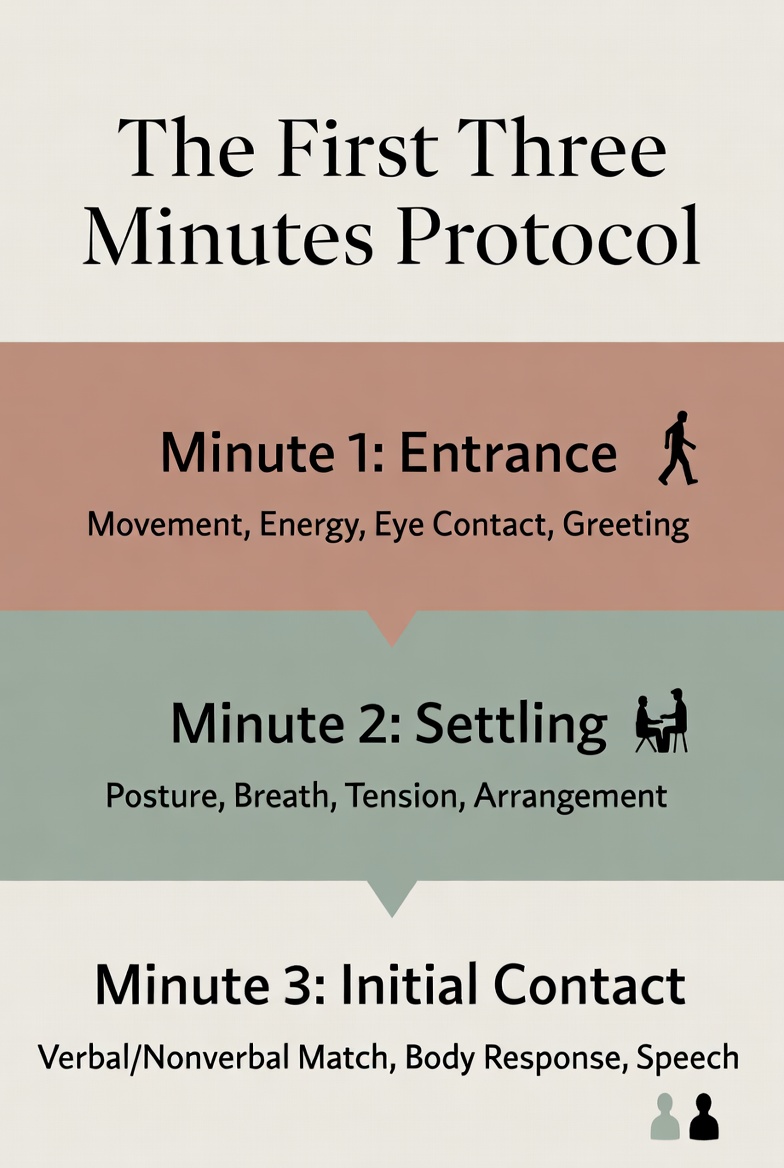
The First Three Minutes Protocol
The moment your client walks through the door, their body is already telling you everything. Develop the habit of watching for the first three minutes before a single therapeutic word is spoken.
The First Three Minutes Protocol — a systematic window of observation before a single therapeutic word is spoken.
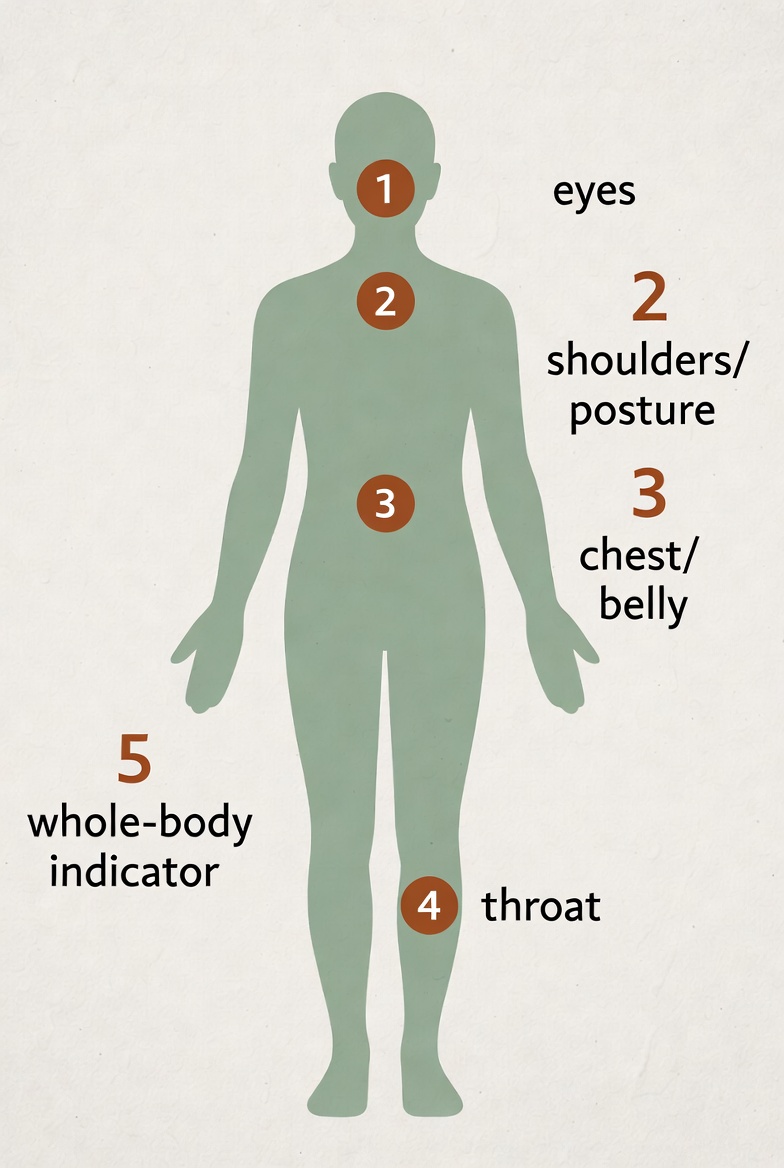
Use this framework for reading the body. At first, move through each point one by one. With practice, you will read all five simultaneously, without thinking. That is the goal.
The Five-Point Assessment — eyes, posture/shoulders, chest/belly (breath), throat (voice), and whole-body movement quality.
Point One: The Eyes
The eyes tell you more than anything else. Before a single word, the eyes reveal the nervous system state. Learn to read them first.
Present Eyes Present eyes: they look at you and actually see you. Natural tracking. Life and warmth. Available for real connection. This is ventral vagal. Safety. This person is here. Scattered Eyes Scattered eyes: darting, unable to settle. Constantly scanning the room. Quick movements. Hypervigilant. This is the nervous system looking for threat. Sympathetic activation.
Glazed Eyes Glazed eyes: looking through you, not at you. Fixed. Distant. "Nobody home." Flat. Lifeless. This is dissociation. Dorsal vagal. The person is not fully in the room. Avoiding Eyes Avoiding eyes: cannot meet yours. Brief contact then immediately away, usually downward. This often carries shame, old relational pain, or a deep fear of being truly seen.
Intense Eyes Intense eyes: staring, unblinking. Penetrating. Can feel almost aggressive. Demanding connection. This can indicate hypervigilance, control, or sometimes dissociation in freeze. Pupil Dilation Watch the pupils. Dilated and large: arousal, fear, excitement. Small and constricted: calm. Pupil changes during the session are real-time signals. They show you what words often hide.
Point Two: The Posture
Posture is the body's long-term story. Not just today. Built over years. It shows you the nervous system's baseline organisation.
Open and Grounded Open and grounded: weight settled into the chair. Spine easy, not rigid. Shoulders down. Chest open. Head resting naturally. This is safety. Self-possession. Ventral vagal. Tense and Guarded Tense and guarded: shoulders up toward the ears. Arms held close. Leaning away. Chest protected. Jaw tight. The body is bracing. Something does not feel safe. This is not feeling safe. Sympathetic activation.
Collapsed Collapsed: sunken chest. Head forward. Rounded shoulders. Low, heavy energy. As if something invisible is pressing down. This is dorsal vagal. Depression. Shame. Resignation. Dorsal vagal. Depression, resignation, or chronic shame. Rigid Rigid: military-straight spine. Tight, held, controlled. No natural movement. Braced. This is control. Often fear of letting go. Armoring that has been in place for a long time.
Point Three: The Breath
Breath is the nervous system made visible. Every breath is a live signal. It is the most reliable real-time indicator of what is actually happening inside.
Full and Easy Full and easy: the belly moves visibly. Ribs expand laterally. No strain. Natural rhythm. Soft and quiet. This is regulation. Safety. Parasympathetic tone. This person can breathe. Shallow and Fast Shallow and fast: chest only, no belly movement. Over 15 breaths per minute. Visible effort. May be audible. Sympathetic activation. Anxiety. Hyperarousal.
Barely Perceptible Barely perceptible: almost invisible. Very shallow and very slow. As if the breath is trying to take up as little space as possible. The body is hiding. This is dorsal vagal. Freeze. Severe restriction. Hiding. Reverse Breathing Reverse breathing: the belly pulls in on the inhale instead of expanding. Upside down. This usually points to deep, chronic holding. The breath has been running backwards for a long time. Very common in trauma survivors.
Point Four: The Voice
The voice carries nervous system information before meaning does. Listen beyond the words. Tone, pace, variation, quality. All of it speaks.
Melodic and Varied Melodic and varied: natural rhythm. The tone moves. Natural pauses. Expressive. The social engagement system is online. The person is present with you. Fast and Pressured Fast and pressured: rapid speech. No pauses. Hard to interrupt. Jumping between topics. Sympathetic activation. Anxiety. Something is running, even if the person does not know it.
Flat and Monotone Flat and monotone: little variation. Slow, lifeless quality. Words seem to cost something. Disconnected from what is being said. Dorsal vagal. Depression. Dissociation. Childlike Childlike: higher pitch than you would expect. A younger quality in the tone or the phrasing. Pay attention when you hear this. A young part may be very close to the surface.
Point Five: Movement Quality
How someone moves tells you how they live in their own body. And how their nervous system lives in them.
Fluid and Coordinated Fluid and coordinated: easy, natural movements. Body parts working together. Graceful without trying. This is what embodiment looks like. The person is at home in their body. A nervous system that feels at home in its body. Restless Restless: constant small movements. Fidgeting, adjusting, unable to be still. This is anxiety. Sympathetic activation. Trauma energy that has nowhere to go seeking discharge.
Jerky and Tense Jerky and tense: stiff, controlled movements. Body parts moving separately rather than together. Robotic quality. Holding, control, disconnection from the body. Frozen Frozen: very still. Almost no movement. But this stillness does not feel peaceful. It feels held. Braced. This is freeze. Dissociation. The quiet that is actually suspension.
The Five-Point Body Assessment
Use this framework for reading the body. At first, move through each point one by one. With practice, you will read all five simultaneously, without thinking. That is the goal.
The Five-Point Assessment — eyes, posture/shoulders, chest/belly (breath), throat (voice), and whole-body movement quality.
Point One: The Eyes
The eyes tell you more than anything else. Before a single word, the eyes reveal the nervous system state. Learn to read them first.
they look at you and actually see you. Natural tracking. Life and warmth. Available for real connection. This is ventral vagal. Safety. This person is here.
darting, unable to settle. Constantly scanning the room. Quick movements. Hypervigilant. This is the nervous system looking for threat. Sympathetic activation.
looking through you, not at you. Fixed. Distant. "Nobody home." Flat. Lifeless. This is dissociation. Dorsal vagal. The person is not fully in the room.
cannot meet yours. Brief contact then immediately away, usually downward. This often carries shame, old relational pain, or a deep fear of being truly seen.
staring, unblinking. Penetrating. Can feel almost aggressive. Demanding connection. This can indicate hypervigilance, control, or sometimes dissociation in freeze.
Watch the pupils. Dilated and large: arousal, fear, excitement. Small and constricted: calm. Pupil changes during the session are real-time signals. They show you what words often hide.
Point Two: The Posture
Posture is the body's long-term story. Not just today. Built over years. It shows you the nervous system's baseline organisation.
weight settled into the chair. Spine easy, not rigid. Shoulders down. Chest open. Head resting naturally. This is safety. Self-possession. Ventral vagal.
shoulders up toward the ears. Arms held close. Leaning away. Chest protected. Jaw tight. The body is bracing. Something does not feel safe. This is not feeling safe. Sympathetic activation.
sunken chest. Head forward. Rounded shoulders. Low, heavy energy. As if something invisible is pressing down. This is dorsal vagal. Depression. Shame. Resignation. Dorsal vagal. Depression, resignation, or chronic shame.
military-straight spine. Tight, held, controlled. No natural movement. Braced. This is control. Often fear of letting go. Armoring that has been in place for a long time.
Point Three: The Breath
Breath is the nervous system made visible. Every breath is a live signal. It is the most reliable real-time indicator of what is actually happening inside.
the belly moves visibly. Ribs expand laterally. No strain. Natural rhythm. Soft and quiet. This is regulation. Safety. Parasympathetic tone. This person can breathe.
chest only, no belly movement. Over 15 breaths per minute. Visible effort. May be audible. Sympathetic activation. Anxiety. Hyperarousal.
almost invisible. Very shallow and very slow. As if the breath is trying to take up as little space as possible. The body is hiding. This is dorsal vagal. Freeze. Severe restriction. Hiding.
the belly pulls in on the inhale instead of expanding. Upside down. This usually points to deep, chronic holding. The breath has been running backwards for a long time. Very common in trauma survivors.
Point Four: The Voice
The voice carries nervous system information before meaning does. Listen beyond the words. Tone, pace, variation, quality. All of it speaks.
natural rhythm. The tone moves. Natural pauses. Expressive. The social engagement system is online. The person is present with you.
rapid speech. No pauses. Hard to interrupt. Jumping between topics. Sympathetic activation. Anxiety. Something is running, even if the person does not know it.
little variation. Slow, lifeless quality. Words seem to cost something. Disconnected from what is being said. Dorsal vagal. Depression. Dissociation.
higher pitch than you would expect. A younger quality in the tone or the phrasing. Pay attention when you hear this. A young part may be very close to the surface.
Point Five: Movement Quality
How someone moves tells you how they live in their own body. And how their nervous system lives in them.
easy, natural movements. Body parts working together. Graceful without trying. This is what embodiment looks like. The person is at home in their body. A nervous system that feels at home in its body.
constant small movements. Fidgeting, adjusting, unable to be still. This is anxiety. Sympathetic activation. Trauma energy that has nowhere to go seeking discharge.
stiff, controlled movements. Body parts moving separately rather than together. Robotic quality. Holding, control, disconnection from the body.
very still. Almost no movement. But this stillness does not feel peaceful. It feels held. Braced. This is freeze. Dissociation. The quiet that is actually suspension.
Clinical Framework Green, Yellow, and Red Flags
Clinical Framework: Green, Yellow, and Red Flags
After you observe, you make a quick read. Not to label. To know what this session needs. How much support. How much containment. How deep you can go today. The assessment informs everything that follows.
Green — Ready to Go Deeper
Generally regulated nervous system. Can make and sustain eye contact. Breathing accessible and can shift with guidance. Some body awareness present. Curious about the process. Can resource (find calm). Stable enough to tolerate activation.
Yellow — Proceed With Care
Nervous system activated or collapsed. Difficulty with sustained eye contact. Restricted breathing that does not easily shift. History of significant trauma. Limited body awareness. Strong protector parts very active. History of dissociation.
Red — Adapt or Refer
Severe uncontrollable dissociation. Active psychosis or break from reality. Current suicidal ideation with plan. Recent psychiatric hospitalisation. Unable to establish any regulation. Medical contraindications. Under influence of substances.
Red flags do not mean “do not help.” They mean adapt your approach or refer to an appropriate professional. Knowing your scope of practice is wisdom, not limitation.
The Incongruence Signal
One of the most important things to notice: does what they say match what their body shows? Incongruence is not lying. It is protection. A part is managing the presentation while another part holds a different truth. Both are real. Your job is to help them meet each other.
Example: “I'm fine, really.” "I'm fine, really. I've dealt with all that." Body shows: tight jaw, held breath, elevated shoulders, averted gaze. A part is presenting "fine" while the body holds something very different. Do not confront directly. Ask: "What do you notice in your body as you say that?" Example: “I don't feel anything.” "I don't feel anything." Body shows: rapid shallow breathing, tension in the hands, restless movement. There is activation. The person just cannot feel it. The numbness is itself a Firefighter. Feeling is present. Perception is not. The numbness is a Firefighter, not an absence.
Anger in sessions — two types to know: Firefighter anger activates fast, burns hot, and the client cannot identify what sits beneath it. Exile anger arrives more slowly, often with tears, and has the quality of something very old finally being said. Firefighter anger: slow down and ground first. Exile anger: open space rather than contain it.
Body Reading Case Examples
Rigid posture. Controlled. Breathing almost invisible. Jaw tight enough to see the muscles working. Precise, clipped speech. Nothing unconscious happening anywhere. The body is armoured.
Upper body elevated, lower body collapsed. Energy floating upward. Breath only in the upper chest. Eye contact too open, ungrounded. Slightly spacey. This is often spiritual bypass. The upper chakras are open. The lower ones are not. Slightly spacey or uncontained.
In groups of three. Round 1: Person A is observed (sits naturally). Person B reports what they see across all five points. Person C notes. 5 minutes. Person A gives feedback: what resonated? What did you miss? Round 2: rotate — Person A shares something mildly emotional while Person B tracks shifts across the five points. Round 3: rotate again so everyone has been observed twice. Group share: what was most challenging to track?
What does your own body typically communicate to others?
Apply the Five Points to yourself right now. What habitual pattern does your body hold?
How might a practitioner read you?
A client comes with chronic back pain. No one has been able to fix it. The body shows: a posture of protection. But also a collapsed chest. Rounded shoulders. Shallow breath. Sadness on the face. Shallow breathing. Face shows tension but also sadness. Voice strained. Eyes ask for help. What you might hypothesise: the pain is holding emotional content. The collapsed posture suggests depression or grief. The back (support) may relate to feeling unsupported in life. The body is communicating what words have not. Approach: never dismiss the physical reality. Explore what was happening when the pain began. Notice what emotions arise when the pain is discussed. Approach: Never dismiss the physical reality of pain. Explore what was happening in life when the pain began. Notice what emotions arise when the pain is discussed. The body chose this location for a reason.
Daily Self-Practice — Three Times Daily
Three times a day, pause and check yourself using all five points. What is your nervous system state right now? What breath pattern are you in? Where is there tension? How fluid or frozen is your movement? What is your voice like? You cannot read others clearly when you cannot read yourself. This practice keeps your instrument calibrated.
Chapter Two: The IFS Lens
““There are no bad parts.” — Richard Schwartz”
IFS was developed by Richard Schwartz. It gives you a map of the inner world. Every person has multiple parts. Sub-personalities, each with their own feelings, beliefs, and way of seeing the world. This is not pathology. This is how humans are built. When you can see which parts are active, everything changes. (This is covered in full depth in Part 7. Here we focus on recognising parts in your assessments.)
A note on shame — the most protected exile: Shame is almost always an exile — the most hidden, most guarded part of the internal system. The managers working to keep us performing and proving our worth are working overtime to make sure that exile is never exposed. Work patiently with the protectors first. The sequencing — protectors first, always — is not optional with shame work.
The Parts Map
Common Manager Parts
The Controller The Controller: must be in charge. Difficulty delegating or trusting others. Plans obsessively. Fear of chaos or surprise underneath. The Perfectionist The Perfectionist: nothing is ever good enough. Harsh inner critic. Drives achievement at any cost. Fear of failure and rejection underneath.
The People-Pleaser The People-Pleaser: focused entirely on others' needs and approval. Difficulty saying no. Knows what everyone needs except themselves. Fear of abandonment underneath. The Achiever The Achiever: worth comes from doing. Constant productivity. Cannot rest. Fear of worthlessness underneath. Often exhausted but incapable of stopping.
Respect — they have worked hard. Recognition of their protective function. Safety before asking them to relax. Partnership, not opposition. The Managers will only step aside when they trust you are not going to let everything collapse. Honour them first. Always.
Common Firefighter Parts
The Numb-er The Numb-er: shuts down feeling. Creates emotional flatness. May use substances, food, or screens. "I just don't feel anything." The Dissociator The Dissociator: leaves the body when things get too much. "Checks out." May not remember periods of time. Creates distance from unbearable experience.
The Rager The Rager: explosive anger. Burns everything down. Creates distance through destruction. May regret it afterward but cannot stop in the moment. The Saboteur The Saboteur: destroys good things before they can be lost. Creates the rejection before it can happen. Proves the belief that good things do not last.
The Most Important Thing About Firefighters Never shame the behaviour. The Firefighter is trying to help. It is doing the only thing it knows how to do to protect an exile from overwhelming pain. When you shame a Firefighter, the system closes down further. When you understand it, it can eventually relax — but only when the exile's pain is addressed.
To be witnessed, not fixed. Compassion, not pity. To feel they are not alone with the pain. Eventually: unburdening (the full IFS protocol is in Part 7). The exile has been alone for a very long time. Your patient, steady presence is what it has been waiting for.
Common Parts Patterns in Practice
The Manager-Heavy System The Manager-Heavy System: controlled, competent, together. Difficulty accessing emotion. Strong inner critic. Often high-achieving but exhausted. The work: build trust, honour the Managers, gradual access to what they protect. The Firefighter-Heavy System The Firefighter-Heavy System: struggles with behaviours they cannot control. Addiction, numbing, dissociation. Shame about these behaviours. The work: no shame. Understand that the Firefighters are trying to help. Find and heal the exiles they protect.
The Exile-Flooding System The Exile-Flooding System: easily overwhelmed by emotion. Parts seem to take over. Very little space between trigger and flood. The work: more grounding, more resources. Build capacity before going into exile territory. The Disconnected System "I don't know what I feel. I don't have parts." High dissociation from inner experience. The work: very gradual. Build interoception first. Help them begin to sense the internal landscape. Build interoception first. Help them begin to sense the internal landscape.
In groups of three. Round 1 (Manager): Person A shares about an area of life where they “have it together.” Persons B and C identify Manager parts they hear and see. Round 2 (Firefighter): Person A shares about a behaviour they wish they did not do. Persons B and C identify the Firefighter quality. Round 3 (Self): Person A speaks about the same topic from Self perspective — “I notice a part of me...” Persons B and C track when Self leads. Rotate so everyone has been Person A.
What Manager parts do you recognise in yourself?
What are they protecting?
What Firefighter parts do you have?
What exiles might they be protecting?
When do you feel most in Self — calm, curious, compassionate, connected?
More Manager Parts
The Analyzer / Intellectualizer Lives in the head. Explains and analyses everything. Avoids feeling by understanding. Fear of overwhelming emotion underneath. In session: gives you a theory of their own psychology. Brilliant and defended. The Caretaker Takes care of everyone else. Neglects own needs. Identity through helping. Fear of own needs being too much underneath. In session: may ask how you are, worry about taking up too much time. Constantly giving, rarely receiving.
More Firefighter Parts
The Self-Harmer Hurts the body to manage emotional pain. Physical pain can feel easier than emotional pain. Creates a sense of control or release when overwhelmed. In session: approach with deep compassion. The Firefighter is protecting something unbearable. The Addict Seeks relief through substances or behaviours. Compulsive quality. Temporary fix, long-term cost. Will take over when exile pain threatens to overwhelm. The addiction is not the problem — it is the solution to a problem you have not yet found.
Signs an Exile Is Near the Surface
Sudden activation in session. Tears that surprise the client. Shame flooding. Regression in language or posture. Protectors working harder than usual — increased intellectualising, checking out. The voice shifting younger. A quality of something very old being close. These are not signs to push forward — they are signs to slow down and resource more, so the exile feels genuinely safe before being approached.
Parts Through the Session Arc
Beginning of Session At the start of a session: usually Manager parts are most visible. Controlling the narrative. Presenting the acceptable version. Managing how they appear to you. As Safety Increases As safety increases: protectors may begin to relax. More vulnerability comes through. Firefighters may activate if you go too fast. Exiles may start to peek through.
In Deeper Work In deeper work: exiles may surface. Young parts with original pain. Flooding may occur. Or careful, titrated contact if you have built enough safety first. In Integration In integration: Self emerges to witness and heal. Compassion for all parts. Understanding the whole system. The internal family begins to come into harmony. This is what we are working toward.
Chapter Three: The Astrological Lens
““Astrology is a language. If you understand this language, the sky speaks to you.” — Dane Rudhyar”
Full astrological training is a whole path of its own (and available as a separate module in the Cocoon ecosystem). But elemental assessment is something every practitioner can use. You can do it through observation alone, without knowing the birth chart.
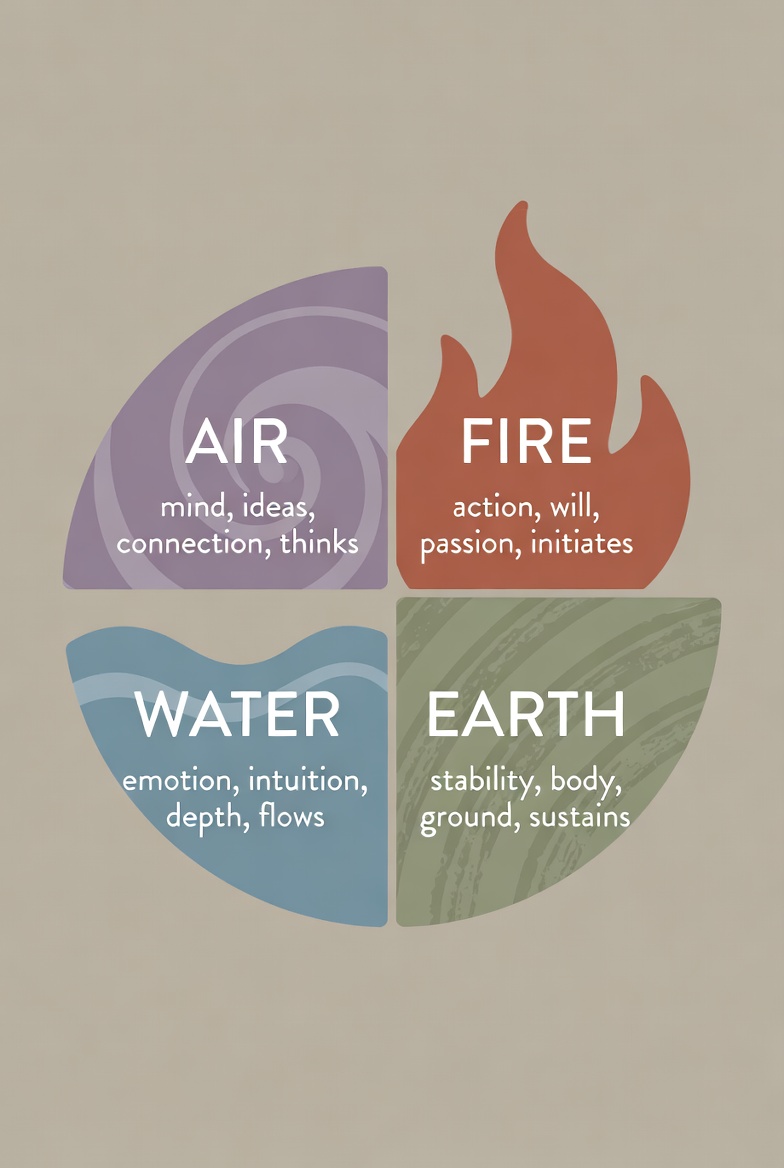
The four elements — Fire, Earth, Air, Water — each representing fundamental energies present in every person in different balance.
Spotting Elements in Practice
Fire Dominance Fire dominance: bright, direct energy. Quick movements. Speaks with passion. Takes up space. Warm, direct eye contact. Energy projects outward. Earth Dominance Earth dominance: solid, grounded presence. Slow and deliberate. Practical focus. Grounded energy. Weight settled. Present in the lower body.
Air Dominance Air dominance: talks a lot. Ideas, theories, concepts. Quick mind, quick speech. May seem disconnected from feeling. Energy is "up": light, fluttery, changeable. Water Dominance Emotionally expressive. Deep, feeling quality. May cry easily. Intuitive knowing. Boundary challenges. Energy flows inward and downward — may flood.
In practice: When meeting a client, ask yourself four questions: Which element seems dominant? Which seems deficient? How does this imbalance show in their presenting issue? And what element might the work need to bring in to create more balance? Example: Client presents with anxiety and overthinking. Dominant: Air (lives in head). Deficient: Earth (ungrounded) and Water (disconnected from feeling). The work: ground into body (Earth), connect to feeling (Water).
In groups of four. Round 1: Each person shares something they are working on. Group discusses which element seems dominant in their presentation, which seems deficient. 5 minutes per person. Round 2: Same person, same topic — group observes what in the body shows the elemental balance, and how you might work with the elements therapeutically. Group share: what patterns did you notice?
Elements in the Body
Fire in the Body Warm, may run hot. Strong, energetic quality. May have inflammation patterns. Eyes often bright. Energy projects outward. Tends toward action. When deficient: low energy, no spark, cold physically, needs activation and motivation. Earth in the Body Solid, grounded presence. Weight settled. Tends toward stillness. Strong, sturdy quality often. Present in the lower body. Slow, measured movements. When deficient: ungrounded, flighty, poor sense of body, may seem uncontained.
Air in the Body Energy moves up and out. May seem light and ungrounded. Breath tends to be upper chest. May talk with hands. Movement is quick and changeable. When deficient: difficulty articulating, concrete thinking only, communication blocks, cannot see other perspectives. Water in the Body Fluid, sometimes formless quality. Energy moves inward and down. Eyes often deep, sensitive. May cry easily. Sensitive nervous system. When deficient: emotionally flat, difficulty crying, defended and rational, mistrusts intuition, avoids depth, may fear emotion.
Chapter Four: The Energetic Lens
““The chakras are the architecture of the soul.” — Anodea Judith”
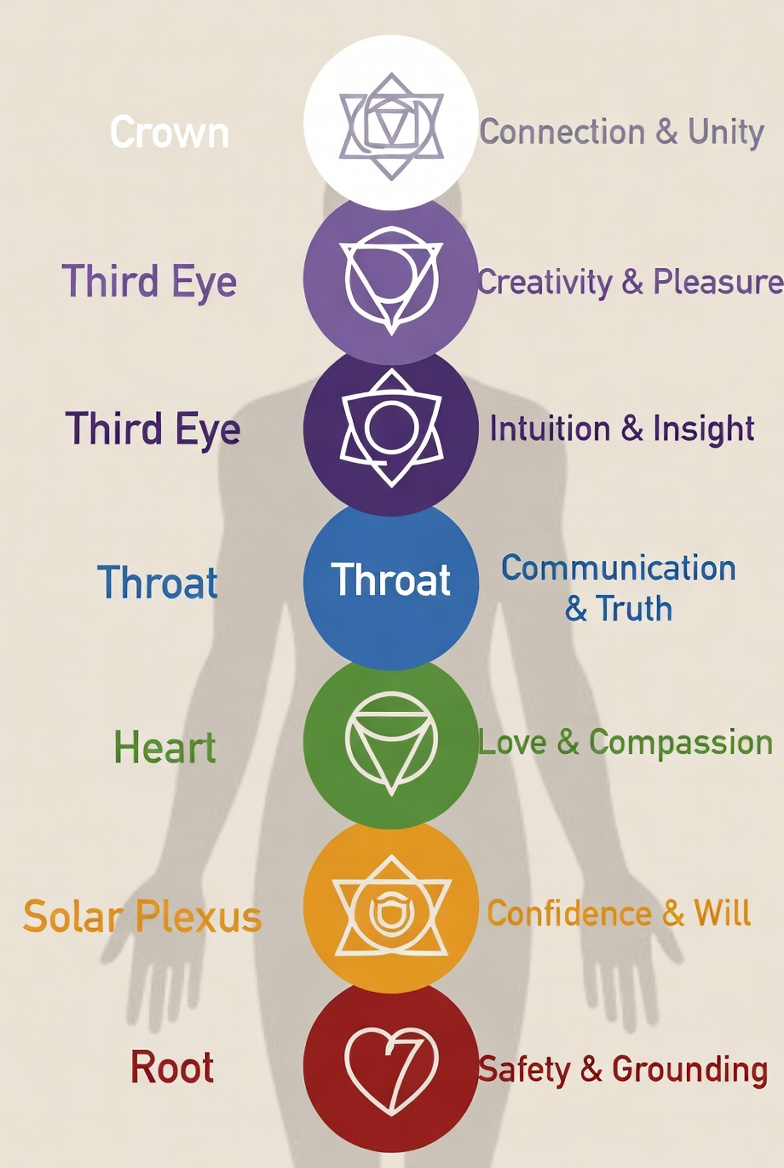
The energetic lens looks at how life force moves through the system. You cannot see energy with the naked eye. But you can sense it. And you can read the physical signs that show you where it flows freely and where it is stuck. The seven major chakras map human development from survival at the base to spiritual connection at the crown. When energy flows freely through them, there is health and vitality. When it is blocked or excessive, recognisable patterns appear.
The seven chakras — energy centres from the base of the spine to the crown, each governing a distinct domain of human experience.
The image shows the chakras from Root (base) to Crown (top). You may notice the labelling has a small discrepancy — the second circle from the top is the Sacral (Svadhisthana), governing creativity and pleasure. This has been corrected in the text below for your reference. Worth updating the image label when you revise it.
The Seven Chakras
Root (Muladhara) — Base of Spine — Safety, Survival, Ground
Blocked:
Excessive:
Sacral (Svadhisthana) — Below Navel — Emotions, Sexuality, Creativity
Blocked:
Excessive:
Solar Plexus (Manipura) — Upper Abdomen — Personal Power, Will, Identity
Blocked:
Excessive:
Heart (Anahata) — Centre of Chest — Love, Compassion, Connection, Grief
Blocked:
Excessive:
Throat (Vishuddha) — Throat — Expression, Truth, Authenticity
Blocked:
Excessive:
Third Eye (Ajna) — Between Eyebrows — Intuition, Vision, Insight
Blocked:
Excessive:
Crown (Sahasrara) — Top of Head — Spiritual Connection, Meaning, Unity
Blocked:
Excessive:
Developmental Stages
Each chakra has a primary developmental window. Root: birth to 1 year (also ongoing). Sacral: 6 months to 2 years. Solar Plexus: 18 months to 4 years. Heart: 4 to 7 years. Throat: 7 to 12 years. Third Eye: adolescence and beyond. Crown: throughout life, particularly spiritually active periods. Knowing this helps you understand where a wound likely originated and what kind of early environment shaped this pattern.
Chakra Assessment in Practice
Visual Observation Where does energy seem concentrated? Where does it seem absent? What is the overall energy pattern? Which regions of the body feel alive and which feel flat, collapsed, or held? Assessment Questions Per Chakra Root: does this person seem grounded? Is there basic trust and safety? Are they in their body? Sacral: how do they relate to emotions? Is there flow or rigidity? Solar Plexus: do they have a sense of personal power? Can they assert themselves? Heart: connected or isolated? Can they give and receive? Throat: can they express themselves? Do they speak their truth?
Most people have a combination of open, deficient, and excessive chakras. Look for: where energy is stuck, where it is leaking, where it flows, and what the overall pattern means. No person has all seven perfectly balanced — the art is in reading the specific combination and understanding what it reveals about their history and their needs.
Spiritual Bypass — What It Looks Like
Spiritual bypass (a term coined by John Welwood) is the use of spiritual ideas and practices to sidestep unresolved emotional issues and unfinished developmental tasks. The tell is in the body: upper chakras open, lower chakras blocked. Transcendence without ground. The person can speak beautifully about unity and love while avoiding ordinary human feeling, embodiment, and accountability.
Signs of Spiritual Bypass Talks of love and light while avoiding anger. Detachment called enlightenment. Forgiveness without grief. Positive thinking that bypasses feeling. Floating, ungrounded quality. Upper body elevated, lower body collapsed. How to Work With It Honour the spiritual seeking — it is real. Gently bring awareness to what might be bypassed. Check for grounding and embodiment. True spirituality includes, not escapes, the human experience. Help integrate spiritual experiences into embodied life.
Integrating the Four Lenses
In practice, you hold all four lenses at once. It sounds like a lot. But with practice it becomes natural, like breathing. A client walks in. You notice: collapsed chest and shallow breath (Body Lens), Manager part presenting but grief seems close (IFS Lens), Water deficient and Earth excess (Elemental Lens), heart chakra blocked and lower chakras dominant (Energetic Lens). The integration: this person is protecting their heart. Heavy, stuck energy. The fluid emotional realm is blocked. Grief is present but protected. Your approach: honour the protection, gently invite the heart to open, bring in Water element, work with the Manager to access the grief beneath. The four lenses together show what no single lens ever could.
In pairs. Round 1 (Self-assessment): each person scans their own chakras and writes brief notes — what feels open, blocked, excessive? Share with partner. Round 2 (Partner assessment): Partner A sits simply present. Partner B senses and observes what they notice about each chakra region. Share observations. Partner A gives feedback: what resonated? Switch. Round 3: compare self-assessment with partner assessment. What did the partner see that you did not?
Which of the four lenses feels most natural to you?
Which needs the most development?
Apply all four lenses to yourself right now. What emerges from this integrated view?
Chapter Five: Common Presenting Issues
People come to you with symptoms. Not sources. Receive what they bring with full respect. And then look deeper. These are patterns, not diagnoses. Hold them lightly. Every person is unique, even when patterns are familiar.
Body Lens Nervous system stuck in sympathetic activation. Shallow, rapid, chest breathing. Elevated shoulders, tight jaw. Scanning eyes. Restless, cannot settle. IFS Lens Hypervigilant Manager constantly scanning. Multiple Manager parts (worrier, planner, controller). Protecting terrified Exiles who learned the world is dangerous. Elemental Lens Air dominance (overthinking). Earth deficiency (ungrounded). Fire may be excess (too much activation). Water may be blocked. Energetic Lens Overactive third eye (constant thinking). Blocked root chakra (no ground). Energy moves up and out, nothing settling down. Solar plexus may be weak. Approach: Do not try to talk them out of anxiety. Build safety through your regulated presence first. Grounding work and honouring the protective function before going anywhere near what the anxiety protects.
Body Lens Dorsal vagal shutdown. Flat affect. Shallow, almost imperceptible breathing. Collapsed posture. Glazed or distant eyes. Voice monotone. Disconnected from body. IFS Lens Strong Firefighter parts (numbing, dissociating). These protect extremely vulnerable Exiles. Manager parts may also suppress. Self is buried under the protective numbing. Approach: Never try to break through the numbness. It is protection. Build safety, work very gently, titrate carefully. Honour the protection while inviting gentle opening. Patience — this pattern took time to build.
Body Lens Nervous system seeking regulation externally. Oscillates between activation and collapse. Shame visible in posture when discussing the behaviour. IFS Lens Strong Firefighter parts managing unbearable pain. The behaviour IS the solution (to something). Exiles carry intense pain underneath. Managers judge the Firefighters, creating internal war. Shame piles on top. Approach: Never shame the behaviour. It is working (sort of). Ask with genuine curiosity: “What is this behaviour trying to do for you?” When the exiles heal, Firefighters can relax.
What lies beneath: Attachment patterns formed in childhood. Exiles seeking what they did not receive. The familiar feels “right” even when harmful. Parts recreating dynamics hoping for a different outcome. Often tied directly to parent relationships. Approach: Help them see the pattern with compassion — it makes sense when you understand its origin. Work with underlying attachment wounds. Heal the exile that believes this is what love looks like.
IFS Lens: A Manager that believes rest is laziness. A worthiness wound (earning love through doing). A Driver part that cannot stop. Exiles carrying “not enough” beliefs. Energetic Lens: Solar plexus exhaustion (will spent). Root depleted (no ground). Heart blocked (cannot receive). Running on empty. Approach: Honour the collapse as intelligent. The system is insisting on what the mind refused. Focus on: rest is not laziness (nervous system education). What is the Driver part protecting against? What would emerge in stillness?
IFS Lens: Strong People-Pleaser Manager. Self buried under adaptive parts. True preferences unknown or suppressed. Exile carries fear of having needs. Energetic Lens: Solar plexus weak (no personal power). Throat blocked (cannot voice own truth). Boundaries of the energy field are diffuse. Approach: The Self was never lost, only hidden. Build interoception first: “What do YOU feel in your body?” Breathwork can bypass the pleasing parts and contact authentic impulse. Watch for emergence of anger — common when the self starts to wake up.
What lies beneath: Trauma stored in implicit memory with no time stamp. The past is NOT past in the nervous system. Incomplete survival responses. Ungrieved losses. The event never reached completion. Approach: You cannot “let go” of what is stored in the body — that is not how it works. Complete what was incomplete. Grieve what was not grieved. Discharge what is still held. Help the nervous system know it is over. Then letting go happens naturally.
Questions That Open Doors
Avoid "why?" It triggers the analytical brain. Use questions that invite exploration, sensation, and depth instead.
Body Questions “What do you notice in your body right now?” “Where do you feel that?” “What does your body want to do?” “If that sensation could speak, what would it say?” IFS Questions “Is there a part of you that feels this way?” “How old does this part seem?” “What is this part afraid would happen if it relaxed?” “How do you feel toward this part right now?”
The critical question: “What would happen if you did not have this [symptom/behaviour/pattern]?” The answer reveals what the pattern is protecting against. Use it sparingly and with care — but it will take you to the root every time.
In groups of three. Person A shares a presenting issue from their own life (real but not too activating). Persons B and C silently apply all four lenses, then share what they see through each. Person A reflects: what resonated? Rotate so everyone has been Person A. Group discussion: what did multi-lens vision reveal that single-lens thinking would have missed?
Skillful Truth-Finding
How do you help someone discover what is underneath without being invasive or presumptuous? These tools help.
The Ulmer Principle Applied Most negative emotions, when you trace them all the way down, are some form of fear. When anger: what might the anger be protecting? What would you feel if you were not angry? When grief: what fear is woven into this loss? When shame: what does the shame fear would happen if it let go? This is not dismissing the presenting emotion. It is getting curious about what lives below it. Following the Body When words stop being useful, bring it back to the body. "Let's pause from the story. What's happening in your body right now?" The body will always take you deeper than narrative.
Extended Case Studies: Seeing in Practice
First Three Minutes: Walks in efficiently, businesslike. Firm brief handshake. Appropriate eye contact but it feels more like a skill than connection. Sits upright, controlled. Checks phone before putting it away. Already has an agenda. Five-Point: Eyes alert, guarded — assessing you as much as you assess them. Posture military-straight, held. Breath almost invisible, minimal upper chest. Voice clear, little tonal variation. Movements precise — nothing unconscious. Four Lenses: Body: high-functioning sympathetic activation, system running on adrenaline and control. IFS: strong Achiever, Controller, Perfectionist parts. Underneath: terrified Exiles who learned vulnerability was dangerous. Energetic: solar plexus dominant. Heart likely blocked. Sacral (pleasure, flow) likely closed. Approach: Honour the achievement. Managers respect competence — be efficient and clear. Build trust before asking anything to soften. Start with breath: “Your breathing is very efficient. What happens if we slow it down?” Do not push for emotion. Consider framing the work as “optimisation” at first — Managers understand optimisation.
First Three Minutes: Tentative entry. Checks your face for cues before speaking. Apologises for something that needs no apology. Takes up less space than necessary. Immediately asks about you. Five-Point: Eyes searching your face — checking if they are doing it right. Posture open to you but collapsed in self. Breath shallow, adapts to the room. Voice tends to rise at the end of sentences (checking for approval). Movements mirror yours unconsciously. Four Lenses: Body: nervous system calibrated to others, hypervigilant to social cues not internal signals. Poor interoception. IFS: dominant People-Pleaser Manager. Exiles carrying: “My needs are too much,” “I'm only valuable if I'm useful.” Energetic: solar plexus weak, throat blocked, energy field diffuse. Approach: Do not take their accommodation at face value. Build interoception first. “What do YOU notice in your body right now?” And be careful not to become another person they please — notice if they are adapting to you. Name it gently if they are.
First Three Minutes: Varies widely — may be hypervigilant (scanning, jumpy) or shutdown (flat, disconnected). May present as very “together” (overcompensation). May tell the trauma story immediately (flooding) or be very guarded about it. Four Lenses: Body: nervous system shaped by trauma. Narrow window of tolerance. IFS: strong Protectors (both Manager and Firefighter). Exiles carrying the trauma — frozen in time. The whole system organised around protecting those Exiles. Energetic: trauma affects all chakras, particularly root (safety) and heart (connection). Approach: Safety first, always. Do not go into trauma material without resources in place. Titrate carefully — small doses of activation with lots of grounding. Work with Protectors first — they need to trust you before letting you near the Exiles. Never force memory or narrative. Go slow. Be prepared for the long game. This is not one-session work.
Clinical Reference: The Assessment Protocol
- Regulate yourself. Your nervous system is your primary instrument. Clear your own energy before you attempt to read anyone else's.
- Prepare the space. Temperature comfortable. Lighting soft. Seating arranged for connection. Distractions minimised.
- Set intention to see clearly. Not to perform, not to demonstrate skill — to genuinely see and serve this person.
- Release agenda. What you expect to see will prevent you from seeing what is actually there. Come empty and open.
The Three Essential Questions
Quick Reference Tables
| Nervous System State | Eyes | Breath | Posture | Voice | | --- | --- | --- | --- | --- | | Ventral Vagal | Soft, present | Full, easy | Open, settled | Melodic, varied | | Sympathetic | Scanning, wide | Rapid, shallow | Tense, guarded | Fast, pressured | | Dorsal Vagal | Glazed, distant | Minimal | Collapsed | Flat, slow |
| Part Type | Presentation | Body Signs | Language | | --- | --- | --- | --- | | Manager | In control, competent | Held, managed | “I understand,” “I should” | | Firefighter | Checked out or desperate | Disconnected or frantic | “Make it stop,” “I don't care” | | Exile | Vulnerable, young | Small, tearful | “I'm scared,” “I'm bad” | | Self | Curious, calm | Settled, open | “I notice,” “I'm curious about this part” |
| Chakra | Blocked Signs | Excessive Signs | | --- | --- | --- | | Root | Anxious, ungrounded, survival panic | Rigid, hoarding, resistant to change | | Sacral | Numb, no flow, guilt around desire | Flooding, compulsive, no boundaries | | Solar Plexus | Powerless, victim, no will | Dominating, aggressive, controlling | | Heart | Isolated, bitter, cannot receive | Codependent, over-giving, no self-care | | Throat | Silent, inauthentic, swallows feelings | Talks too much, harsh, does not listen | | Third Eye | Confused, disconnected from intuition | Overthinking, ungrounded visions | | Crown | Meaningless, cynical, existential despair | Spiritual bypass, ungrounded transcendence |
| Nervous System State | Eyes | Breath | Posture | Voice |
|---|---|---|---|---|
| Ventral Vagal | Soft, present | Full, easy | Open, settled | Melodic, varied |
| Sympathetic | Scanning, wide | Rapid, shallow | Tense, guarded | Fast, pressured |
| Dorsal Vagal | Glazed, distant | Minimal | Collapsed | Flat, slow |
| Part Type | Presentation | Body Signs | Language |
|---|---|---|---|
| Manager | In control, competent | Held, managed | “I understand,” “I should” |
| Firefighter | Checked out or desperate | Disconnected or frantic | “Make it stop,” “I don't care” |
| Exile | Vulnerable, young | Small, tearful | “I'm scared,” “I'm bad” |
| Self | Curious, calm | Settled, open | “I notice,” “I'm curious about this part” |
| Chakra | Blocked Signs | Excessive Signs |
|---|---|---|
| Root | Anxious, ungrounded, survival panic | Rigid, hoarding, resistant to change |
| Sacral | Numb, no flow, guilt around desire | Flooding, compulsive, no boundaries |
| Solar Plexus | Powerless, victim, no will | Dominating, aggressive, controlling |
| Heart | Isolated, bitter, cannot receive | Codependent, over-giving, no self-care |
| Throat | Silent, inauthentic, swallows feelings | Talks too much, harsh, does not listen |
| Third Eye | Confused, disconnected from intuition | Overthinking, ungrounded visions |
| Crown | Meaningless, cynical, existential despair | Spiritual bypass, ungrounded transcendence |
Clinical Skill: Tracking and Titration
Tracking is continuous. You are never not tracking. Every moment of a session, you are watching where the client is. Titration means controlling how much activation there is, keeping it inside the window of tolerance.
Signs to Watch For
Nearing the Top (Hyperarousal) Signs you are nearing the top of the window: breath becoming faster and shallower, face flushing or paling, voice speeding up, eyes widening or darting, restless movement increasing. Slow down. Resource. Nearing the Bottom (Hypoarousal) Signs you are nearing the bottom: eyes glazing or going distant, breath almost invisible, voice flattening, posture collapsing, colour draining, responses slowing or stopping. Gently activate. Connect. Bring them back.
Activation present but tolerable. Can still think and feel together. Body is involved but not overwhelmed. Client can report what is happening. Natural movement of energy and emotion. Integration happening. This is the sweet spot — stay here.
How to Titrate
Slowing Down "Let's pause here for a moment." "Take a breath." "Let's resource before we go further." "What do you notice in your feet right now?" Any of these pauses the momentum and gives the system time to settle. Pendulation Pendulation: touch the difficult, then return to ground. Move between activation and resource. Do not stay in intensity too long. Build capacity through the back-and-forth. This is not avoidance. It is building range.
The Session Arc
Opening (10–15%) Opening: establish safety. Assess state. Set intention. Begin regulated. Resource before going anywhere deep. Never skip this. Building (25–30%) Building: gradually increase depth. Track continuously. Titrate as needed. Build toward the core material.
Working (30–40%) Working: the deepest work of the session. Stay within the window. Allow processing. Support completion. Do not rush. Integration & Closing (25–30%) Closing: return to ground. Help them make simple meaning of what happened. Consolidate. Full grounding. A clear, warm ending. Next steps for between now and the next session.
Common Assessment Challenges
“I Can’t See Anything” Relax your seeing. Soft eyes, not staring. Start with what is obvious: breath, posture. Practice regularly. It develops over time. Trust what you notice, even if it is subtle. You are seeing more than you know. “I See Too Much” If you see too much: focus on essentials first. What is their nervous system state? What do they need right now? Add layers gradually. Not everything needs to be seen at once.
“I Project My Own Stuff” If something feels very familiar, very charged, or very certain: check yourself. Is this about them or about me? Know your own patterns. Get supervision for complex cases. “I Get Overwhelmed by Their Energy” If you get overwhelmed by their energy: your boundaries are too porous. You are absorbing rather than observing. Ground yourself before and during sessions. You can perceive without absorbing. Clear yourself after. This is a skill. It develops.
Weekly Development Practice
Week 1 — Body Observation Week 1 body practice: each day, observe three people using the Five-Point Assessment. Journal your observations. Each week, practise with a partner and get feedback. Week 2 — Parts Observation Week 2 parts practice: notice parts throughout your day, in yourself and in others during conversations. Each week, practise identifying parts with a partner.
Week 3 — Elemental Observation Week 3 elemental practice: each day, observe elemental balance in three people. Notice your own elemental shifts. Each week, assess each other's elements and compare notes. Week 4 — Energetic Observation Week 4 energetic practice: each day, sense chakra energy in yourself and observe energy patterns in others. Weekly partner practice with feedback. From Week 5 onward, integrate all four lenses daily.
Specific Client Types
The Skeptic The Skeptic: arms crossed, challenging questions, testing you. Underneath is a Manager guarding vulnerability. They have been hurt by trusting before. Answer clearly, honour their intelligence, earn trust through competence. The wall will come down when it is ready. The Over-Talker The Over-Talker: fills every silence. A Manager using talk to avoid the silence where feelings might arise. Gently interrupt: "Let's pause here." Redirect to body. Create safety in silence gradually.
The Performer The Performer: has the "right" answers. Does breathwork "perfectly." Something feels off, like a show. A Manager who knows how to look good. Notice the incongruence. Create safety for imperfection. Model it yourself. The Intellectualiser The Intellectualiser: explains everything. Understanding is their defence. Insight protects against feeling. Honour the intelligence while redirecting: "What happens if we drop into the body?"
The Collapsed One The Collapsed One: low energy, minimal eye contact, soft voice, trouble answering questions. Seems far away. Dorsal vagal dominance. Go slow. Build safety gradually. Gentle activation, not overwhelming. Connection and warmth. Small movements, small breaths. Patience. The Spiritual Seeker The Spiritual Seeker: speaks in spiritual language, has done many workshops, may have genuine spiritual experiences. Check for grounding and embodiment. Are the lower chakras online? Is there integration, or avoidance? True spirituality includes the human experience. It does not escape from it.
Ethics: The Ethics of Seeing
What you see is sacred. When someone is truly seen, they are also vulnerable. This is a gift of trust. Handle it with care.
See in Service of Healing Your seeing is to help them. Not to demonstrate your skill. Not to show what you can perceive. Share only what serves. You may see things they are not ready to know. Hold what does not serve them to hear yet. Never Use Seeing to Manipulate Your perception gives you power. Use it ethically. What you see in session stays in session. This is not optional. It is sacred.
The difference between seeing and seeing through: Seeing clearly means understanding with compassion and using your perception to serve. Seeing through means making them feel exposed, reducing them to patterns, making them feel analysed. The client should feel seen, not seen through. Held, not examined. Understood, not figured out.
Beyond the Lenses: Presence
The lenses are training tools. They help you develop your perception. But the goal is integrated seeing: perceiving the whole person without consciously thinking about which lens you are using. A fully present practitioner, even without any framework, will perceive what needs perceiving. A technically skilled practitioner who is not present will miss what matters most.
Presence is: Being fully here. Regulated and available. Open without agenda. Connected to your own body and heart. Not caught in your own material. From presence, seeing arises naturally. Your nervous system is your primary instrument. Keep it clear. From that ground, everything else follows.
Avoid Pathologising Seeing patterns is not diagnosing illness. Avoid making people into their problems. Every person is more than any lens can reveal. Hold what you see lightly. Stay humble about the limits of your perception. Support Autonomy Your seeing should empower them to see themselves, not make them dependent on your perception. The goal is for them to develop their own capacity to understand their inner world. Your seeing serves their freedom.
“The Practitioner’s Prayer May I see clearly. May I serve wisely. May my perception bring healing, not harm. May I remain humble in the face of human mystery. May I remember that every person is more than any lens can reveal. May my seeing serve love.”
Your Ongoing Development
Learning to see has four stages. Stage 1: you know what you do not know. The lenses feel clunky. You think about every step. Stage 2: you can use the lenses when you think about them, with effort. Stage 3 (unconscious competence) — the lenses become second nature, intuition is trained and reliable. Stage 4 (mastery) — you see the whole person, lenses integrate seamlessly, and you know when to let go of all lenses and simply be present. Mastery is a direction, not a destination.
You can only take clients where you have been willing to go yourself. The more of your own work you have done, the clearer you can see others. The less you project. The more you can truly be present. Your own therapy, regular breathwork practice, knowing your patterns through the four lenses: this is not optional. It is the foundation of clear seeing.
Summary of Part 6 Key Points
- The presenting issue is rarely the actual issue. Your task is to see the whole iceberg beneath what shows. - Multiple lenses reveal what single lenses cannot. Body, IFS, Elemental, and Energetic lenses work together. - The body never lies. The Five-Point Assessment gives immediate information before a word is spoken. - Parts run the show. Learning to see Managers, Firefighters, Exiles, and Self transforms your work. - Elements tell you what’s in balance. Fire, Earth, Air, and Water provide a framework for understanding the whole person. - Chakras map energy flow. The seven chakras show where energy is open, blocked, or excessive. - Common patterns have predictable depths. Anxiety, numbness, addiction, and other issues have common underlying structures. - Questions open or close. How you ask determines what emerges. - Track and titrate continuously. Never stop monitoring state and adjusting intensity. - Spiritual bypass is defence in spiritual clothing. True spirituality goes through, not around. - Presence trumps technique. Your regulated, available presence is your primary instrument. - Your seeing serves their healing. Not your ego, not your skill demonstration — their freedom.
Frequently Asked Questions
How long does it take to develop good seeing? With consistent practice you will notice improvement in weeks. Real integration takes years. Mastery is lifelong. Be patient with yourself. Every session develops it. What if I see something wrong? You will see things incorrectly sometimes. Everyone does. Hold your seeing lightly. Stay humble. Learn from the mistakes. The goal is not perfect seeing. It is useful, compassionate seeing that gets better over time.
What if my assessment differs from their experience? Trust what you see, but hold it lightly. Check in: "I notice... what do you experience?" Your seeing is hypothesis, not diagnosis. They are the expert on their own inner experience. How much should I share with clients? Share what serves. Not everything you see needs to be said. Ask yourself: will this help them right now? Is this the right moment? Am I sharing to help them, or to show what I can see?
Daily practice: consistent observation and self-assessment. Weekly practice: partner work and study. Monthly review: growth and areas to develop. Ongoing personal work: my own healing and growth. Supervision: regular consultation for complex cases. Humility: remembering I am always learning. Ethics: using my seeing to serve, never to harm. Presence: keeping my nervous system clear and available. My lenses are tools, not truth. Every person is more than any lens can reveal.
Part 6 Self-Mastery Checklist
Knowledge (I Understand) The Iceberg Principle. Why multiple lenses matter. The Five-Point Assessment. Nervous system state reading. Green/yellow/red flags. IFS parts. The four elements. The seven chakras. Common presenting issues. Spiritual bypass. Tracking and titration. Ethical considerations. Skills (I Can) Observe the first three minutes systematically. Apply Five-Point Assessment reliably. Identify nervous system states. Recognise parts in session. Read elemental balance. Assess chakra patterns. See beneath presenting issues. Ask opening questions. Track state throughout. Titrate appropriately. Integrate multiple lenses simultaneously.
Practice (I Do) Daily self-assessment through all four lenses. Regular observation practice. Weekly partner practice. Monthly review and adjustment. Ongoing personal work. Supervision for complex cases. Being (I Am) Present and regulated. Humble about my seeing. Compassionate in my perception. Ethical in my use of insight. Committed to continuous growth. In service to the healing of others.
Part 6 Completion
Knowledge
☐ The Iceberg Principle and why the presenting issue is rarely the actual issue
☐ Why multiple lenses matter and what each one reveals
☐ The First Three Minutes Protocol
☐ The Five-Point Body Assessment (eyes, posture, breath, voice, movement)
☐ Green, yellow, and red flags and what they mean for your approach
☐ Incongruence — what it is and how to work with it compassionately
☐ The two types of anger in sessions (Firefighter vs Exile)
☐ IFS parts recognition — Managers, Firefighters, Exiles, and Self energy
☐ The four elements and how to spot dominance and deficiency
☐ All seven chakras — what they govern, blocked signs, excessive signs
☐ Spiritual bypass — what it looks like and how to work with it
☐ Common presenting issues and what typically drives each one
☐ Questions that open vs questions that close
☐ Tracking and titration throughout a session
☐ The ethics of seeing and the difference between seeing and seeing through
Practice and Skills
☐ Applied all four lenses to yourself honestly
☐ Completed all six community exercises
☐ Daily life laboratory practices for developing observation
☐ Embodiment and journal practices completed
☐ All ten video companions watched
☐ Identified your dominant and deficient lenses and committed to developing them
Part 6 Video Library
6.1 — 15 min
Developing the Practitioner's Eye
6.2 — 20 min
The Five-Point Body Assessment
6.3 — 20 min
Seeing Parts in Session
6.4 — 18 min
Introduction to Elemental Assessment
6.5 — 22 min
Introduction to Chakra Assessment
6.6 — 20 min
Reading Beneath Presenting Issues
6.7 — 18 min
Tracking and Titration in Practice
6.8 — 15 min
The Ethics of Seeing
6.9 — 20 min
Case Studies — Seeing in Action
6.10 — 12 min
Your Ongoing Development as a Practitioner
IFS Lens “No Bad Parts” — Richard Schwartz “Internal Family Systems Therapy” — Richard Schwartz Energetic Lens “Eastern Body, Western Mind” — Anodea Judith “Wheels of Life” — Anodea Judith Shadow and Spiritual Work “Owning Your Own Shadow” — Robert Johnson “Spiritual Bypassing” — Robert Augustus Masters “Toward a Psychology of Awakening” — John Welwood The Practitioner's Inner Life “Meeting the Shadow” — Connie Zweig & Jeremiah Abrams Seek ongoing supervision and personal therapy — these are not optional.?
How Far You Have Come
Return to the pre-assessment at the start of Part 6. Compare your ratings. Then use these prompts to reflect.
Which of the four lenses has most expanded how you see people? Why?
What did you learn about yourself by applying the four lenses inward?
How will your seeing change the way you approach your first (or next) client session?
What lens needs the most development? What is your commitment to developing it?
Save Reflection
Saved — carry this seeing into Part 7.