Chapter One: The Art and Science of Session Facilitation
“"The session follows a bell curve: building energy, reaching a peak, and coming down. What goes up must come down. You cannot skip the descent."”
Why Structure Matters
Some practitioners resist structure. They want to "flow" with whatever arises, to be spontaneous. And yes, intuition and responsiveness are essential. But structure is not the opposite of flow — it is the container that makes flow safe.
Think of a riverbed. The water flows freely, finding its natural path. But it is the riverbed — the banks, the depth, the contours — that directs the flow. Without the riverbed, you do not have a river. You have a flood.
Safety The client knows what to expect and can relax into the process. You know the territory and can navigate effectively. Consistency Every session follows a complete arc. Nothing essential is skipped. Results are reproducible.
Professionalism You can explain your process to clients, colleagues, and medical professionals. Your work is coherent and describable. Ethical Practice You know when you are in unknown territory. Structure helps you stay within scope and identify what worked and what did not.
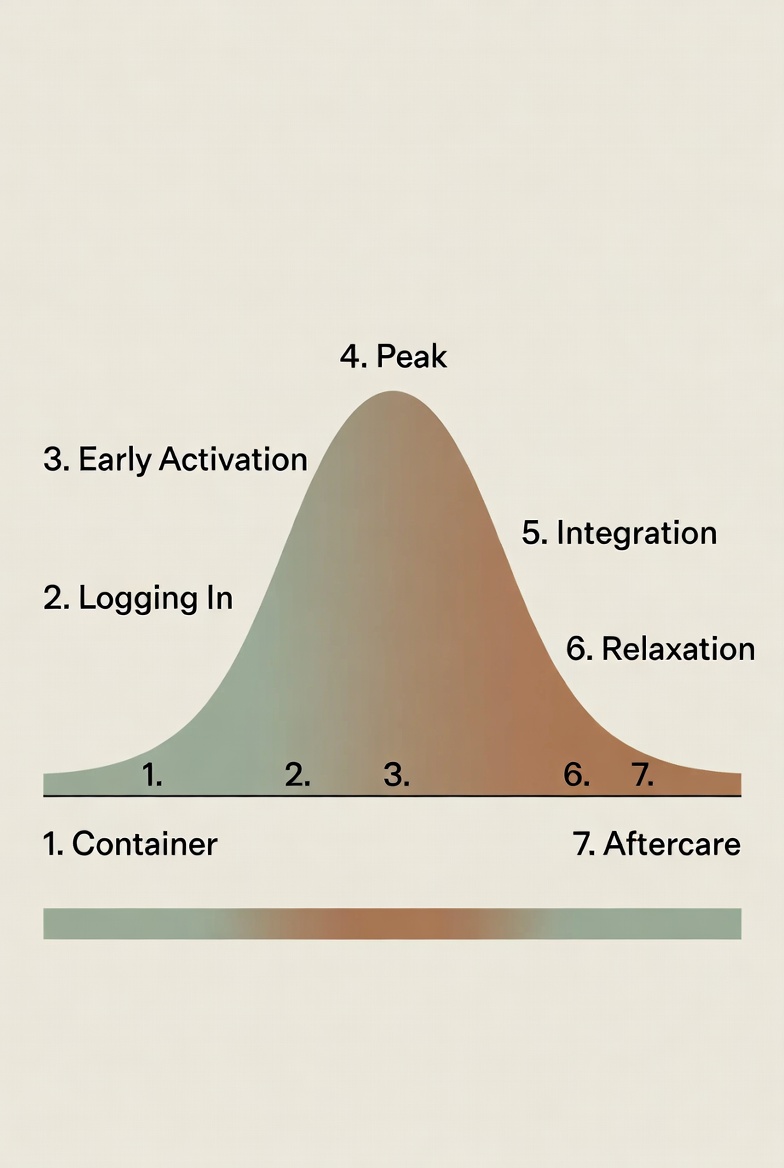
The Bell Curve of Arousal
Every effective session follows a natural arc of arousal and regulation. This arc is not optional — it is the physiological basis of how transformation happens.
Rising (Phases 1-3) Client arrives, settles, and establishes present-moment awareness. Activation builds through breath and technique. Arousal increases. Material begins to surface. Peak (Phase 4) Maximum activation within the window of tolerance. The material is present and moving. The transformation occurs.
Descending (Phases 5-6) Activation decreases. The nervous system integrates. Relaxation deepens. Client returns to ordinary consciousness, grounded and integrated.
The critical insight: what goes up must come down. If you end at the peak, the client leaves activated, ungrounded, possibly destabilised. If you rush the descent, integration does not complete. The full arc is not optional — it is essential.
The Seven Expert Perspectives on Session Structure
The Neuroscientist "The session arc mirrors the natural rhythm of sympathetic activation and parasympathetic recovery. Building arousal, processing, then allowing full return to baseline engages the brain's natural integration mechanisms." The Psychologist "The structure creates a 'holding environment' — Winnicott's term for a safe container where vulnerable material can emerge. Without structure, the container leaks. Material surfaces but does not integrate."
The TCM Doctor "The session moves chi. Building activation disperses stagnation. The descent allows chi to settle and redistribute. Rushing either phase creates imbalance." The Naturopath "The session creates controlled stress, then allows full recovery. This builds resilience — the capacity to return to baseline. Incomplete sessions create chronic activation."
The Energy Healer "The arc moves energy through the system. Activation loosens blocks, the peak releases them, the descent allows the system to reorganise at a new level. Each phase is essential." The Spiritual Teacher "The session is a journey into the underworld and back. The structure ensures safe return. Without proper closing, pieces of the soul can remain scattered."