
Chapter Four: Verbal Guidance & Touch
“"What you say matters. How you say it matters more. And sometimes the most powerful intervention is silence."”
The Power of Voice
Your voice is a primary instrument of facilitation. It is not just a delivery mechanism for instructions — it IS itself an intervention. Your voice can create safety or trigger fear, ground or activate, connect or distance. Your voice transmits your state. If you are anxious, your voice carries anxiety regardless of what words you use.
Warmth Genuine care communicated through tone. Not artificial sweetness, but authentic kindness. Steadiness Calm, even in intense moments. Your steady voice anchors them when they are activated.
Pacing Matching the client's state, then leading slightly. If they are activated, do not speak slowly immediately — match first, then gradually slow. Silence Comfort Knowing when not to speak. This is perhaps the most important quality. The default rule: when in doubt, stay silent. You can always speak later. You cannot unsay words that interrupted a process.
The uncomfortable truth: many new practitioners fill silence because THEY are uncomfortable, not because the client needs words. Learn to be comfortable with silence. Your silence communicates trust in the process.
When to Speak, When to Be Silent
Speak When Giving instruction (breath guidance). Client needs encouragement. Transition between phases. Checking in briefly. Providing safety cues. Grounding them. Guiding attention. Be Silent When Integration is happening. Deep processing is underway. Client is in flow. Emotion is moving naturally. You feel the urge to fill space. You do not know what to say. Something sacred is occurring.
Questions That Open vs. Questions That Close
Questions That OPEN Return attention to body and present moment. "What do you notice?" · "Where do you feel that in your body?" · "What is here right now?" · "What wants to happen?" · "Can you stay with that?" · "What does that feel like?" Questions That CLOSE Lead to thinking, analysing, leaving experience. "Why do you think you feel that way?" · "What does that mean?" · "Is that related to your childhood?" · "What caused that?" · "What should we do about it?"
Opening questions return attention to BODY and PRESENT. Closing questions activate MIND and ANALYSIS. In somatic work, we primarily use opening questions. We are not doing talk therapy. We are facilitating body experience. The mind's analysis can come later — after the body has done its work.
Voice Qualities in Practice
Pace Slower than normal conversation. Matches breath rhythm. Pauses between phrases. Gives time for processing. Volume Soft but audible. Not loud (activating). Not too quiet (straining to hear also activates). Consistent level.
Tone Warm, not cold. Grounded, not heady. Present, not distant. Melodic variation (not monotone). From your centre, not your throat.
If someone heard your facilitation voice without understanding the words, would they feel soothed or anxious? Record yourself and listen back. This is one of the most useful practices you can do.
Complete Verbal Guidance Scripts
What NOT to Say
Avoid Interpretation NOT: "That was your inner child releasing." INSTEAD: "What was that like for you?" Avoid Leading NOT: "You must be feeling relieved now." INSTEAD: "How are you feeling?"
Avoid Minimising NOT: "Everyone goes through this." INSTEAD: "That sounds significant." Avoid Fixing NOT: "Here's what you should do about that." INSTEAD: "What do you need right now?"
Avoid Over-Explaining NOT: "What's happening is that your CO2 is dropping which creates respiratory alkalosis…" INSTEAD: "This is normal. Your body knows what to do."
Touch Protocols
Touch is powerful. It can heal or harm, comfort or intrude. Clear protocols are essential — for the client's safety and yours.
Consent Framework
Before the Session Explain what touch might involve. "In this work, I may use supportive touch — like a hand on the shoulder, holding your feet, or a hand on your back. All touch is optional. You can say no to any touch at any time." Ask: "Are there any areas of your body you'd prefer I not touch?" Document their response. At the Beginning of Each Session Even with prior consent, check each session: "Just to check in — is touch okay for you today? Any adjustments from what we discussed?"
During the Session Even with prior consent, check before new touch: "I'm going to place my hand on your shoulder. Is that okay?" Wait for affirmative response (verbal or nod). If Response Is Unclear Ask again clearly: "I want to make sure — is it okay if I hold your feet?" If they say no or seem uncomfortable: immediately remove or do not apply touch. No explanation needed. Simply say "Of course" and continue with verbal support only.
Types of Supportive Touch
Grounding Touch Purpose: create safety, anchor to present, activate ventral vagal. Holding feet (excellent for grounding and calming). Hand on shoulder (reassurance and connection). Hand on upper back (support and containment). Containing Touch Purpose: create boundaries, help contain intense experience. Gentle pressure on forehead (calming). Hands on either side of head (containing the mind). Hands on shoulders pressing gently down (grounding intense energy).
Supporting Movement Purpose: allow completion of physical impulses. Light pressure on belly (breath support). Holding arm or leg (allowing movement against resistance). Supporting tremoring (containment without stopping). Crisis Touch Purpose: emergency grounding only. Both hands on feet with firm pressure. Hand on sternum with clear "You're here, you're safe." Use only when clearly needed.
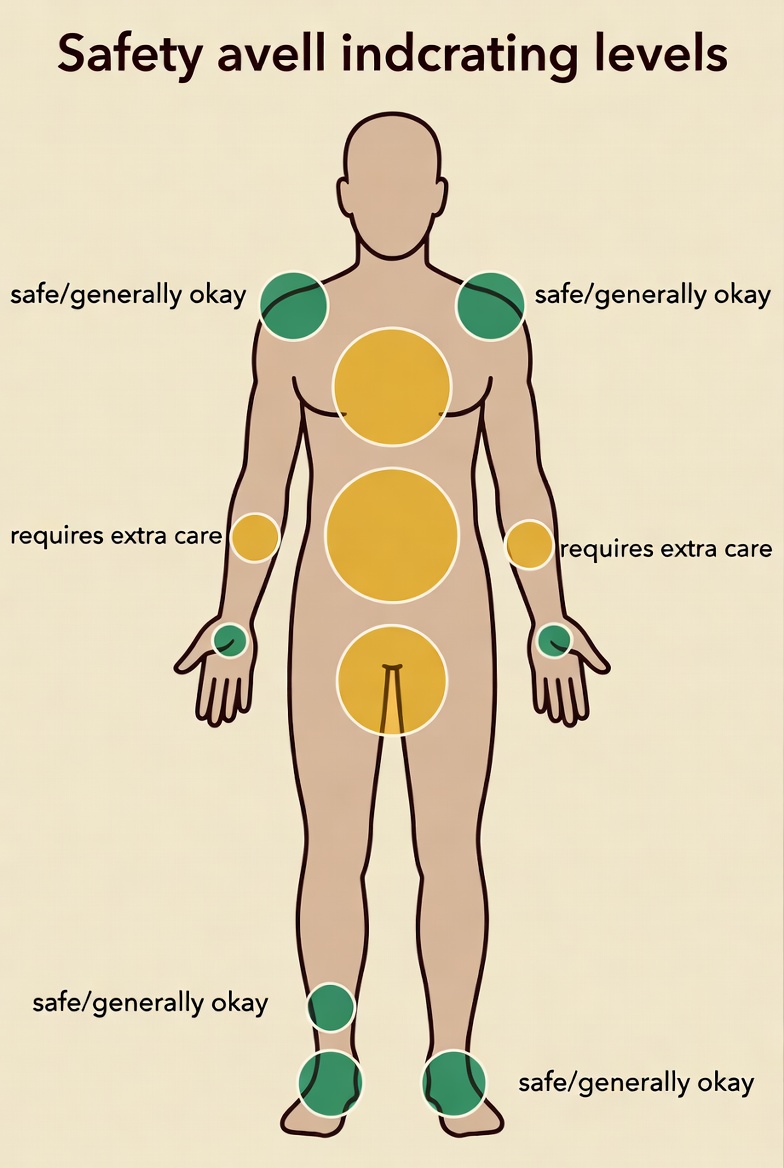
Safe touch points — generally safe (green) and requires extra care (yellow)
Note: feet, hands, shoulders, head/scalp are generally safe with consent. Chest, abdomen, and lower back require explicit consent and clear clinical purpose.
| Location | Purpose | Notes | | --- | --- | --- | | Feet | Grounding, calming | Excellent first touch, rarely triggering | | Hands | Connection, support | Can hold or place hand on | | Shoulders | Reassurance | Gentle pressure, not massaging | | Upper back | Support, holding | Flat hand, still pressure | | Head/scalp | Calming, containing | Ask specifically first | | Abdomen | Breath support | Always ask specifically — vulnerable area | | Chest | Heart support | Be very clear about purpose; professional approach required |
Avoid unless specifically trained Throat. Groin area. Breasts. Inner thighs. Any area client specified as off-limits. When in doubt, ask. Better to ask and confirm than to assume and trigger.
Touch Quality
Grounded & Slow Touch from your centre, not just your hands. Your whole body supports the touch. No sudden movements. Approach slowly, touch slowly, release slowly. Present & Purposeful Full attention in your hands. Not thinking about what comes next. Know why you are touching. Random touch is confusing.
Supportive vs. Directive Supportive touch: offers presence and safety, creates conditions for release, follows the body's lead. Says "I'm here with you." We use supportive touch only. We do not force the body to release through touch.
Energy Through Touch
When you touch a client, you are connecting energy fields. Your state affects them through touch.
Before Touching Ground yourself. Access Self-energy (calm, curious, compassionate). Set intention to support, not fix. Be present in your own body. During Touch Stay connected to your own body. Let energy flow through, not from you. Notice what you sense. Remain boundaried — their experience, not yours.
Working with Resistance
Sometimes clients resist touch or verbal guidance. This is information, not obstruction.
If They Resist Breath Guidance A protective part may be active. Slow down. "I notice the breath wants to stay shallow. What might happen if it went deeper?" Honour the resistance. It is there for a reason. If They Resist Touch Honour it completely. "No problem. I'll stay right here without touch. You're still supported." Do not take it personally. Do not try to convince them.
If They Go Silent Silence can be integration or shutdown. Check in briefly: "I'm here with you. Take your time." If silence continues and you're concerned, orient gently. If They Want to Leave Never block or argue. "Of course. Let's take a moment to ground before you go." Ensure they are safe to leave. Their autonomy comes first.
Solo recording: record yourself reading the body scan script. Listen back. Notice: warm or cold? Rushed or paced? Grounded or heady? Partner practice: Partner A reads a script with eyes closed, Partner B gives feedback on voice quality. Switch roles. Practice silence: sit with a partner in silence for 3 minutes. Notice your impulse to fill the space. Practice being comfortable without speaking.
Partners sitting, A as client, B as practitioner. Practice: (1) B asks for touch consent before session. (2) B asks before each touch point. (3) B practices different touch qualities (grounding, containing). (4) A gives feedback after each touch. (5) Practice having A say "no" and B responding appropriately. Switch roles. Debrief: how did it feel to ask for consent? To receive clear consent? To say no? To receive no?
| Location | Purpose | Notes |
|---|---|---|
| Feet | Grounding, calming | Excellent first touch, rarely triggering |
| Hands | Connection, support | Can hold or place hand on |
| Shoulders | Reassurance | Gentle pressure, not massaging |
| Upper back | Support, holding | Flat hand, still pressure |
| Head/scalp | Calming, containing | Ask specifically first |
| Abdomen | Breath support | Always ask specifically — vulnerable area |
| Chest | Heart support | Be very clear about purpose; professional approach required |