Session Structure & Techniques
THE ARCHITECTURE OF TRANSFORMATION
The Cocoon Method — Practitioner Training Manual
Contents
- 01Before You Begin
- 02Chapter One: The Art and Science of Session Facilitation
- 03Chapter Two: The Seven Phases of a Cocoon Session
- 04Chapter Three: Breathing Techniques for Sessions
- 05Chapter Four: Verbal Guidance & Touch
- 06Chapter Five: Working with What Arises
- 07Chapter Six: Session Planning & Aftercare
- 08Chapter Seven: Integration & Practitioner Development
- 09Chapter Eight: Session Facilitation in Practice
- 10Part 10 Completion Checklist
Before You Begin
Before You Begin
Rate yourself honestly before reading. Return after completing Part 10 to see how far you have come.
Session Structure
I know the seven phases of a Cocoon session and the purpose of each
I understand the bell curve of arousal and why the descent is essential
I can guide a complete body scan from feet to head
I know the difference between CCB, coherent breathing, extended exhale, and functional breathing
I know when to use each breathing technique and how to transition between them
I can manage tetany calmly and effectively
I understand touch consent protocols and safe touch points
I know how to respond to tears, anger, fear, tremoring, and dissociation
I know the difference between overwhelm and intense-but-contained processing
I can plan a session including space setup, music arc, and aftercare
You now have the knowledge — nervous system science, anatomy, psychology, energy systems, assessment skills, IFS tools. But knowledge without structure is like having ingredients without a recipe. You might create something, but it will be inconsistent, sometimes brilliant, sometimes missing crucial elements.
This part teaches you how to run a session. Not just the techniques, but the architecture — the container that holds transformation. How to begin. How to build. How to peak. How to descend. How to close. And everything in between.
I remember my early sessions vividly. I had read the books, done the trainings, experienced the work myself. But when I sat with my first client, I felt lost. When do I speak? When do I stay silent? How much activation is enough? What if they cry?
The session arc is not arbitrary. It follows the natural rhythm of the nervous system, the wave of activation and integration that allows lasting change. Rush it, and the work does not land. Skip steps, and safety is compromised. Trust the arc, and transformation becomes possible.
“"Learn the structure so thoroughly that you can forget it. Then your facilitation becomes art."”
Chapter One: The Art and Science of Session Facilitation
“"The session follows a bell curve: building energy, reaching a peak, and coming down. What goes up must come down. You cannot skip the descent."”
Why Structure Matters
Some practitioners resist structure. They want to "flow" with whatever arises, to be spontaneous. And yes, intuition and responsiveness are essential. But structure is not the opposite of flow — it is the container that makes flow safe.
Think of a riverbed. The water flows freely, finding its natural path. But it is the riverbed — the banks, the depth, the contours — that directs the flow. Without the riverbed, you do not have a river. You have a flood.
Safety The client knows what to expect and can relax into the process. You know the territory and can navigate effectively. Consistency Every session follows a complete arc. Nothing essential is skipped. Results are reproducible.
Professionalism You can explain your process to clients, colleagues, and medical professionals. Your work is coherent and describable. Ethical Practice You know when you are in unknown territory. Structure helps you stay within scope and identify what worked and what did not.
The Bell Curve of Arousal
Every effective session follows a natural arc of arousal and regulation. This arc is not optional — it is the physiological basis of how transformation happens.
Rising (Phases 1-3) Client arrives, settles, and establishes present-moment awareness. Activation builds through breath and technique. Arousal increases. Material begins to surface. Peak (Phase 4) Maximum activation within the window of tolerance. The material is present and moving. The transformation occurs.
Descending (Phases 5-6) Activation decreases. The nervous system integrates. Relaxation deepens. Client returns to ordinary consciousness, grounded and integrated.
The critical insight: what goes up must come down. If you end at the peak, the client leaves activated, ungrounded, possibly destabilised. If you rush the descent, integration does not complete. The full arc is not optional — it is essential.
The Seven Expert Perspectives on Session Structure
The Neuroscientist "The session arc mirrors the natural rhythm of sympathetic activation and parasympathetic recovery. Building arousal, processing, then allowing full return to baseline engages the brain's natural integration mechanisms." The Psychologist "The structure creates a 'holding environment' — Winnicott's term for a safe container where vulnerable material can emerge. Without structure, the container leaks. Material surfaces but does not integrate."
The TCM Doctor "The session moves chi. Building activation disperses stagnation. The descent allows chi to settle and redistribute. Rushing either phase creates imbalance." The Naturopath "The session creates controlled stress, then allows full recovery. This builds resilience — the capacity to return to baseline. Incomplete sessions create chronic activation."
The Energy Healer "The arc moves energy through the system. Activation loosens blocks, the peak releases them, the descent allows the system to reorganise at a new level. Each phase is essential." The Spiritual Teacher "The session is a journey into the underworld and back. The structure ensures safe return. Without proper closing, pieces of the soul can remain scattered."
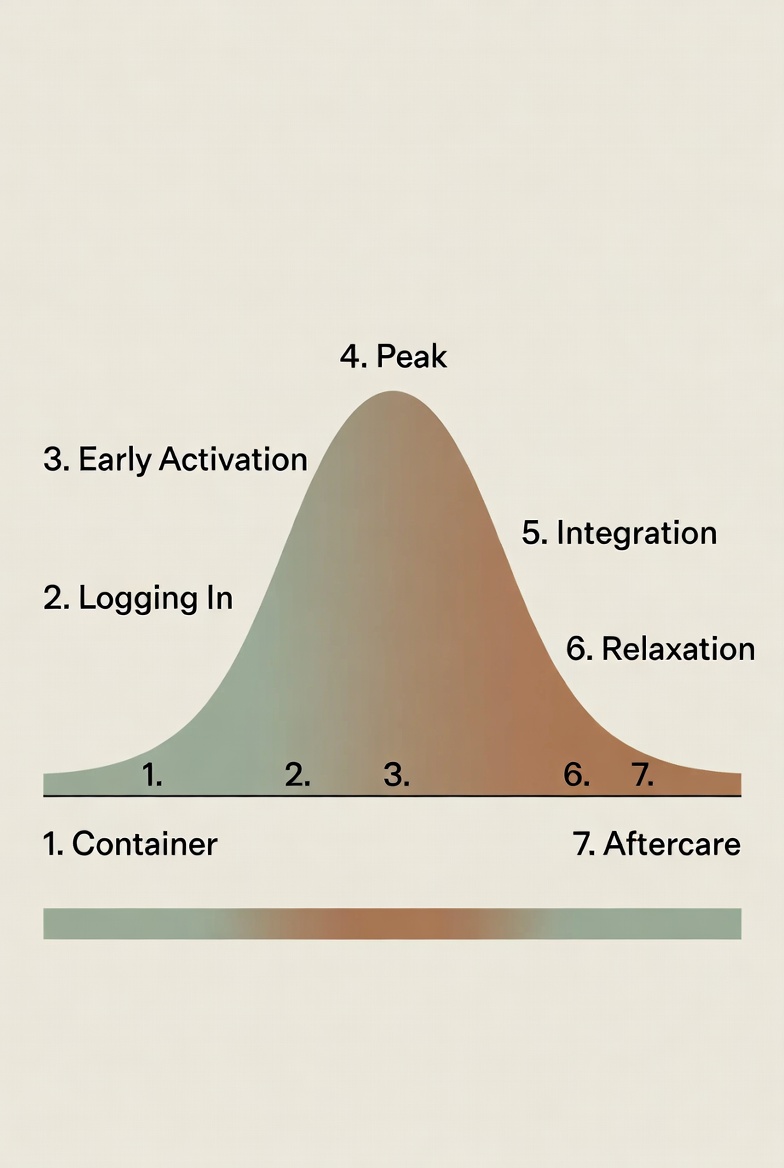
Chapter Two: The Seven Phases of a Cocoon Session
The Seven Phases — the bell curve of a Cocoon session
What goes up must come down. The descent is not optional.
Every Cocoon session follows a seven-phase structure. This arc creates the container for transformation, guides the journey from opening to closing, and ensures safe activation and complete integration.
As you guide your client through the seven phases, you are also guiding their parts system. The Logging In settles the managers enough that Self becomes slightly more accessible. The Activation Phase may activate firefighters before it opens exiles — and reading which is happening changes your guiding choices. The Integration Phase gives the parts that arose a chance to be acknowledged before the session closes. You do not need to use IFS language explicitly in every session. But understanding that you are always working with a parts system — not just a nervous system — gives you a layer of reading that makes every session more precise.
P1 Phase 1: Creating the Container 5-10 minutes · NS Goal: Ventral vagal engagement, social connection Purpose: Establish safety, connection, and intention What happens: The session begins before the client lies down. The container is created through: physical preparation (space clean, warm, sound ready), your preparation (reviewed notes, entered Master State, regulated, grounded), a warm greeting, the check-in ("How are you arriving today?
"), and setting the frame (reviewing agreements, clarifying intention). Your role: Enter Master State BEFORE they arrive — this cannot be overstated. If you are not regulated, you cannot regulate them. Create physical safety: temperature, lighting, sound, privacy. Establish connection: your regulated nervous system invites theirs to co-regulate. Note their state as they talk — this informs your session design. Common mistakes: Rushing the opening (it IS the real work). Skipping the check-in. Not reviewing touch agreements. Starting dysregulated by taking a call right before or not giving yourself transition time. "Welcome. Come in, make yourself comfortable. How are you arriving today?
" · "Before we start, I want to remind you — you can stop at any time. Just say 'pause' and we'll pause."?
Script: Setting Intention
"What would you like to focus on today? What would make this session feel complete?"
"Take a moment and just notice — how is your body? Your energy? Anything that wants me to know before we begin?"
P2 Phase 2: Logging In (Body Scan) 5-10 minutes · NS Goal: Interoceptive connection, present-moment grounding Purpose: Arrive in body, establish baseline awareness What happens: The client lies down. You guide them from external awareness to internal awareness — from thinking to sensing. Transition to the mat, then a progressive body scan from feet to head, noticing without changing. Then breath awareness: notice natural breath pattern, where it moves in the body, its quality. No instruction yet — just observation. Your role: Guide attention inward — your voice becomes the bridge from ordinary consciousness to body awareness. Slow, soft, rhythmic guidance. Create baseline: you need to know where they're starting. The scan reveals tension, holding, breath patterns. Do NOT fix yet — just observe. Track their response: can they follow your guidance?
Where do they get stuck?
Common mistakes: Going too fast (the mind needs time). Skipping body parts. "Fixing" during the scan ("release your jaw" — no, just notice). Not tracking what you observe. "Let yourself settle into the mat. Feel the surface supporting your body. You don't have to hold anything up. Let the ground hold you."?
Complete Body Scan Script
"Bring your awareness to your feet. Just notice them. Temperature? Sensation? Nothing to change, just notice. Now your lower legs… ankles, calves, shins. What is present?
Moving up to your knees… your thighs… front and back of the legs. Noticing.
Your pelvis and hips… your lower back… your belly. Is the belly soft or held? Just notice.
Your mid-back… your chest… your shoulders. Where do you feel tension? Where ease?
Your arms… upper arms, elbows, forearms, hands, fingers. Just noticing what's here.
Your neck… your throat… your jaw. Is it clenched or soft?
Your face… your forehead… the space behind your eyes.
The whole body now. What is the overall sense? Where does your attention want to go? And notice your breath. Without changing it. Where does breath move in your body? What is its quality? Its rhythm? Just observe."
P3 Phase 3: Activation (Building Energy) 15-30 minutes · NS Goal: Controlled sympathetic activation within window of tolerance Purpose: Access material, reveal holding patterns, mobilise energy What happens: The breath technique begins. Energy builds in the system. The nervous system activates. Material surfaces. Early activation (first 5-10 min): establishing breath pattern, building rhythm. Mid activation (10-20 min): energy building, emotional material may surface. Peak activation (20-30 min): maximum intensity within window, material fully present. Your role: Guide the breath with clear, consistent instruction. Encourage through discomfort — the edge is where the work happens. Track the window of tolerance constantly — are they approaching overwhelm?
Adjust intensity. Stay present — this is where material surfaces, your grounded presence is their anchor. Common mistakes: Pushing past the window. Not tracking signs of overwhelm. Speaking too much during peak moments. Showing anxiety when intensity builds. "You're doing great. Keep the breath connected." · "Let it come. You're safe." · "Stay with it. Let your body do what it needs to do."?
Signs of Healthy Activation Tingling in hands, feet, face (normal). Temperature changes (normal). Emotional waves (healthy processing). Spontaneous movement (body releasing). Sound wanting to emerge (expression). Tremoring (discharge happening). Signs of Approaching Overwhelm Breath becoming gasping or panicked. Eyes wide, facial tension increasing. "I can't" statements. Thrashing without direction. Freezing, going silent. Unable to hear your guidance.
P4 Phase 4: Integration (Transformation) 10-20 minutes · NS Goal: Transition from activation to processing Purpose: Allow completion, insight, and transformation What happens: The most important phase — and the most commonly rushed. Moving from active breathing to natural breath. Intensity gradually decreasing. Body processing what was activated. Emotions completing their cycles. Body movements finishing. Insights arising. Resolution happening. New patterns forming. Your role: Signal the transition: "Let your breath find its own rhythm now. There's nothing to do." Then reduce your intervention — integration happens without your guidance. Allow stillness. The client may be very still. This is integration. Do NOT fill the silence. Trust the process. Common mistakes: Rushing because it "looks like nothing is happening." Asking questions. Interpreting their experience. Suggesting what they might be feeling. Moving to the next phase too quickly. Getting anxious about silence. "Rest now." · "Let yourself be breathed." · "Nothing to do." · "Just receive."?
What Integration Looks Like Quiet crying that softens. Deep sighing. Body settling. Face relaxing. Subtle movements completing. Very slow, deep breathing. Apparent stillness (much happening internally). Why This Phase Gets Rushed Practitioner discomfort with silence. Feeling like nothing is happening. Wanting to move to the next thing. Time pressure. Misunderstanding what integration looks like. Remember: the silence IS the work.
P5 Phase 5: Relaxation (Grounding) 10-15 minutes · NS Goal: Full parasympathetic engagement, safety and rest Purpose: Deep rest, parasympathetic activation, embodiment What happens: The nervous system completes its descent. Deep relaxation becomes possible. Parasympathetic dominance. Body heavy or floating. Profound stillness. Sense of peace. Breath slow and regular. Body visibly relaxed. Face soft. Limbs heavy. May appear to be sleeping. Your role: Create conditions: music soft and spacious, room comfortable, no pressure. Minimal intervention. Your presence is enough. Silence is the intervention. Track for completion: spontaneous deeper breath (sigh), slight stirring, eyes beginning to move under lids, natural readiness to emerge. Common mistakes: Rushing this phase because it "looks complete." Turning on lights or changing music abruptly. Starting to talk about the session. "Rest as long as you need." · "There's no hurry."?
P6 Phase 6: Logging Out (Closing) 5-10 minutes · NS Goal: Reorientation to external world while maintaining integration Purpose: Return to ordinary consciousness, ground and orient What happens: Gradual return from inner journey to outer reality. Awareness expanding back to room. Physical sensations returning. Gentle movement beginning. Eyes opening when ready. Transition to sitting. Your role: Guide gently: soft voice guiding them back. No sudden shifts. Ground: help them feel their body, the room, the present. Do NOT rush. Give plenty of time. They are returning from somewhere far. Common mistakes: Starting to talk about the session immediately. Asking how they are feeling before they're ready. Rushing them up. Turning on bright lights. Returning to your busy energy. "When you're ready, begin to notice the room around you… wiggle your fingers and toes, very gently. When it feels right, gently roll to one side. And in your own time, slowly come up to sitting. There's no hurry."?
P7 Phase 7: Aftercare (Integration Support) 5-10 minutes · NS Goal: Consolidate regulation, prepare for re-entry to world Purpose: Ground, debrief, provide integration guidance What happens: The client has returned but needs transition time before leaving. Offer water. Give time to settle. Check in when ready. Answer questions. Assess groundedness: can they make eye contact?
Is speech coherent?
Do they know where they are?
Are they safe to drive?
If NOT grounded: more time, walk around, cold water on wrists, grounding exercises. Your role: Continue holding space — the session is not over when they sit up. Listen more than speak. Do NOT interpret. Ensure groundedness before they leave. Provide clear integration guidance. Common mistakes: Jumping immediately into analysis of the session. Rushing them out the door. Forgetting to check groundedness. Sending them off still spacey. "How are you feeling?
Take your time." · "Would you like to share anything about your experience?
"?
Standard Aftercare Instructions
"For the next 24-48 hours: take it easy, no big decisions. Rest if you need to. Hydrate well. Time in nature if possible. Avoid alcohol and stimulants. Gentle movement only. Let yourself process — things may continue to unfold. Journal if you feel called to."
In pairs, practice the full session arc (abbreviated, 15 min total). Person A facilitates: Phase 1 Creating Container (2 min), Phase 2 Logging In (2 min), Phase 3 Activation with simple breath only (4 min), Phases 4-5 Integration/Relaxation (3 min), Phase 6 Logging Out (2 min), Phase 7 Aftercare (2 min). Person B receives then gives feedback: How did each phase feel? What transitions worked? What was rushed or needed more time? Switch roles. Group discussion: what did you learn about the arc?
Which phase of the arc do you anticipate finding most challenging?
Where might you be tempted to rush?
To over-talk?
To under-support?
What helps you trust the process and allow the arc to complete naturally?
Chapter Three: Breathing Techniques for Sessions
“"Different breath patterns serve different purposes. You must know when to use which technique based on what the client needs in the moment — not what you planned to do."”
As a Cocoon practitioner, you have multiple breathing techniques available. Knowing when to use each is as important as knowing the techniques themselves. Think of these as tools. A carpenter doesn't just use a hammer for everything. The art is matching technique to moment.
Baseline — where we begin and return What it is: How humans are designed to breathe at rest — quiet, nasal, diaphragmatic, slow. The baseline of respiratory health and nervous system regulation. Characteristics: Nasal breathing. Diaphragmatic movement (belly expands on inhale). Slow rate (6-10 breaths per minute). Quiet (no audible breathing). Relaxed, no effort especially on exhale. Small, appropriate volume. When to use: Beginning of session (establishing baseline). End of session (returning to normal). When client is overwhelmed (regulate first). Between active phases. Teaching healthy breathing patterns. Cue: "Let your breath settle into a natural rhythm. Breathing gently through your nose. Let your belly rise on the inhale, fall on the exhale. No effort. Just easy, natural breath. Like you're resting but awake."?
Many clients have dysfunctional baseline breathing — mouth breathing, chest breathing, over-breathing. Teaching functional breathing is foundational work that supports everything else. If they can't breathe nasally: work on nasal patency. If breath is stuck in chest: use hands on belly to guide. If over-breathing: reduce volume, slow pace.
Primary activation technique — the main event What it is: Continuous breathing without pauses between inhale and exhale. The breath becomes one connected flow — like a circle or wave. This pattern activates the sympathetic nervous system and begins to surface material. Characteristics: Mouth breathing (or nose in, mouth out). Connected rhythm — no pause between inhale and exhale. Full breaths (complete inhale, relaxed exhale). Continuous flow like a circle or wave. Medium to faster pace. Three-part inhale (belly, ribs, chest) when building. When to use: Activation phase of sessions. When accessing deeper material. When building energy for release. When emotion needs to move. Client is grounded and ready. No contraindications present. Duration: 15-30 minutes typically. Cue: "Open your mouth and breathe. Inhale fully — belly, ribs, chest. Exhale without pausing — just release. Keep the breath connected, no gaps. Like a circle. Like a wave. In flows into out flows into in. Keep going." Cautions: Monitor for tetany (hand cramping). Track window of tolerance. Slow down if overwhelm threatens. Contraindicated in pregnancy, cardiovascular issues, severe anxiety, recent surgery. Not for clients who need grounding first.?
The Three-Part Inhale for Maximum Activation
Step 1: Belly Belly fills first. Diaphragm descends. Lower belly expands outward. Step 2: Ribs Ribs expand laterally. Mid-chest opens sideways.
Step 3: Chest Chest rises at top. Upper lobes fill. Step 4: Release Exhale releases everything with no effort. Just let it go.
CCB Variations
Slow CCB For building gradually, sensitive clients, first-timers. Lower intensity, longer duration. Good for new clients and those with narrow window. Fast CCB For pushing through resistance, accessing deep material. Greater intensity, shorter duration. Use when capacity is established.
Soft CCB Gentler intensity, longer duration. Good for emotional integration work. Strong CCB Greater volume, shorter duration. For dramatic activation when indicated.
What Happens During CCB
CO2 drops (respiratory alkalosis). pH shifts (body becomes more alkaline). Tingling, temperature changes (normal). Emotional material surfaces. Body memories activate. Altered states possible. Tetany can occur (manageable — see below).
Nervous system regulation — heart-brain coherence What it is: Breathing at approximately 5-6 breaths per minute with equal inhale and exhale creates a state called heart-rate variability coherence. The heart rhythm becomes smooth and sine-wave-like, the nervous system balances, and the brain enters calm alertness. Characteristics: 5-6 breaths per minute. Equal inhale and exhale (5 seconds each). Nasal breathing preferred. Smooth, even rhythm. Optional focus on heart area. When to use: Calming an activated client. Building capacity before deeper work. Heart-centred practices. Integration phase. Clients with anxiety. Teaching self-regulation. Cue: "Breathe in for five counts… one, two, three, four, five. Out for five counts… one, two, three, four, five. Smooth and even. You might imagine the breath flowing through your heart."?
At 5-6 breaths per minute, breathing synchronises with natural cardiovascular rhythms. The baroreceptor reflex creates coherence between heart and breath. Both branches of the ANS balance. The smoothness matters more than exact timing. Heart focus enhances the effect.
Activate parasympathetic — calm and ground What it is: When the exhale is longer than the inhale, the vagus nerve is stimulated and the parasympathetic nervous system activates. This is the most reliable way to shift from stressed to calm. Characteristics: Exhale longer than inhale (common ratios: 4:6, 4:8, 5:7). Slow, deliberate pace. Nasal or mouth exhale (mouth helpful for longer exhales). Often with soft sound on exhale (sighing, humming). When to use: Client is too activated. Panic or overwhelm arising. Transition to relaxation phase. Grounding after intense material. Any time parasympathetic activation is needed. Cue: "Let's slow the breath down. Breathe in for four counts… one, two, three, four. Now exhale slowly for six, seven, eight. Let the exhale be longer. Feel yourself settling."?
Variations 4-7-8 breathing (inhale 4, hold 7, exhale 8). Sighing exhale (audible release). Humming exhale (activates vagus through vibration). Ocean breath (soft ujjayi sound on exhale). Why It Works The exhale activates the vagal brake on the heart. Longer exhales mean more vagal activation. The body receives the signal: "danger has passed, relax." This is the fastest reliable route to parasympathetic activation.
Energising, activating, clearing stagnation What it is: Rapid, rhythmic breathing with emphasis on sharp exhales. The inhale is passive (belly snaps out naturally after the exhale). Creates heat and energy. Characteristics: Rapid rhythmic breathing (1-2 breaths per second). Emphasis on sharp exhale (inhale is passive). Pumping action in belly. Through nose. 30-120 breaths per round. When to use: Energising a sluggish client. Clearing stagnant energy. Building heat and activation. Morning practices. Kapha constitution clients. Breaking through numbness or dissociation (carefully). Cue: "Short, sharp exhales through the nose, pumping the belly. The inhale happens naturally — don't force it. Like a train picking up speed. Pump, pump, pump…" Cautions: NOT for pregnancy. NOT for high blood pressure. NOT for acute anxiety (too activating). NOT for hernias or recent abdominal surgery. Use briefly (1-2 minutes max). Always follow with grounding breath.?
Balancing, centring, focus What it is: Equal parts — inhale, hold, exhale, hold — creating a "box" or square pattern. Activates both branches of the ANS and creates centred alertness. Characteristics: Equal parts: inhale, hold, exhale, hold. Typically 4-4-4-4 counts (adjust as needed). Creates stability and presence. Focuses the mind. When to use: Centring before session. Building focus and presence. Balancing an erratic client. Practitioner self-regulation. When both activation and calm are needed. Cue: "Breathe in for four counts… one, two, three, four. Hold for four… one, two, three, four. Exhale for four… one, two, three, four. Hold for four… one, two, three, four. A perfect square. Feel the balance."?
Managing Tetany
Tetany (carpopedal spasm) can occur during CCB due to respiratory alkalosis — the drop in CO2 that comes with sustained deep breathing. It is uncomfortable but not dangerous.
Signs Hand cramping (claw-like position). Tingling intensifying in hands, feet, face. Lip pursing or numbness around mouth. Leg cramping in more severe cases. Tight feeling in chest. Why It Happens CCB reduces CO2, which raises blood pH. This affects calcium availability to muscles, causing spasm. Prevention: watch for early signs, ensure client is not forcing the exhale, check for muscle tension in arms and hands (clenching worsens it).
Management Protocol
- 1 Don't panic (yours or theirs). Your calm response is essential. "This is normal and will pass."
- 2 Slow the breath. Don't stop suddenly — transition to slower breathing. "Let's slow down together. Easy breath now."
- 3 Add CO2 back. Have client breathe into cupped hands briefly. Or add pauses between breaths.
- 4 Relax the muscles. "Shake out your hands. Relax your fingers. Open and close your fists."
- 5 Reassure. "This happens sometimes. It will pass in a minute or two. You're safe."
It resolves quickly once CO2 normalises. Your calm response prevents it from becoming frightening. It will pass within 1-2 minutes in most cases.
Breath Apnea (Spontaneous Pauses)
Sometimes clients spontaneously stop breathing during sessions. This can have different meanings depending on context.
During Activation (1-2 seconds) Client is reaching an activation plateau. Normal. Response: allow a moment, then gently encourage continuation. "Keep the breath moving." During Facilitation (5-30 seconds) Response to bodywork, intense moment, or approaching material. Pause your intervention, maintain contact, wait for breath to resume. Say softly: "It's safe."
Extended Pause (30+ seconds) Nervous system reset or deep processing. Can be part of the work. Response: do not panic. Stay present. Gently invite breath: "When you're ready, let a breath come." Trust the body. At the Peak Natural pause at maximum activation before descent. Response: wait. This is often where transformation happens. Do not rush it.
Matching Breath to Session Phase
| Phase | Primary Technique | Purpose | | --- | --- | --- | | Creating Container | Functional | Establish baseline, settle | | Logging In | Slow functional | Arrive in body, awareness | | Early Activation | CCB (slower) | Begin building energy | | Peak Activation | CCB (faster/fuller) | Access material, maximum arousal | | Integration | Natural/slowing | Allow processing | | Relaxation | Extended exhale | Parasympathetic activation | | Logging Out | Functional | Return to normal |
If Too Activated Slow the breath. Extended exhale emphasis. Grounding cues. Your own calm presence. May need to stop CCB entirely. If Not Accessing Increase CCB intensity. Encourage fuller breaths. Add movement or sound. Check for protective parts (IFS). They may need more safety first.
If Dissociating Stop CCB immediately. Grounding breath (functional, slow). Orient to room. Physical contact with consent. Do not continue activation until present. If Integrating Minimal intervention. Let breath find its own rhythm. Trust the process. Silence is usually best.
Solo practice (15 min): Functional breathing (2 min baseline). Transition to CCB (4 min activation). Slow to Coherent (2 min beginning integration). Extended exhale (2 min deepening relaxation). Return to Functional (2 min baseline return). Notice: how each transition feels, what your body does at each shift, where you feel challenged. Then partner practice: guide a partner through the transitions and get feedback on timing, cues, and voice. Switch roles.
Role-play tetany management. Partner A acts as client experiencing tetany (hand cramping, tingling). Partner B responds as practitioner, practising: staying calm, reassuring language, slowing the breath, guiding CO2 restoration, relaxing the hands. Debrief: how did the "client" feel with the response? What worked? Switch roles.
Which breathing technique are you most comfortable with?
Least comfortable?
How do you personally respond to CCB?
What arises for you?
What signs do you look for to know when to shift techniques?
| Phase | Primary Technique | Purpose |
|---|---|---|
| Creating Container | Functional | Establish baseline, settle |
| Logging In | Slow functional | Arrive in body, awareness |
| Early Activation | CCB (slower) | Begin building energy |
| Peak Activation | CCB (faster/fuller) | Access material, maximum arousal |
| Integration | Natural/slowing | Allow processing |
| Relaxation | Extended exhale | Parasympathetic activation |
| Logging Out | Functional | Return to normal |
Chapter Four: Verbal Guidance & Touch
“"What you say matters. How you say it matters more. And sometimes the most powerful intervention is silence."”
The Power of Voice
Your voice is a primary instrument of facilitation. It is not just a delivery mechanism for instructions — it IS itself an intervention. Your voice can create safety or trigger fear, ground or activate, connect or distance. Your voice transmits your state. If you are anxious, your voice carries anxiety regardless of what words you use.
Warmth Genuine care communicated through tone. Not artificial sweetness, but authentic kindness. Steadiness Calm, even in intense moments. Your steady voice anchors them when they are activated.
Pacing Matching the client's state, then leading slightly. If they are activated, do not speak slowly immediately — match first, then gradually slow. Silence Comfort Knowing when not to speak. This is perhaps the most important quality. The default rule: when in doubt, stay silent. You can always speak later. You cannot unsay words that interrupted a process.
The uncomfortable truth: many new practitioners fill silence because THEY are uncomfortable, not because the client needs words. Learn to be comfortable with silence. Your silence communicates trust in the process.
When to Speak, When to Be Silent
Speak When Giving instruction (breath guidance). Client needs encouragement. Transition between phases. Checking in briefly. Providing safety cues. Grounding them. Guiding attention. Be Silent When Integration is happening. Deep processing is underway. Client is in flow. Emotion is moving naturally. You feel the urge to fill space. You do not know what to say. Something sacred is occurring.
Questions That Open vs. Questions That Close
Questions That OPEN Return attention to body and present moment. "What do you notice?" · "Where do you feel that in your body?" · "What is here right now?" · "What wants to happen?" · "Can you stay with that?" · "What does that feel like?" Questions That CLOSE Lead to thinking, analysing, leaving experience. "Why do you think you feel that way?" · "What does that mean?" · "Is that related to your childhood?" · "What caused that?" · "What should we do about it?"
Opening questions return attention to BODY and PRESENT. Closing questions activate MIND and ANALYSIS. In somatic work, we primarily use opening questions. We are not doing talk therapy. We are facilitating body experience. The mind's analysis can come later — after the body has done its work.
Voice Qualities in Practice
Pace Slower than normal conversation. Matches breath rhythm. Pauses between phrases. Gives time for processing. Volume Soft but audible. Not loud (activating). Not too quiet (straining to hear also activates). Consistent level.
Tone Warm, not cold. Grounded, not heady. Present, not distant. Melodic variation (not monotone). From your centre, not your throat.
If someone heard your facilitation voice without understanding the words, would they feel soothed or anxious? Record yourself and listen back. This is one of the most useful practices you can do.
Complete Verbal Guidance Scripts
▼ Opening the Session "Welcome. Come in, make yourself comfortable. Take a moment to arrive here." "This time is for you. There's nothing you need to do except be here." "Before we begin — you can stop at any time. Just raise your hand or say 'pause.' You always have control of this process." "What would you like to focus on today?
What would make this session feel complete?
"?
▼ Initiating CCB "Now open your mouth and begin connected breathing. Inhale fully — let the breath fill your belly, then your ribs, then your chest. And exhale without pause — just release. Keep the breath flowing. In flows into out flows into in. Like a wave. Like a circle. Keep going." "No pauses between inhale and exhale. The breath is continuous. In and out and in and out." "Keep the breath connected. You're doing great."?
▼ Encouragement During Activation "You're doing great. Keep the breath connected." "Stay with it. Let your body do what it needs to do." "This is normal. Keep breathing." "Whatever is arising, let it come. You're safe." "You've got this. Keep going."?
▼ When Emotion Arises "Let it come. You're safe." "That's right. Let it move through." "Stay with the breath. Let the feeling be here." "You don't have to do anything with it. Just breathe." "Whatever this is, it's welcome here."?
▼ When They Want to Stop "I hear you. Let's slow the breath down together. In… and out… slower. You're safe. Take your time." "It's okay to pause. Stay with me. Feel your feet." "You can stop whenever you need to. What would help right now?
"?
▼ Transitioning to Integration "Now let your breath find its own rhythm. There's nothing to do. Just let yourself be breathed." "The active part is complete. Rest now. Let your body integrate." "Nothing to do. Nowhere to go. Just be."?
▼ During Relaxation "Rest now." · "Let yourself receive." · "Nothing to do. Nowhere to go." · "Just be." (Mostly silence. These four phrases cover everything this phase needs.)?
▼ Logging Out "When you're ready, begin to notice the room around you. Feel the temperature of the air on your skin. The sounds in the room." "Wiggle your fingers and toes. Very gently. There's no rush." "Feel the weight of your body. Feel the surface beneath you." "When it feels right, you might gently roll to one side. Take your time." "And in your own time, slowly come up to sitting. There's no hurry. Stay with the experience as you move."?
What NOT to Say
Avoid Interpretation NOT: "That was your inner child releasing." INSTEAD: "What was that like for you?" Avoid Leading NOT: "You must be feeling relieved now." INSTEAD: "How are you feeling?"
Avoid Minimising NOT: "Everyone goes through this." INSTEAD: "That sounds significant." Avoid Fixing NOT: "Here's what you should do about that." INSTEAD: "What do you need right now?"
Avoid Over-Explaining NOT: "What's happening is that your CO2 is dropping which creates respiratory alkalosis…" INSTEAD: "This is normal. Your body knows what to do."
Touch Protocols
Touch is powerful. It can heal or harm, comfort or intrude. Clear protocols are essential — for the client's safety and yours.
Consent Framework
Before the Session Explain what touch might involve. "In this work, I may use supportive touch — like a hand on the shoulder, holding your feet, or a hand on your back. All touch is optional. You can say no to any touch at any time." Ask: "Are there any areas of your body you'd prefer I not touch?" Document their response. At the Beginning of Each Session Even with prior consent, check each session: "Just to check in — is touch okay for you today? Any adjustments from what we discussed?"
During the Session Even with prior consent, check before new touch: "I'm going to place my hand on your shoulder. Is that okay?" Wait for affirmative response (verbal or nod). If Response Is Unclear Ask again clearly: "I want to make sure — is it okay if I hold your feet?" If they say no or seem uncomfortable: immediately remove or do not apply touch. No explanation needed. Simply say "Of course" and continue with verbal support only.
Types of Supportive Touch
Grounding Touch Purpose: create safety, anchor to present, activate ventral vagal. Holding feet (excellent for grounding and calming). Hand on shoulder (reassurance and connection). Hand on upper back (support and containment). Containing Touch Purpose: create boundaries, help contain intense experience. Gentle pressure on forehead (calming). Hands on either side of head (containing the mind). Hands on shoulders pressing gently down (grounding intense energy).
Supporting Movement Purpose: allow completion of physical impulses. Light pressure on belly (breath support). Holding arm or leg (allowing movement against resistance). Supporting tremoring (containment without stopping). Crisis Touch Purpose: emergency grounding only. Both hands on feet with firm pressure. Hand on sternum with clear "You're here, you're safe." Use only when clearly needed.
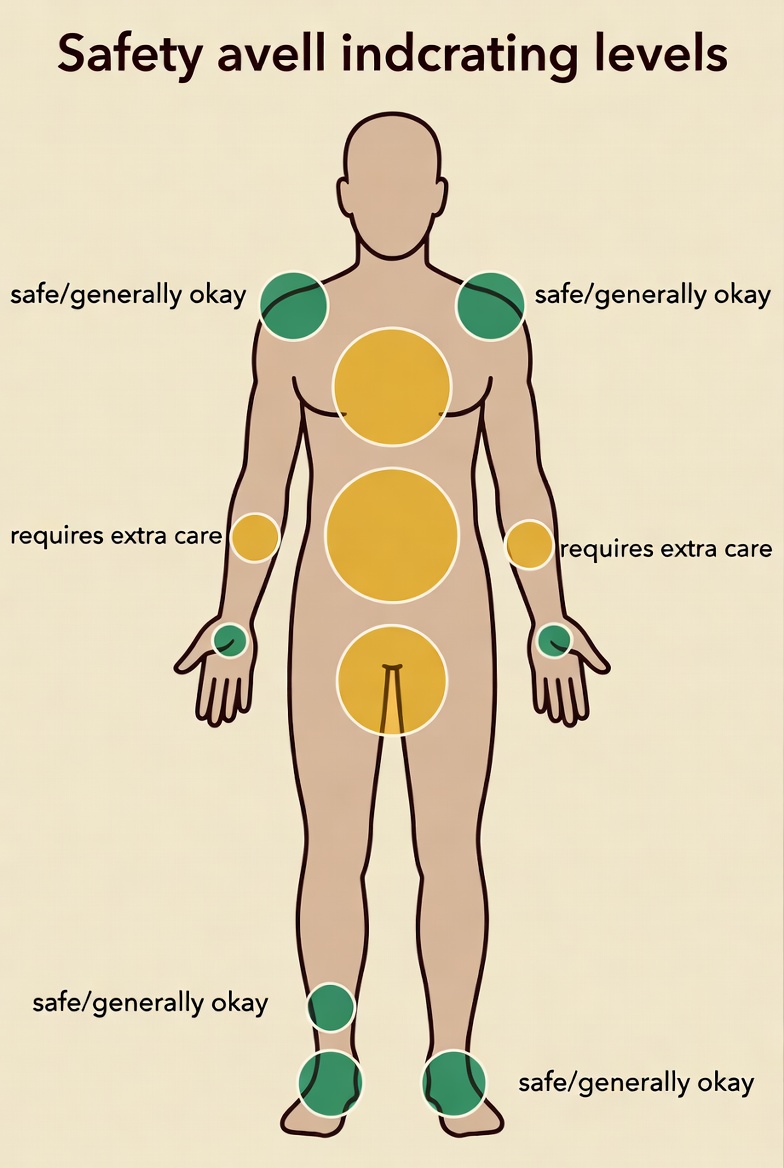
Safe touch points — generally safe (green) and requires extra care (yellow)
Note: feet, hands, shoulders, head/scalp are generally safe with consent. Chest, abdomen, and lower back require explicit consent and clear clinical purpose.
| Location | Purpose | Notes | | --- | --- | --- | | Feet | Grounding, calming | Excellent first touch, rarely triggering | | Hands | Connection, support | Can hold or place hand on | | Shoulders | Reassurance | Gentle pressure, not massaging | | Upper back | Support, holding | Flat hand, still pressure | | Head/scalp | Calming, containing | Ask specifically first | | Abdomen | Breath support | Always ask specifically — vulnerable area | | Chest | Heart support | Be very clear about purpose; professional approach required |
Avoid unless specifically trained Throat. Groin area. Breasts. Inner thighs. Any area client specified as off-limits. When in doubt, ask. Better to ask and confirm than to assume and trigger.
Touch Quality
Grounded & Slow Touch from your centre, not just your hands. Your whole body supports the touch. No sudden movements. Approach slowly, touch slowly, release slowly. Present & Purposeful Full attention in your hands. Not thinking about what comes next. Know why you are touching. Random touch is confusing.
Supportive vs. Directive Supportive touch: offers presence and safety, creates conditions for release, follows the body's lead. Says "I'm here with you." We use supportive touch only. We do not force the body to release through touch.
Energy Through Touch
When you touch a client, you are connecting energy fields. Your state affects them through touch.
Before Touching Ground yourself. Access Self-energy (calm, curious, compassionate). Set intention to support, not fix. Be present in your own body. During Touch Stay connected to your own body. Let energy flow through, not from you. Notice what you sense. Remain boundaried — their experience, not yours.
Working with Resistance
Sometimes clients resist touch or verbal guidance. This is information, not obstruction.
If They Resist Breath Guidance A protective part may be active. Slow down. "I notice the breath wants to stay shallow. What might happen if it went deeper?" Honour the resistance. It is there for a reason. If They Resist Touch Honour it completely. "No problem. I'll stay right here without touch. You're still supported." Do not take it personally. Do not try to convince them.
If They Go Silent Silence can be integration or shutdown. Check in briefly: "I'm here with you. Take your time." If silence continues and you're concerned, orient gently. If They Want to Leave Never block or argue. "Of course. Let's take a moment to ground before you go." Ensure they are safe to leave. Their autonomy comes first.
Solo recording: record yourself reading the body scan script. Listen back. Notice: warm or cold? Rushed or paced? Grounded or heady? Partner practice: Partner A reads a script with eyes closed, Partner B gives feedback on voice quality. Switch roles. Practice silence: sit with a partner in silence for 3 minutes. Notice your impulse to fill the space. Practice being comfortable without speaking.
Partners sitting, A as client, B as practitioner. Practice: (1) B asks for touch consent before session. (2) B asks before each touch point. (3) B practices different touch qualities (grounding, containing). (4) A gives feedback after each touch. (5) Practice having A say "no" and B responding appropriately. Switch roles. Debrief: how did it feel to ask for consent? To receive clear consent? To say no? To receive no?
What is your relationship with using your voice in facilitation?
How comfortable are you with silence during sessions?
What are your personal boundaries around giving and receiving touch?
Where might you need to develop more comfort or skill?
| Location | Purpose | Notes |
|---|---|---|
| Feet | Grounding, calming | Excellent first touch, rarely triggering |
| Hands | Connection, support | Can hold or place hand on |
| Shoulders | Reassurance | Gentle pressure, not massaging |
| Upper back | Support, holding | Flat hand, still pressure |
| Head/scalp | Calming, containing | Ask specifically first |
| Abdomen | Breath support | Always ask specifically — vulnerable area |
| Chest | Heart support | Be very clear about purpose; professional approach required |
Chapter Five: Working with What Arises
“"Your job is not to make things happen. Your job is to be present with what happens."”
The Spectrum of Experience
In breathwork sessions, clients may experience a wide range of phenomena. Nothing should surprise you. Everything is welcome.
Physical Experiences Tingling, numbness, pins and needles. Temperature changes (hot flashes, cold waves). Spontaneous movement (arms lifting, back arching). Tremoring, shaking, vibrating. Muscle tension or release. Pain surfacing and releasing. Tetany. Nausea (rare). Yawning, sighing. Emotional Experiences Waves of sadness, grief. Anger, rage. Fear, terror. Joy, bliss. Love, gratitude. Shame, guilt. Confusion, disorientation. Relief, peace. Mixed emotions (waves of different feelings).
Mental Experiences Memories arising (clear or fragmented). Insights and realisations. Visual imagery. Dreamlike states. Confusion or clarity. Thoughts stopping. Expanded awareness. Energetic Experiences Chakra sensations. Energy moving through body. Lightness or heaviness. Expansion or contraction. Heat or coolness flowing. Vibration or buzzing.
Your job: hold space for all of it without attachment to any particular outcome. Do not prefer tears over anger. Do not prefer breakthrough over subtle shift. Meet what arises.
Responding to Emotional Release
Signs: Crying (soft or intense), face contorting with grief, body shaking with sobs, quiet tears streaming. Your role: Stay present and calm. Offer tissues without interrupting (place nearby). Do not try to stop or comfort too quickly. Allow the wave to complete naturally. Grief comes in waves — allow each wave to crest and subside naturally. Do not interrupt the cycle. What to say: "Let it come…" · "You're safe. I'm here." · "Let it move through…" · "There's nothing to do except let this be here." What NOT to do: Rush to comfort (patting, "there there"). Ask what they are crying about. Try to stop the tears. Minimise ("it's okay, you're okay"). Show alarm or concern. Touch without invitation.?
Signs: Face reddening, jaw clenching, fists forming, sounds emerging, body tensing with rage, wanting to hit or kick. Your role: Stay grounded in your own body. Encourage expression: "Let it out. You can make sound." Offer resistance if appropriate. Keep them safe from harming themselves or the space. Do not take it personally — it is not about you. What to say: "Let it out. You can make sound." · "Push here [offering resistance]." · "It's safe to be angry." · "Let your body express this." What NOT to do: Try to calm them prematurely. Ask what they are angry about. Engage with the content of the anger. Show fear (this can escalate or shame). Let them harm themselves or the space.?
Signs: Eyes wide, breath catching, trembling, wanting to flee, terror in the body, frozen quality. Your role: Increase safety cues. Ground them if needed. Your calm is their anchor. Important distinction: fear that is processing (waves, moving, completing) vs. fear that is overwhelming (frozen, unable to continue). The first you support. The second you ground. What to say: "I'm here. You're safe." · "Feel your feet on the ground." · "This is old fear. You're safe now." · "I'm not going anywhere." What NOT to do: Dismiss the fear ("there's nothing to be afraid of"). Push them deeper into it. Show your own concern. Leave them in terror without grounding.?
Signs: Spontaneous laughter, smiling, lightness, giddiness, tears of joy, expansive feelings. Your role: Let it be. Joy is healing too. May express as laughter or movement. Celebrate without interrupting. What to say: Very little needed. Perhaps: "Beautiful." · "Yes." Allow silence and let them experience it. What NOT to do: Analyse it. Ask questions. Deflate it with words. Rush past it to "more important" material.?
Responding to Physical Phenomena
■ Tremoring and Shaking What it is: The body's natural discharge mechanism. Involuntary shaking, trembling, vibrating. Can be in hands, legs, jaw, or whole body. TRE (Tension and Trauma Release Exercises) is built on this natural capacity. Tremoring releases held tension from the nervous system. Your role: Let it happen. Do not stop it. Normalise it. Stay grounded yourself. Do not amplify or force — let it be what it is. May need containing touch (feet, shoulders). Tremoring typically completes naturally within minutes. What to say: "This is your body releasing stored tension." · "Let it happen. Don't try to stop it." · "You're safe. There's nothing wrong." · "Good. Let it shake." What NOT to do: Stop the tremoring (unless clearly overwhelming). Amplify or encourage more than what's natural. Get concerned or show alarm. Interpret what it means. Massage or manipulate (this changes it).?
■ Spontaneous Movement What it is: The body moving in unexpected ways — arms lifting, back arching, head turning, pelvis rocking. The body completing movements it could not complete before, or expressing energy that needs to move. Your role: Allow it unless it seems unsafe. "Let your body do what it needs to do." Trust the body's wisdom. Create space for movement. May need to ensure safety (nothing to hit). What to say: "Let your body move." · "Trust what's happening." · "Your body knows what to do." What NOT to do: Stop movement unless clearly unsafe. Interpret the movement. Try to direct or shape it. Touch in ways that interrupt.?
■ Pain Arising What it is: Old pain surfacing to be released. The body storing and then releasing pain through awareness and breath. Client reports pain in area where they had injury, surgery, or chronic tension. Or pain with no clear source. Your role: "Stay with it if you can. Breathe into it." If too intense, slow down. Pain often releases with continued breath. Distinguish from acute injury (very rare). If pain is severe, sharp, or concerning, stop and check. What to say: "Breathe into that area." · "Stay with it if you can." · "This may be old pain releasing." · "Let me know if it's too much." What NOT to do: Force them to stay with unbearable pain. Ignore their distress. Assume all pain is release (check for injury). Touch the painful area without consent.?
■ Numbness and Dissociation What it is: Client spacing out, going blank, feeling far away. Protective dissociation — the system avoiding overwhelming material. Signs: eyes glazing over, voice flat or distant, feeling far away, going limp, not responding. Your role: Ground immediately. Stop CCB, use grounding breath. Physical contact (feet, shoulders) with consent. Orient to room. Do not continue activation until they are present. This means the window of tolerance is exceeded — do not continue activation. What to say: "Feel your body on the surface." · "Can you feel my hand?
" · "Open your eyes and look at me." · "You're here, in this room, with me." · "Tell me what you see." · "Feel your feet." What NOT to do: Continue activation. Leave them in this state. Ignore the signs. Rush them back. Panic or show alarm.?
Managing Overwhelm
Signs of Overwhelm Breath becoming gasping or frozen. Eyes wide with panic. Inability to hear you. Thrashing without completion. "I can't" statements. Freezing, going mute. Extreme distress. Different From Intensity Intense-but-contained processing. Strong emotion that is moving. Discomfort within capacity. Fear that is being breathed through. These you support — do not rush to intervene.
- 1 Stop activating technique. No more CCB. Done immediately.
- 2 Slow breath. "Slow down with me. In… and out… slower. Nice and slow."
- 3 Ground. "Feel your feet. Feel the mat beneath you. Feel my hand on your feet."
- 4 Orient. "Open your eyes. Look at me. Look around the room. Tell me what you see."
- 5 Contain. "You're safe. I'm here with you. Nothing is wrong. We can stop anytime."
- 6 Do not resume activation. Shift to integration and relaxation. Session goals are secondary to their safety.
Track window of tolerance throughout. Titrate intensity gradually. Check in regularly. Know their history. Build relationship and safety first.
Intervene minimally. Support maximally. Trust the process while maintaining safety. Allow when: process is moving naturally, client has capacity, expression is completing, integration is happening. Intervene when: client is clearly overwhelmed, dissociation is occurring, safety is compromised, client explicitly requests help.
| What Arises | Your Response | What to Say | What NOT to Do | | --- | --- | --- | --- | | Tears | Witness, allow wave | "Let it come" | Rush to comfort | | Anger | Ground yourself, allow expression | "Let it out" | Engage content, show fear | | Fear | Increase safety, ground if needed | "I'm here, you're safe" | Dismiss, push deeper | | Joy | Allow, celebrate | Very little | Analyse, deflate | | Tremoring | Allow, normalise | "Let it shake" | Stop it, interpret | | Movement | Allow, ensure safety | "Trust your body" | Direct or stop | | Pain | Breathe into, track | "Stay with it if you can" | Force, ignore | | Dissociation | Ground immediately | "Open your eyes, look at me" | Continue activation | | Overwhelm | Stop, ground, contain | "Slow down with me" | Push through |
Groups of 3: Person A (client), Person B (practitioner), Person C (observer). Scenarios to practise: (1) Client begins crying intensely. (2) Client's hands are cramping (tetany). (3) Client seems to be dissociating. (4) Client reports they want to stop. Person B responds appropriately for each. Person C observes and notes what worked, what could improve. Debrief after each scenario. Rotate roles so everyone experiences each position.
How do you typically respond when someone near you is in emotional intensity?
What types of expression do you find easiest to hold space for?
Most challenging?
What is your relationship with your own anger?
Grief?
Fear?
Joy?
What happens in your body when you witness intense emotion?
| What Arises | Your Response | What to Say | What NOT to Do |
|---|---|---|---|
| Tears | Witness, allow wave | "Let it come" | Rush to comfort |
| Anger | Ground yourself, allow expression | "Let it out" | Engage content, show fear |
| Fear | Increase safety, ground if needed | "I'm here, you're safe" | Dismiss, push deeper |
| Joy | Allow, celebrate | Very little | Analyse, deflate |
| Tremoring | Allow, normalise | "Let it shake" | Stop it, interpret |
| Movement | Allow, ensure safety | "Trust your body" | Direct or stop |
| Pain | Breathe into, track | "Stay with it if you can" | Force, ignore |
| Dissociation | Ground immediately | "Open your eyes, look at me" | Continue activation |
| Overwhelm | Stop, ground, contain | "Slow down with me" | Push through |
Chapter Six: Session Planning & Aftercare
“"The session serves the client, not the structure. Trust the arc. Trust the process. Trust yourself. And always, always, meet them where they are."”
Planning a Single Session
Physical Space Setup
☐ Room temperature comfortable (lean warm)
☐ Lighting adjustable (dimmer for relaxation)
☐ Mat and cushions prepared
☐ Blanket available
☐ Tissues within reach
☐ Water ready
☐ Phone silenced
☐ Privacy ensured
☐ Nothing in space to hit or break
☐ Quality speakers, playlist ready and tested
☐ Backup playlist downloaded (no internet dependency)
☐ Your notes reviewed, client history in mind
☐ You have entered Master State
☐ You have grounded yourself
☐ Your energy from previous session has been cleared
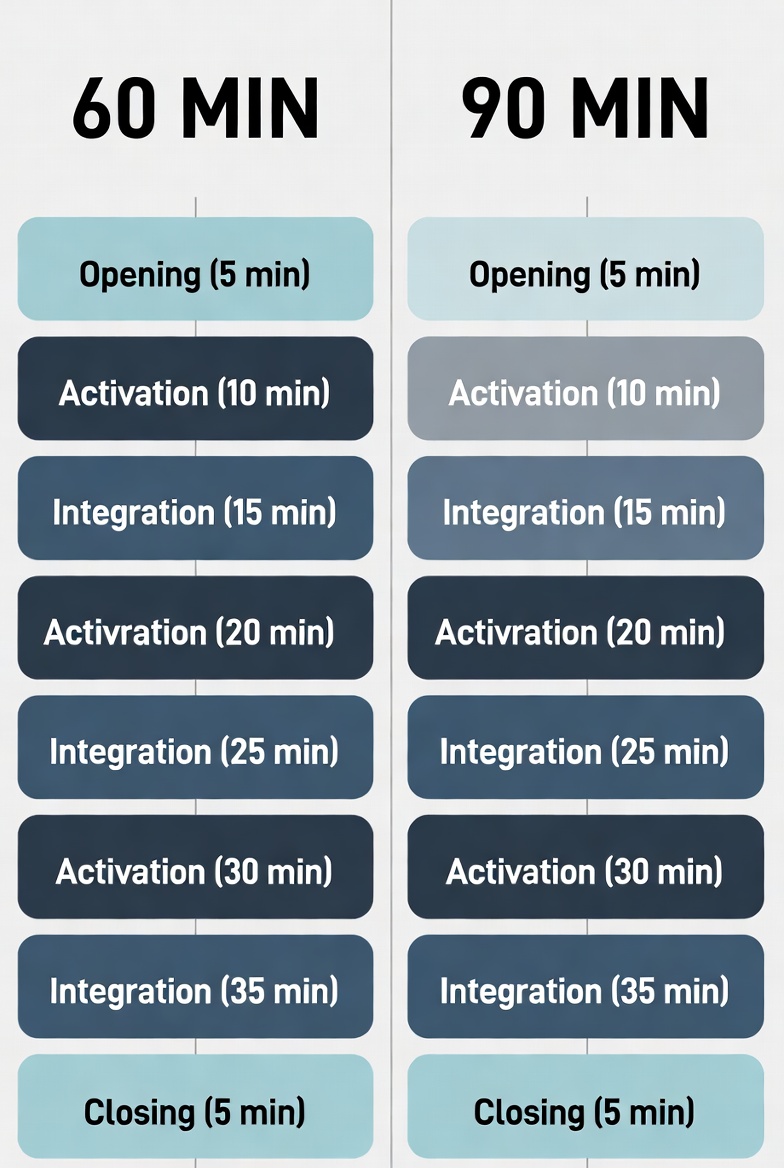
60-min vs 90-min session structure — the complete arc
Opening and closing phases are consistent; activation and integration scale with session length.
Music and Playlist Structure
Music is a powerful co-facilitator. It supports the arc of the session, holds the container, and can evoke states that words cannot. The right music at the right moment can do more than an hour of talking.
| Time (60 min) | Phase | Music Quality | | --- | --- | --- | | 0-5 min | Arrival | Gentle, ambient, soft | | 5-10 min | Logging In | Slow, grounding | | 10-25 min | Activation Build | Intensity gradually increasing | | 25-35 min | Peak Activation | Fullest intensity | | 35-45 min | Integration | Softening, spacious | | 45-55 min | Deep Relaxation | Ambient, very soft | | 55-60 min | Return | Gentle, grounding |
| Time (90 min) | Phase | Music Quality | | --- | --- | --- | | 0-10 min | Arrival | Gentle arrival | | 10-15 min | Logging In | Slow, grounding | | 15-40 min | Activation Build | Building intensity | | 40-55 min | Peak / Plateau | Maximum intensity | | 55-70 min | Integration | Softening | | 70-85 min | Deep Relaxation | Very soft, spacious | | 85-90 min | Return | Gentle return |
Music Selection Principles No lyrics during activation (lyrics engage the cognitive mind). Intensity builds gradually — the music mirrors the breath and body. Transitions are smooth (jarring transitions startle and activate). Volume adjusts with phases (louder for activation, softer for integration). Test playlists with your own nervous system first. Practical Tips Test playlists yourself before using with clients. Download to device — do not rely on internet. Use quality speakers (not phone speakers). Have backup playlists ready. Update playlists regularly (they get stale). Note which tracks work and which do not. Have silence as an option — some integration needs silence.
Designing Multi-Session Journeys
Session 1: Assessment and Foundation More talking than usual. Thorough intake. Very gentle activation (15 min max). Lots of grounding. Clear aftercare. Goals: comprehensive intake, establish relationship and trust, assess nervous system capacity, establish safety. Assess: how do they respond to activation? What is their window of tolerance? What protective patterns appear? Session 2: Building Capacity Check in about integration from Session 1. Moderate activation (20-25 min). Track capacity carefully. Note what emerges. Goal: review first session, build on foundation, deepen trust. Assess: did they integrate Session 1 well? Can they handle more intensity?
Session 3: First Deeper Work Fuller activation if capacity demonstrated. Follow what emerges. Full integration time. First significant work accomplished. Goal: deeper access now that safety is established. This is often the turning point.
| Phase | Sessions | Focus | By the End | | --- | --- | --- | --- | | Foundation | 1-3 | Assessment, relationship, capacity-building | Deep understanding, trust, direction clear | | Deepening | 4-6 | Core material, fuller activation | May include intense releases, themes emerge | | Integration | 7-9 | Working with what has emerged, patterns shifting | Less crisis, more consolidation, building independence | | Completion | 10 | Review journey, acknowledge transformation | Resources for continuing, container properly closed |
Plans are starting points, not scripts. If client arrives activated: skip logging in, go straight to grounding. If major material surfaces early: follow it, abandon your plan. If crisis emerges: handle the crisis, session goals become secondary. If integration takes longer: extend integration, shorten next activation phase. The session serves the client, not the structure.
Aftercare and Integration
Immediate aftercare is non-negotiable. Allow 2-3 minutes of silence. Offer water. Remain present and calm. Do not rush conversation. Check in when they seem ready.
Assessing Groundedness Before They Leave
Ready to Go Clear eye contact. Coherent speech. Knows where they are. Can name what day it is. Steady on feet. Regulated breathing. If NOT Grounded Continue grounding exercises. Have them walk around the room. Cold water on wrists. Eyes open, looking around, naming things. Feel feet on floor. DO NOT let them leave until present.
The Integration Conversation
Your role: listen more than talk. Reflect back what they say. Do NOT interpret their experience. Do NOT compare to other clients. Let them lead.
Good Questions "What stood out for you?" · "What do you want to remember?" · "How are you feeling now compared to when we started?" · "Is there anything you want to say or ask?" · "What do you need right now?" If They Do Not Want to Talk "There's no need to process verbally. Sometimes the body needs time before the mind understands." Respect silence. Not everyone processes through talking.
Specific Aftercare Based on Session Content
If Grief Arose Journaling about what emerged. Permission to continue grieving. Grief rituals if appropriate. Avoid intense conversations for 24 hours. If Anger Arose Safe anger expression practices. Journaling. Movement (running, vigorous exercise). Avoid suppressing — let it continue to move.
If Fear Arose Grounding practices as homework. Safety resources. Consider a check-in sooner than usual. If Big Insight Arose Journaling the insight. Contemplation practice. Action steps if appropriate. Do not rush to act — let it settle first.
Intense exercise same day (nervous system needs to settle). Alcohol or recreational substances (interferes with integration). Major stress or conflict. Processing with unsupportive people. Making big decisions. These are not optional suggestions — they protect the work.
Documentation
What to Document Intake: full health history, mental health history, medications, previous breathwork/therapy experience, goals and intentions, consent forms signed. Session notes: date and duration, client's state at arrival and departure, techniques used, what arose (without excessive detail), homework assigned, notes for next session, any concerns. Why It Matters Tracks progress over time. Protects you legally. Informs future sessions. Required for some certifications. Professional standard. If you are ever questioned about a session, good notes are your protection.
Sample Session Note Format
Client: [Name] Date: [Date] Session #: [Number] Arrival State: [Brief description of how they arrived] Session Content: — Techniques used: [List] — What emerged: [Brief summary] — Key moments: [Notable experiences] Departure State: [How they left — grounded, regulated, etc.] Integration Plan: [Homework, next session focus] Notes for Next Session: [Anything to follow up on]
Design a session for this scenario: New client, Session 3. Sessions 1-2 were gentle, client showed good capacity, reported feeling safer with you. They want to work on long-held grief about their mother's death 5 years ago. Design: (1) How will you set up the space? (2) What's your intention? (3) What music arc will you use? (4) What techniques will you emphasise? (5) What might arise and how will you respond? (6) What aftercare will you provide? Share designs in small groups. Get feedback.
Partner A: just completed an intense session (improvise what emerged). Partner B: facilitator doing aftercare. Practise: assessing groundedness, the integration conversation, providing aftercare instructions, ensuring they are safe to leave. Give each other feedback. Switch roles.
What aspect of session facilitation are you most excited about?
What are you most nervous about?
How will you prepare yourself before each session?
What support do you need as you begin practising these skills?
| Time (60 min) | Phase | Music Quality |
|---|---|---|
| 0-5 min | Arrival | Gentle, ambient, soft |
| 5-10 min | Logging In | Slow, grounding |
| 10-25 min | Activation Build | Intensity gradually increasing |
| 25-35 min | Peak Activation | Fullest intensity |
| 35-45 min | Integration | Softening, spacious |
| 45-55 min | Deep Relaxation | Ambient, very soft |
| 55-60 min | Return | Gentle, grounding |
| Time (90 min) | Phase | Music Quality |
|---|---|---|
| 0-10 min | Arrival | Gentle arrival |
| 10-15 min | Logging In | Slow, grounding |
| 15-40 min | Activation Build | Building intensity |
| 40-55 min | Peak / Plateau | Maximum intensity |
| 55-70 min | Integration | Softening |
| 70-85 min | Deep Relaxation | Very soft, spacious |
| 85-90 min | Return | Gentle return |
| Phase | Sessions | Focus | By the End |
|---|---|---|---|
| Foundation | 1-3 | Assessment, relationship, capacity-building | Deep understanding, trust, direction clear |
| Deepening | 4-6 | Core material, fuller activation | May include intense releases, themes emerge |
| Integration | 7-9 | Working with what has emerged, patterns shifting | Less crisis, more consolidation, building independence |
| Completion | 10 | Review journey, acknowledge transformation | Resources for continuing, container properly closed |
Chapter Seven: Integration & Practitioner Development
Stages of Practitioner Development
Stage 1: Conscious Incompetence You know what you do not know. Learning the structure, the techniques, the protocols. Everything feels mechanical and uncertain. This is uncomfortable but necessary. Stay humble. Practise. Get feedback. Stage 2: Conscious Competence You can do it, but you have to think about it. Following the arc, choosing techniques, responding to what arises — all require conscious effort. This is where most of the hard work happens. Keep practising. Trust the structure.
Stage 3: Unconscious Competence The structure becomes second nature. You respond intuitively. Your facilitation flows. You are present with the client, not thinking about what to do next. This takes time — typically hundreds of hours of practice. It cannot be rushed. Stage 4: Mastery You can teach, adapt, innovate. You understand WHY the structure works, not just how. You can hold complexity with ease. And mastery is ongoing — even masters keep learning.
Common Challenges and How to Navigate Them
Filling Silence You speak because YOU are uncomfortable, not because the client needs words. Navigation: practise being with silence. Notice your impulse to speak. Wait. Breathe. Let the silence do its work. Over-Identifying Client's material activates your own. You lose boundaries. You feel their feelings as yours. Navigation: strengthen your personal practice. Work with your own material. Get supervision when triggered.
Wanting to Fix You want to make them feel better, solve their problem, create breakthrough. Navigation: remember your role is to hold space, not fix. Trust the process. Their healing is their work. You facilitate conditions. Fear of Intensity When things get intense, you back off. Not because they need it, but because YOU are uncomfortable. Navigation: work with your own capacity for intensity. Do your own breathwork. Get comfortable with discomfort.
Rigidity You follow the plan even when the client needs something different. Navigation: remember — the session serves the client, not the structure. Practise adapting. Learn to read what is needed in the moment. Not Enough Structure You are so responsive that you lose the container. Sessions wander without arc or completion. Navigation: return to the fundamentals. Use the seven phases. Trust the structure — it exists for good reason.
The Practitioner's Internal Process
Facilitation is not just about what you DO. It is about who you ARE while you are doing it. Your internal state shapes everything.
Managing Your Own Activation When clients activate, you activate too. Co-regulation means your nervous systems are connected. The skill: notice your activation without acting on it. Use it as information while maintaining your own regulation. Practical Grounding Techniques Ground through your feet (keep feeling the floor). Track your breath (notice when it changes, return to slow). Use peripheral vision (soft, wide vision keeps you in ventral vagal). Feel your back body. Internal narration: "They're crying. I'm feeling sadness. That's mine, not theirs. I'm okay. They're okay."
Client sessions will trigger your own unresolved material. Protocol: (1) Notice when your material surfaces. (2) Acknowledge it internally ("my stuff is coming up"). (3) Contain it for now. (4) Return attention to the client. (5) Process your material later in personal practice, supervision, or therapy. The more cleared you are, the more space you have for clients.
Advanced Facilitation Skills
Reading the Room
Tracking Breath Rate (fast = activated, slow = regulated or collapsed). Location (chest = activated, belly = regulated). Sound (gasping = overwhelm, sighing = release). Pauses (holding = something coming). Tracking Body Muscle tension (increasing or decreasing). Temperature changes (flushing, pallor). Movement (spontaneous, frozen, restless). Position (open, closed, protective).
Tracking Face Micro-expressions (fear, anger, sadness). Eye movement (present, dissociated, searching). Jaw (clenched, soft). Colour (flushed, pale). Timing — The Art Too early: interrupts a natural process. Too late: allows overwhelm. Just right: supports without directing. Wait one breath before acting. Ask yourself: "Is this for them or for me?" Get feedback from clients and supervisors.
Holding Paradox
The work contains paradoxes. Mastery means holding both sides simultaneously, not choosing one over the other.
Be Present AND Give Space Your presence creates the container. Constant intervention breaks it. Both at the same time. Hold Structure AND Be Flexible The structure exists to serve, not to constrain. Know the structure so well you can leave it.
Intervene Minimally AND Do Not Abandon Too little and they are lost. Too much and you interfere. Find the third option: presence without intervention.
Supervision and Feedback
You cannot see your own blind spots. Difficult cases need consultation. Countertransference requires processing. Growth requires feedback.
Finding a Supervisor More experienced practitioner in your modality. Someone whose work you respect. Clear agreement about frequency and compensation. Confidentiality understood. Willing to give honest feedback. What to Bring Cases that challenge you. Moments where you felt lost. Countertransference reactions. Ethical dilemmas. Questions about technique. Your own material that was activated.
Special Situations
Working with Trauma Survivors Safety first — more safety, more titration, more grounding. Go slower than you think necessary. Give maximum choice and control. Have grounding techniques ready and use them liberally. Watch for dissociation constantly. Do not: push for catharsis, encourage them to "go deeper," interpret their trauma, touch without clear consent, continue when dissociated. Working with Grief Create permission for whatever arises. Tears are welcome but not required. Do not push for "full expression." Allow multiple sessions focused on grief. Integration takes time. Say: "Whatever is here is welcome." "There's no right way to grieve." Never say: "They're in a better place" or "It's time to move on."
Working with Anger Many clients (and practitioners) are uncomfortable with anger. Create explicit permission. Provide safe outlets (pushing, sound, movement). Stay grounded yourself — do not show fear. After anger, there is often grief or fear underneath. Do not rush to what is beneath — let them complete the anger first. Working with Spiritual Experiences What may arise: mystical states, encounters with beings, past life memories, kundalini experiences, unity consciousness, visions. Your role: do not interpret, do not encourage or discourage, create safety, ground them after intense experiences. Do not project your spiritual beliefs or dismiss spiritual content as "just" psychological.
Common Questions from New Practitioners
What if nothing happens? "Nothing happening" is something happening. It might be safety building, resistance, or integration. Not every session needs dramatic release. The relationship is the therapy. What if I don't know what to do? Stay present. Breathe. Ground. Be with them. Presence is often the intervention. You do not need to know — your presence and the process know.
What if I make a mistake? You will. All practitioners do. Learn from it. Get supervision. Repair if needed. The relationship can hold mistakes if it is fundamentally solid. How many sessions per day? Start with fewer (1-2) and build. Quality matters more than quantity. Watch for signs of depletion. Most experienced practitioners work 3-5 sessions per day maximum.
Chapter Eight: Session Facilitation in Practice
Therapist herself. Wants to explore breathwork for personal growth. Some anxiety history, no major trauma disclosed. Session Design: 45-minute session (shorter for first). Reviewed intake, set intention (safety first, gentle introduction). Calming playlist with moderate activation. Container (8 min): Warm welcome. Reviewed process and agreements. Discussed her intention (more embodiment, less in her head). Confirmed touch consent. Logging In (7 min): Standard body scan. Noted tension in shoulders, shallow breathing. No major resistance. Activation (15 min): Started with slow CCB. Built gradually. She accessed well — tears emerged around minute 10. Allowed tears, continued breath. No overwhelm signs. Integration (8 min): Transitioned to natural breath. Quiet crying completed. Deep stillness. Face softened. Aftercare: Tears were about her mother (recent death). Did not process deeply — noted for future. Clear aftercare instructions. Scheduled Session 2. Key Learning: Even "gentle" first sessions can access real material. Trust the process. Do not assume therapists need less care — they often need permission to receive.
Corporate professional, Session 4. Previous sessions productive but contained. Today arrived already activated — difficult week. Container: Noticed agitation immediately. More check-in than usual. He wanted to "push through" — noted this as information. Logging In: Body scan revealed extreme tension. Breath already rapid. Adjusted plan: more grounding before activation. Activation: Started CCB but he escalated quickly. By minute 5, breathing was gasping. Face showed panic rather than processing. Immediately intervened. Intervention: "Let's slow down together." He struggled to slow. "Feel your feet. Feel my hands on your feet." Continued grounding for several minutes. Eventually breath regulated. Did NOT return to activation — spent rest of session on grounding and integration. Aftercare: Longer than usual. Discussed what happened. Reframed: honouring limits is not failure. "Pushing through" can be a trauma pattern, not healing. Key Learning: Client's arriving state matters more than your plan. When overwhelm threatens, ground first. Your job is to slow things down when needed.
Yoga teacher, Session 2. First session was pleasant but "nothing really happened." Confused why breathwork does not work for her. Assessment: Very controlled presentation. Breath stays shallow despite instruction. Reports feeling "fine" throughout. Protective structure is strong. What I tried: Standard CCB — she intellectualised the experience. More encouragement — she tried harder (more control). Sound and movement — she felt self-conscious. Nothing was breaking through. Shift: Instead of pushing activation, got curious. "I notice your breath wants to stay shallow. What might happen if it went deeper?" Long pause. Then: "I might lose control." "What would that mean?" Tears came — without any breath technique. The Rest of Session: Gentle exploration of her fear of losing control. Some emotion moved. Minimal breathwork. Mostly presence. Key Learning: Not accessing material is information, not failure. The resistance IS the material sometimes. Getting curious about blocks often opens more than pushing through them.
Business owner, Session 6. Previous sessions moderate, productive. Today seemed like a normal session — until it wasn't. What happened: Standard CCB building normally. Around minute 15, suddenly intense shaking began. Whole body tremoring. Sounds emerging (groaning, then yelling). My response: Stayed grounded in my own breath and body. Let it happen — this was discharge, not overwhelm. "Let it come. Your body knows what to do." Resisted urge to touch (would have interrupted). Stayed present and calm. The peak: Tremoring intensified. He yelled, screamed. Body moved intensely. Then suddenly… stillness. Profound quiet. Face completely peaceful. Aftercare: He had no memory of what the material was — body release without narrative. Felt "emptied out" in a good way. Very grounded. He said: "I didn't know my body could do that." Key Learning: Intensity is not always overwhelm. Sometimes the body needs to discharge dramatically. Trust the process. Your calm IS the container. You do not need to understand what happened — neither does the client necessarily.
Part 10 Completion Checklist
Knowledge
☐ The seven phases of a Cocoon session and the purpose of each
☐ The bell curve of arousal and why the descent is non-negotiable
☐ All breathing techniques: Functional, CCB, Coherent, Extended Exhale, Breath of Fire, Box Breathing
☐ When to use each breathing technique and how to transition between them
☐ CCB variations (slow, fast, soft, strong) and what each is for
☐ Managing tetany: signs, prevention, and the five-step protocol
☐ Breath apnea: types and how to respond to each
☐ Voice qualities: warmth, steadiness, clarity, pacing, silence comfort
☐ Questions that open vs. questions that close
☐ Touch consent framework: before session, at start, during, after
☐ Types of supportive touch and safe touch points
☐ Responding to tears, anger, fear, and joy
☐ Responding to tremoring, spontaneous movement, pain, and dissociation
☐ The six-step overwhelm response protocol
☐ The difference between overwhelm and intense-but-contained processing
☐ The 60-minute and 90-minute music arc structures
☐ How to design Sessions 1, 2, and 3 in a new client journey
☐ The 10-session journey arc: Foundation, Deepening, Integration, Completion
☐ Immediate aftercare and assessing groundedness before they leave
☐ What to document and the sample session note format
☐ The four stages of practitioner development
☐ Common practitioner challenges and how to navigate each
☐ How to manage your own activation during sessions
☐ Special situations: trauma survivors, grief, anger, spiritual experiences
Practice
☐ I have practised the full session arc with a partner
☐ I can guide the complete body scan from memory
☐ I have practised transitioning between all breathing techniques
☐ I have practised managing tetany in a role-play
☐ I have recorded my facilitation voice and listened back
☐ I have practised sitting in silence with a partner
☐ I have practised the full touch consent protocol
☐ I have practised responding to tears, anger, fear, and joy in role-plays
☐ I have designed a complete session plan for a case scenario
☐ I have practised the aftercare conversation
☐ I have written a complete session note
☐ I have identified my growing edges and created a development plan
Part 10 Video Library
10.1 — 20 min
The Seven Phases Walkthrough
10.2 — 12 min
Setting Up the Space
10.3 — 18 min
The Body Scan (Demonstration)
10.4 — 20 min
Guiding CCB (Demonstration)
10.5 — 15 min
Transitions Between Phases
10.6 — 18 min
Voice and Verbal Guidance Practice
10.7 — 15 min
Touch Protocols Demonstration
10.8 — 20 min
Responding to Emotion
10.9 — 12 min
Managing Tetany
10.10 — 15 min
Grounding a Dissociated Client
10.11 — 18 min
The Aftercare Conversation
10.12 — 20 min
Music and Playlist Building
Part 10 Glossary
Activation
The phase of building energy through breath, increasing sympathetic arousal.
Aftercare
Support provided after the main session work, including grounding, debriefing, and integration guidance.
CCB
Connected Conscious Breathing — continuous mouth breathing without pauses between inhale and exhale.
Coherent Breathing
Breathing at approximately 5-6 breaths per minute for heart-brain coherence.
Container
The physical, emotional, and energetic space that holds the session.
Dissociation
A protective response where the client mentally "leaves" the present moment.
Extended Exhale
Breathing pattern where exhale is longer than inhale, activating parasympathetic response.
Functional Breathing
Normal, healthy breathing — nasal, diaphragmatic, slow, quiet.
Integration
The phase where activated material is processed and transformed.
Logging In
The body scan process of arriving in body awareness.
Logging Out
The gradual return to ordinary consciousness at session end.
Master State
The regulated, grounded, present state the practitioner enters before facilitating.
Overwhelm
When activation exceeds the window of tolerance, creating distress rather than processing.
Session Arc
The complete trajectory from opening through closing, following a bell curve of arousal.
Tetany
Muscle cramping (especially hands) that can occur during CCB due to respiratory alkalosis.
Titration
Gradual, measured exposure to intensity, building capacity over time.
Window of Tolerance
The range of arousal within which a person can process experience without overwhelm.
How Far You Have Come
Return to your pre-assessment ratings. Compare. Then reflect on these questions.
What is the most important thing you learned in Part 10? How will it change how you facilitate?
Which phase of the seven-phase arc will you need to practise most? Why?
What is your relationship with silence during sessions? How will you develop this?
Which breathing technique transition do you find most challenging? What will you do about it?
What kind of facilitator do you want to become? Describe them in detail.
Save Reflection
Saved — carry this into Part 11.