The Diaphragm: Engine of Breath
“The diaphragm is the floor of the heart and the roof of the gut — the meeting place of emotion and instinct.”
The Primary Muscle of Respiration
The diaphragm is not only a breathing muscle. In IFS terms, the chronic tightness you find in the diaphragm across so many clients is a protector doing its job. It learned that a full breath was dangerous — that letting the belly go meant being too open, too vulnerable, too exposed. Keeping the breath high and controlled meant staying safe.
When you work with the diaphragm, you are in direct conversation with whatever part learned to hold there. You create enough safety for the protector to consider yielding. That is not a technique. That is a relationship.
When you place your hands on the diaphragm and rest there with warmth and zero agenda, you are often the first thing that has ever said to that place: I see you here. I am just here with you. That quality of contact — before any technique — is already the work.
Anatomy of the Diaphragm
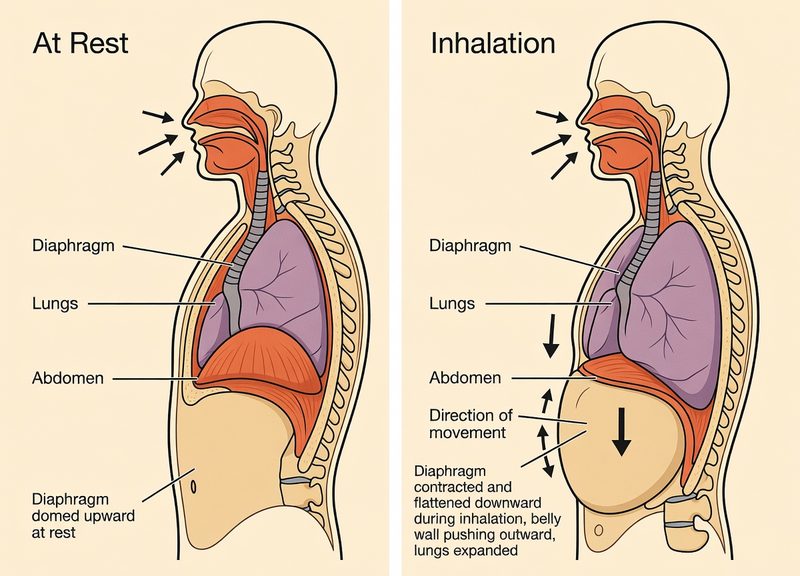
Dome-shaped when relaxed. Higher on the right side (because the liver pushes it up). Located at approximately the level of the lower ribs. Attaches all the way around the inner circumference of the ribcage.
The non-muscular center of the dome. This tendon attaches to the pericardium (the sac around the heart). When the diaphragm moves, it directly affects the heart.
The muscular fibers that radiate out from the central tendon to the attachments. These fibers contract and relax to move the dome.
Sternal: two small slips to the back of the xiphoid process. Costal: fibers to the inner surfaces of the lower six ribs and cartilages — the largest attachment. Lumbar: the crura (two muscular 'legs') extend down and attach to the lumbar vertebrae (right crus L1–L3; left crus L1–L2).
The Three Openings (Hiatus)
The aorta passes through here, along with the thoracic duct and azygos vein. Behind the diaphragm, so not compressed when the diaphragm contracts.
The esophagus passes through here, along with the vagus nerves. Passes through the muscular portion. Critical: a restricted diaphragm can compress the vagus nerve, affecting vagal tone. Releasing the diaphragm can directly improve vagal function.
The inferior vena cava passes through here. In the central tendon, so when the diaphragm contracts and descends, it widens this opening, helping venous return to the heart.
How the Diaphragm Works
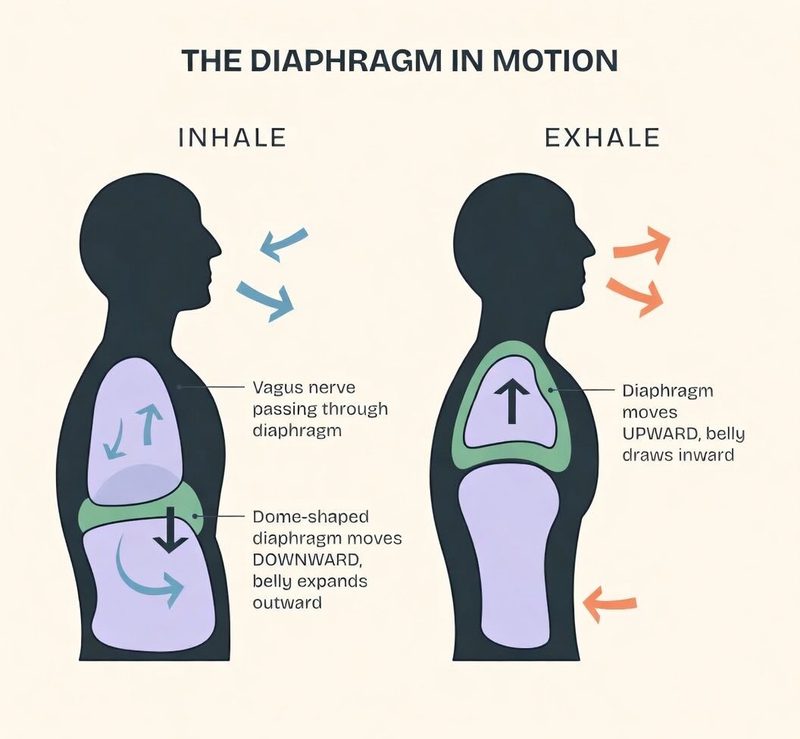
On Inhalation: The diaphragm contracts. The dome flattens and descends. Thoracic volume increases. Decreased pressure pulls air into the lungs. Abdominal contents are pushed down and out. The belly expands (in healthy breathing).
On Exhalation: The diaphragm relaxes. The dome rises back to its resting position. Thoracic volume decreases. Air is pushed out of the lungs. Abdominal contents return to position. The belly moves back in.
The diaphragm is the only skeletal muscle that works mainly in one direction. It contracts on inhale and relaxes on exhale. Forced exhalation uses the abdominal muscles to push the diaphragm up beyond its resting position.
- 1Basic Location: Lie on your back with knees bent. Place your fingertips just below your ribcage, at the soft area of your upper abdomen. Breathe gently. On inhale, does this area expand outward (pushing your fingers away)? On exhale, does it sink back in? This movement is your diaphragm in action. If you feel the opposite (belly pulling in on inhale), you have paradoxical breathing.
- 2Finding the Edges: With your fingers still at the base of your ribs, slowly trace along the lower edge of your ribcage from front to side. You are tracing the attachment of the diaphragm to the ribs. Notice tender spots, areas of tightness or restriction, places where you cannot feel any movement.
- 3Diaphragm in Daily Life: Throughout your day, check in. When you sit at your desk, is your diaphragm free or compressed? When you are stressed, does your belly grip? After eating, does your breathing become more restricted? When you laugh genuinely, can you feel your diaphragm?
Find a partner from the training. Guide each other through the diaphragm finding exercises. Having someone else observe can reveal what you miss in yourself: Can your partner see belly movement when you breathe? Can they see the ribcage expand sideways? Do they notice you gripping anywhere? Share with the group what you discovered.
The Diaphragm as Pressure Pump
The lymphatic system has no heart to pump it. It relies on muscle contraction and pressure changes to move lymph. The diaphragm's rhythmic movement is a primary driver of lymphatic circulation. Poor breathing = poor lymphatic drainage = compromised detoxification and immune function.
The pressure changes created by the diaphragm help return blood to the heart via the inferior vena cava. Deep breathing literally helps your cardiovascular system.
Each breath massages the abdominal organs: the liver gets squeezed and released, the stomach gets gently compressed, the intestines receive rhythmic pressure, the kidneys move with each breath. Shallow breathing denies your organs this natural massage.
The diaphragm is part of the 'inner core' — along with the pelvic floor, transverse abdominis, and multifidus. These muscles work together to stabilize the spine. Breathing dysfunction often relates to core weakness and back pain.
The Diaphragm and Emotion
Wilhelm Reich identified the diaphragm as a key site of 'body armor' — chronic muscular tension that defends against feeling. The diaphragm is uniquely positioned to suppress emotion:
- Crying requires diaphragmatic movement — restrict the diaphragm and you stop crying
- Screaming requires diaphragmatic power — freeze the diaphragm and you cannot scream
- Full laughter engages the diaphragm — a tight diaphragm limits genuine laughter
- Sobbing is diaphragmatic — controlled breathing stops sobs
When a child is told 'stop crying,' they do not just suppress tears — they freeze their diaphragm. When we swallow our words, the diaphragm grips. When we 'hold it together,' the diaphragm is part of what holds. Over years, these momentary freezes become chronic restrictions.
Grief is classically held in the diaphragm — hence 'gut-wrenching grief.' But the diaphragm can hold any suppressed emotion:
- Swallowed anger (the rage that could not be expressed)
- Unexpressed fear (the terror that was too much)
- Held grief (the tears that were not permitted)
- Suppressed vulnerability (the openness that felt too dangerous)
- 1In yourself: What happens to your diaphragm when you feel anxious? Sad? Surprised? Can you feel it tighten or release with different emotions?
- 2In others: Watch people who are upset — can you see their diaphragm grip? Watch people laughing — can you see the diaphragmatic movement? Watch someone trying not to cry — what happens in their midsection?
- 3In media: Watch actors portray grief or fear — what do they do with their breath? Good actors know that emotional authenticity requires diaphragmatic engagement.
Signs of Diaphragmatic Dysfunction
Shallow breathing that stays in the upper chest · Inability to take a full, satisfying breath · Visible tension at the solar plexus · Rigidity at the base of the ribs · Chronic upper back or neck tension · Digestive issues · Hiatal hernia · Difficulty engaging core muscles · Lower back pain.
Breath rate consistently above 12–14 per minute · Belly does not move on inhale · Paradoxical breathing (belly pulls in on inhale) · Inability to slow the breath comfortably · Air hunger despite adequate oxygen.
Difficulty crying even when wanting to · Laughter that stays in the head/throat, not belly · Feeling 'stuck' emotionally · Chronic low-level anxiety · Difficulty accessing deeper emotions · Feeling 'armored' or protected in the midsection.
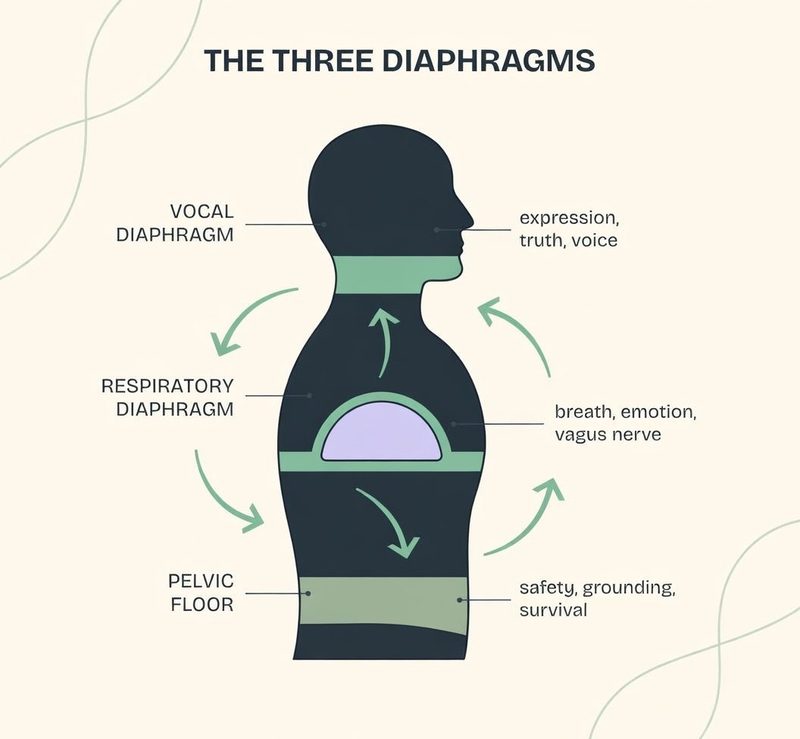
The Three Diaphragms
The main muscle of breathing, which we have been discussing.
The area at the top of the chest, including the scalenes and muscles of the throat. Restriction here affects voice, neck tension, and the flow between head and body.
The muscular floor of the pelvis. Mirrors the respiratory diaphragm — as one descends, the other should descend. Chronic pelvic floor tension often relates to diaphragmatic restriction.
Lie down and practice feeling all three diaphragms. Place one hand on your belly (respiratory diaphragm area). Place one hand on your low belly/pelvic area. Bring awareness to your throat. Breathe slowly and notice: Do all three areas move together? Is one restricted while others move? Which diaphragm felt most free? Which felt most restricted?
Causes of Diaphragmatic Restriction
Suppressed emotions · Chronic anxiety or stress · Trauma (especially in the torso) · Early childhood experiences of needing to 'hold it together'.
Chronic sitting (compresses the diaphragm) · Tight clothing (especially belts, waistbands) · Poor posture (forward head, rounded shoulders) · Abdominal surgery (scar tissue) · Respiratory illness · Hiatal hernia.
Chronic stress · Never being taught to breathe properly · Athletic training that emphasizes 'sucking in' the belly · Aesthetic pressure to have a flat stomach · Desk-bound work.
Messages about emotional expression (boys don't cry) · Fashion that requires tight waists · Sedentary lifestyle · Lack of vocal expression (singing, shouting).
The vagus nerve passes through the diaphragm at the esophageal hiatus. This means: a restricted diaphragm can compress the vagus nerve · chronic diaphragmatic tension may reduce vagal tone · releasing the diaphragm can improve vagal function · diaphragmatic breathing directly stimulates the vagus.
The vagus nerve also innervates the diaphragm (along with the phrenic nerve). There is a bidirectional relationship. Clinical implication: When working with nervous system dysregulation, always assess and address the diaphragm.
- 1Position: Lie on your back with knees bent. Place both hands on your upper abdomen, fingers pointing toward each other, at the base of your ribs.
- 2Phase 1 — Awareness (2 min): Simply notice what is there. Is there tension? Tenderness? Numbness? No need to change anything yet.
- 3Phase 2 — Softening (3 min): On each exhale, imagine your diaphragm softening. Not forcing, just inviting release. Send warmth and kindness to this area.
- 4Phase 3 — Gentle Pressure (3 min): As you exhale, let your fingers sink slightly into the soft tissue below your ribs. On inhale, keep fingers in place but do not press. On exhale, sink a little deeper.
- 5Phase 4 — Integration (2 min): Release your hands to your sides. Breathe naturally and notice any shift. The belly may move more freely. The breath may drop deeper.
- 6Note: This may bring up emotion. That is normal — the diaphragm holds emotion. Allow whatever arises.
Morning: Before getting out of bed, take three full diaphragmatic breaths. Notice if your diaphragm feels free or restricted upon waking.
Throughout the day: Check your posture — is your diaphragm compressed? If sitting for extended periods, stand and take full breaths every hour. Notice if your belly is gripped while working.
After eating: Wait before lying down. Take gentle breaths to help digestion. Notice how full stomach affects diaphragm movement.
Before sleep: Practice the diaphragm release. Allow the belly to be completely soft. Let the day's holding release.