The Respiratory System: Architecture of Life
“Breath is the bridge which connects life to consciousness, which unites your body to your thoughts. — Thich Nhat Hanh”
The Purpose of Respiration
As you learned in Part 3, breath is the only autonomic function under voluntary control. The respiratory system is the control panel for the entire autonomic nervous system.
The pumping action of respiration moves lymph through the body. Without proper breathing, lymphatic drainage suffers.
The diaphragm and respiratory muscles are core stabilizers. Proper breathing supports the spine and posture.
The movement of the diaphragm massages the internal organs with every breath, supporting digestion and circulation.
The respiratory system is intimately involved in emotional expression and suppression. We hold our breath to hold back feelings. We sigh to release them.
From the perspective of yoga, TCM, and other traditions, the breath carries prana or chi — life force — into the body.
The Components of the Respiratory System
Upper Respiratory System: Nose and nasal cavity · Mouth (as secondary pathway) · Pharynx (throat) · Larynx (voice box)
Lower Respiratory System: Trachea (windpipe) · Bronchi and bronchioles (airways) · Lungs · Alveoli (air sacs) · Diaphragm and respiratory muscles
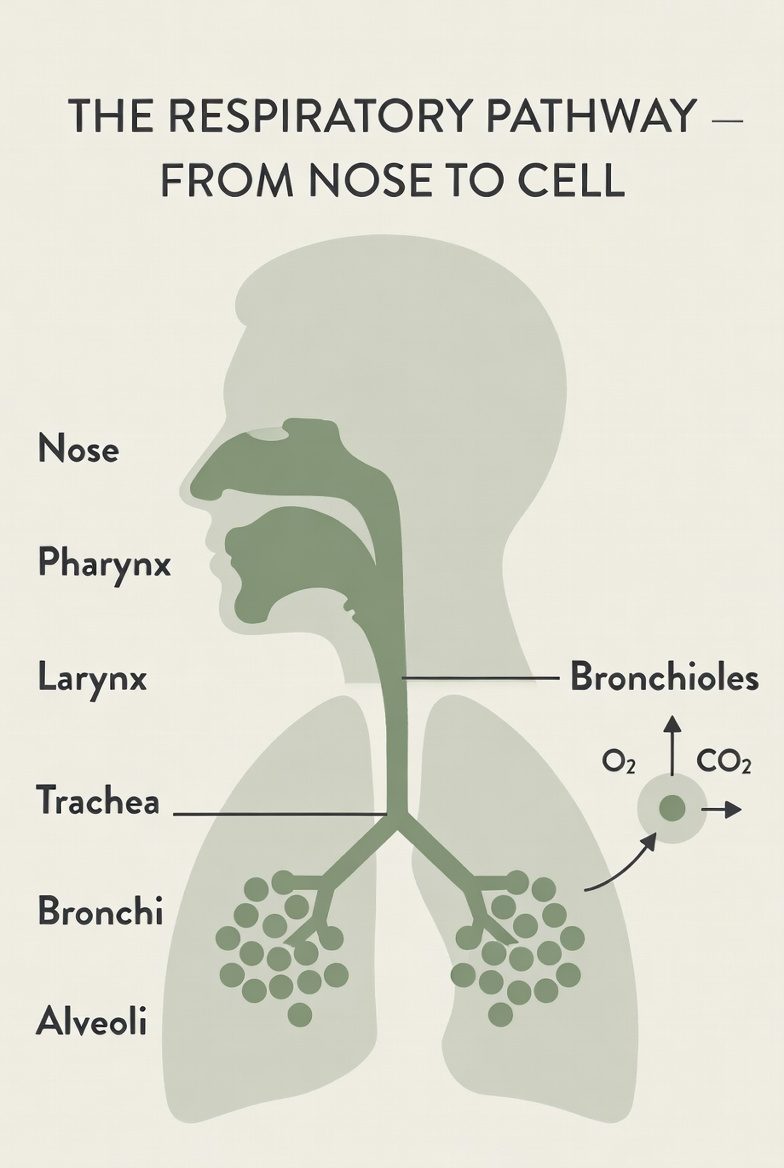
Air enters through the nose (ideally), travels through the upper airways, down the trachea, through increasingly smaller airways, until it reaches the alveoli where gas exchange occurs. Then the journey reverses for exhalation.
The Nose: Gateway of Breath
Nasal hairs and mucous membranes trap particles, dust, bacteria, and allergens — protecting the lungs from contamination. The nose filters approximately 20 billion particles per day.
The nasal passages add moisture to incoming air, protecting the delicate lung tissue from drying out. By the time air reaches the lungs, it is nearly 100% humidified.
The nose warms (or occasionally cools) incoming air to body temperature, regardless of external conditions. This prevents thermal shock to lung tissue.
The paranasal sinuses produce nitric oxide, which dilates blood vessels, has antimicrobial properties, enhances oxygen absorption in the lungs, and supports immune function.
When we breathe through the mouth, we bypass ALL of these functions. No filtration, no humidification, no warming, no nitric oxide. This is why nasal breathing is not optional — it is essential.
Your nostrils take turns being dominant. Approximately every 2–4 hours, the dominant nostril switches. This 'nasal cycle' relates to the alternation of brain hemisphere dominance and has been recognized in yoga for thousands of years (hence alternate nostril breathing).
- 1Observe yourself: How do you breathe when relaxed? When stressed? Do you wake with a dry mouth? When exercising, at what intensity do you switch to mouth breathing? Can you climb stairs breathing only through your nose?
- 2Observe others: At a cafe or on public transport, watch people's mouths. How many are mouth breathing? Can you spot the open-mouth posture of chronic mouth breathers? Notice children — many breathe through their mouths habitually.
- 3Count the mouth breathers: Keep a mental tally for one day. You may be shocked how common it is.
The Airway Pathway
1. Nasal Cavity — Air enters through the nostrils and passes through the nasal cavity, where it is filtered, warmed, and humidified. The turbinate bones create turbulence that increases contact with the mucous membranes.
2. Pharynx (Throat) — The shared passage for air and food. Nasopharynx (behind the nose), oropharynx (behind the mouth), laryngopharynx (above the voice box).
3. Larynx (Voice Box) — Contains the vocal cords and the epiglottis. This is where the vagus nerve influences breath and voice — why humming and chanting tone the vagus.
4. Trachea (Windpipe) — 10–12 cm long, reinforced by C-shaped cartilage rings. Splits at the carina into two main bronchi.
5. The Carina — The branching point where the trachea divides. Highly sensitive — touching triggers intense coughing.
6. Bronchi — The two main bronchi enter the lungs and branch repeatedly like an upside-down tree. The right bronchus is wider and more vertical.
7. Bronchioles — Smaller and smaller airways, eventually less than 1mm. Walls contain smooth muscle that can constrict (asthma) or relax.
8. Alveoli — The tiny air sacs where gas exchange occurs. Approximately 300–500 million alveoli, surface area about 70 square meters — the size of a tennis court.
The Lungs: Organs of Life
Right lung: 3 lobes (upper, middle, lower). Left lung: 2 lobes — smaller to make room for the heart. Each lung is surrounded by a double membrane called the pleura. The pleural space between the membranes contains lubricating fluid.
Total lung capacity: approximately 6 liters in adults. Tidal volume (normal breathing): about 500 ml. We typically use only 10–15% of our lung capacity in normal breathing. Deep breathing can access much more.
The lungs do not have muscles. They expand because the diaphragm and intercostal muscles create negative pressure that pulls air in. When these muscles relax, the elastic recoil of the lungs pushes air out.
Gas Exchange: Where the Magic Happens
The Bohr Effect: Why CO2 Matters
It is essential for oxygen delivery. The Bohr Effect, discovered in 1904, describes how CO2 affects hemoglobin's grip on oxygen.
When CO2 is present: Hemoglobin releases oxygen more readily. Oxygen can enter the tissues where it is needed.
When CO2 is low: Hemoglobin holds onto oxygen more tightly. Even though the blood is fully oxygenated, less oxygen reaches the tissues.
When someone hyperventilates: they blow off CO2 · blood becomes more alkaline · hemoglobin holds oxygen more tightly · less oxygen reaches the brain and tissues · they feel breathless and dizzy — not from lack of oxygen but from lack of CO2.
The lightheadedness and tingling of hyperventilation is not from 'too much oxygen' (a common misconception). It is from too little CO2 causing reduced oxygen delivery despite full blood oxygen saturation.
Clinical Implications: Over-breathing is not therapeutic — it is dysregulating. The goal is not maximum oxygen but optimal CO2. Slow, gentle breathing maintains appropriate CO2 levels.
- 1Sit comfortably and close your eyes.
- 2Bring attention to your nostrils. Feel the air entering. Which nostril is more open right now? Can you feel the temperature difference between inhale and exhale?
- 3Follow the air through your nasal passages. Sense the interior space behind your nose. You cannot see it, but you can feel air moving through it.
- 4Bring awareness to your throat. Feel the air passing through. If you hum gently, feel the vibration in the larynx.
- 5Follow the air into your chest. Can you feel where it goes? Is there a sense of the branching pathways?
- 6Sense your lungs expanding. Where do you feel movement? Upper chest? Lower ribs? Back?
- 7Reverse the journey on exhale. Air leaving lungs, rising through chest, through throat, through nasal passages, out through nostrils.