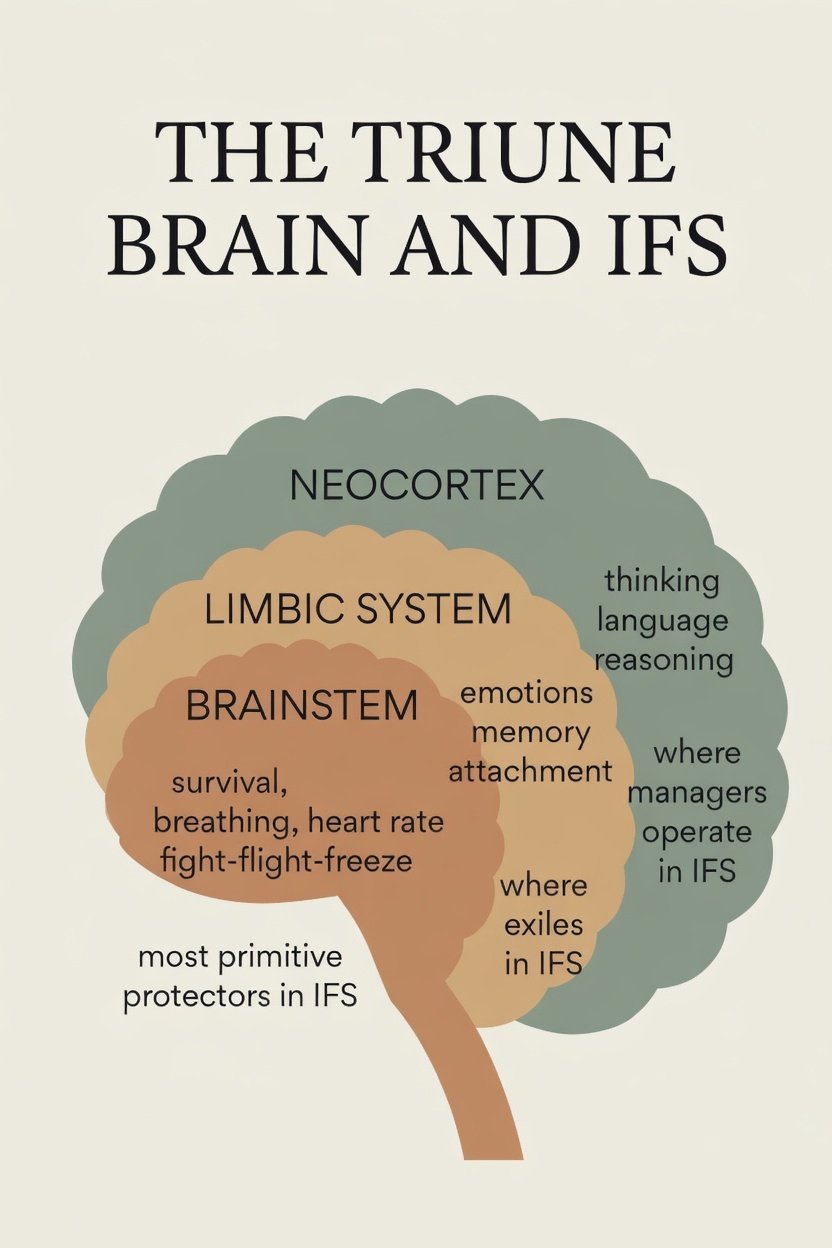
The Triune Brain Model
“You cannot reason with the reptilian brain. You can only make it feel safe.”
Brainstem. Pure survival logic — binary, instinctive, fast. Does not think; it reacts. Fight, flight, freeze. Governs heartbeat, breathing, basic alertness. Does not understand nuance or explanation.
Emotional brain. Creates emotional meaning, stores emotional memory, drives social behavior. This is where attachment patterns form, where relational wounds live. This is where trauma stores.
Thinking brain. Analyzes, plans, creates meaning. Language, abstract reasoning, self-reflection. Slow but nuanced. Can serve healing or block it — insight is valuable only after the body has done its work.
Brainstem (primitive protectors), Limbic (exiles), Neocortex (managers). From The Cocoon Method.
The Speed Factor
Clinical Guidance: Reptilian Brain Active
Speak slowly and simply, or say nothing at all. Your regulation is the most important thing in the room. Offer grounding: feet on the floor, the weight of a blanket. Stay present. Do not try to fix. The body needs to complete what it started, not be interrupted.
Try to talk them through it. Rush the process. Ask questions requiring thought. Touch without clear consent. Get activated yourself. Show fear or panic. Try to stop what is happening. Offer "it's okay" — this bypasses what the body needs.
The Limbic Brain: Key Structures
Clinical Guidance: Limbic Brain Active
Stay present and connected. Match their emotional register — attuned, not identical. Offer your regulated presence. Validate the emotion without amplifying it. Use warm, connected tone. Allow the feeling to move. Be with them, not above them. Trust that the emotion has somewhere to go.
Analyse or interpret while they are feeling. Try to fix or stop the emotion. Withdraw or become distant. Get lost in their feeling (you are the anchor). Offer premature reassurance. Rush to meaning-making before the emotion has moved through.
The Neocortex: Double-Edged
The Integration of All Three
Clinical Reading: Which Brain Is Active?
Freezing, trembling, shaking, primal sounds, glazed eyes, skin colour changes. This brain does not need words. It needs safety, warmth, and your calm presence.
Big emotions. Grief. Rage. Terror. Longing. Attachment needs surfacing. The client may seem younger. This brain needs attunement, emotional presence, and co-regulation. It needs to feel felt.
Explaining, analysing, asking why, making meaning. This is helpful after body-based work. But watch for it as a way of avoiding feeling instead of processing it. Then you gently bring them back to the body.
Which brain needs attention right now? Reptilian: create safety, ground, and wait. Limbic: attune, allow expression, validate. Neocortex: invite understanding and help them integrate what has moved through.
The Typical Session Flow
1. Begin with Neocortex: Conscious intention, understanding the process, consent, orientation.
2. Move to Limbic: Emotion arises, feelings emerge, attachment material surfaces.
3. Access Reptilian: Deep survival material, primal expression, body-level processing.
4. Return through Limbic: Emotional integration, feeling completion, relational repair.
5. Complete with Neocortex: Meaning-making, conscious integration, planning.
The thought lives in the neocortex. The trauma lives in the limbic brain and brainstem. These structures do not share a language. The neocortex cannot directly modify subcortical encoding. This is why affirmations can feel hollow — the words live in one place; the wound lives in another.
Notice yourself this week. Which brain takes over in work stress? In intimate conversations? In conflict? In moments of creativity? Share with the group. Knowing your own patterns is the foundation for recognising them in others.
- 1Reptilian (2 min): Is there any sense of threat? Any survival tension? Notice your most basic sensations — temperature, heartbeat, basic aliveness.
- 2Limbic (3 min): What emotions are present? What feelings want attention? Notice what your heart wants. What connection or expression is needed?
- 3Neocortex (3 min): What thoughts are running? What analysis or meaning-making is happening? What is your mind trying to figure out?
- 4Integration (2 min): Which brain is most active? What would each one need right now? Can you sense all three simultaneously?