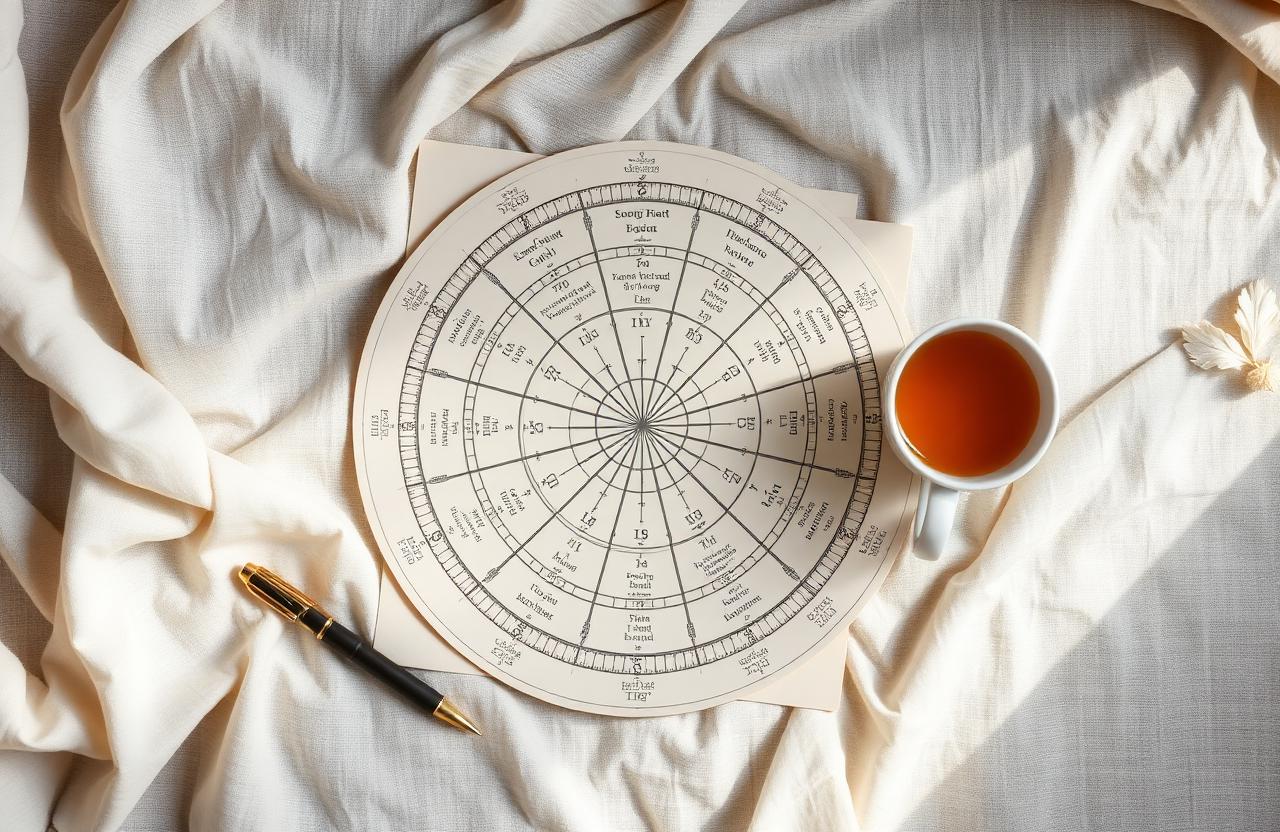
Chapter 2: The Sacred Language of Astrology
Imagine the Ancient Sky
Before electric lights, before cities, before the constant hum of modern life, humans lived beneath a sky ablaze with stars.
Every night, our ancestors looked up. They watched. They noticed. They recorded what they saw.
Generation after generation, they observed the wandering stars (what we now call planets) moving against the fixed background of constellations. They noticed patterns. They saw correlations between celestial events and earthly experiences: the flooding of rivers, the behavior of animals, the moods of people, the rise and fall of kingdoms.
This was not superstition. It was careful, systematic observation spanning thousands of years.
Imagine living without artificial light. Every clear night, you would see thousands of stars. The Milky Way would stretch across the entire sky. The Moon would be your primary source of nighttime illumination, her phases marking the passage of time.
How might this change your relationship with the cosmos?
From this deep observation emerged astrology: one of humanity’s oldest sciences and most enduring wisdom traditions.
Astrology Through the Ages
Astrology has been practiced for thousands of years across virtually every major civilization. Far from being a modern invention or passing trend, it represents one of humanity’s most sophisticated systems of observation and understanding.
A Global Story
| Civilization | Contribution | Time Period |
|---|---|---|
| Babylon | Systematic planetary observation, omen astrology | 2000+ BCE |
| Egypt | Stars aligned with sacred architecture, decans | 3000+ BCE |
| Greece | Philosophy meets astrology, natal charts developed | 500 BCE onward |
| India | Jyotish (“science of light”), Vedic astrology | 1500+ BCE |
| Maya | Complex calendar systems, time as spiral | 2000+ BCE |
| China | Different cosmic map, lunar mansions | 2000+ BCE |
Babylon: Where It Began
The Babylonians were among the first to systematically record celestial observations. Their priest-astronomers kept meticulous records of planetary movements, eclipses, and celestial phenomena over centuries.
They noticed that certain planetary configurations seemed to correlate with events on Earth:
- Floods and droughts
- Abundance and famine
- War and peace
- The fate of kings
This was the birth of omen astrology, the recognition that heaven and earth reflect one another.
What made Babylonian astrology significant:
- Systematic observation over 1000+ years
- Detailed written records (clay tablets)
- Recognition of planetary cycles
- Development of the zodiac divisions
- Integration with mathematics and astronomy
The Babylonians understood something profound: to know the sky was to know oneself and one’s world.
Egypt: Stars and Sacred Architecture
The Egyptians aligned their temples and pyramids with specific stars. The Great Pyramid of Giza aligns with remarkable precision to true north and to the constellation Orion.
For the Egyptians, the stars were not distant objects but living presences, gods whose movements told the story of existence itself.
Greece: Philosophy Meets the Heavens
The Greeks transformed astrology from omen-reading into a philosophical system. They developed the concept of the natal chart: a map of the sky at the moment of an individual’s birth.
This was revolutionary. It meant that each person carried a unique celestial signature, a cosmic fingerprint that revealed their nature, potential, and life path.
Key Greek contributions:
- The zodiac as we know it
- Planetary rulerships
- Aspects (relationships between planets)
- Houses (areas of life experience)
India: Jyotish, the Science of Light
In India, astrology developed as Jyotish, literally “the science of light.” It was considered one of the six limbs of the Vedas, the sacred scriptures.
Jyotish emphasizes:
- Karma and dharma
- Life purpose
- Timing of events
- Remedial measures (mantras, gems, rituals)
To this day, Jyotish remains deeply integrated into Indian culture, consulted for marriage, business, and life decisions.
Astrology as Ancient Medicine
In many traditional cultures, doctors were also astrologers.
The cycles of the Moon and the alignments of planets guided:
- Medical diagnosis
- Preparation of plant medicines
- Timing of healing practices
- Surgical procedures
This integration of celestial wisdom with healing arts was considered essential for effective treatment.
Paracelsus, the renowned Swiss physician and father of toxicology, declared:
““A physician without a knowledge of astrology has no right to call himself a physician.””
For him and many others, understanding cosmic influences on human health was fundamental to the healing arts.
The Hermetic Principle
Central to astrological philosophy is the hermetic principle:
This ancient axiom suggests that the cosmos and the human psyche mirror one another. What happens in the heavens reflects what happens on Earth. The macrocosm and microcosm correspond.
Modern parallels:
- Fractals (patterns repeating at different scales)
- Holography (the part contains the whole)
- Systems theory (interconnection of all things)
- Quantum entanglement (non-local connection)
The hermetic principle is not magic. It is a recognition of the profound interconnectedness of all existence.
The Fall of Astrology: The Enlightenment Shadow
What Happened
During the Enlightenment (17th-18th centuries), Western culture underwent a radical shift. The new paradigm valued:
- Rational thought over intuition
- Materialism over meaning
- Mechanism over organism
- Measurement over mystery
Astrology, which cannot be easily reduced to materialist mechanisms, was dismissed as superstition.
| Enlightenment View | What Was Lost |
|---|---|
| Only matter is real | Connection to meaning and purpose |
| Universe is a machine | Sense of living cosmos |
| Humans are separate from nature | Ecological and cosmic belonging |
| Only the measurable matters | Wisdom traditions spanning millennia |
Astrology was exiled from the academy, stripped of respectability, reduced to newspaper horoscopes and fortune-telling.
What Survived
Despite suppression, astrology never died. It continued in:
- Folk traditions
- Esoteric circles
- Family lineages
- Underground schools
The wisdom was preserved, waiting for a time when it could re-emerge.
The Renaissance: Jung and the Return of Soul
Carl Jung’s Contribution
In the twentieth century, Carl Jung, the pioneering Swiss psychiatrist and founder of analytical psychology, drew extensively on astrology to explore the archetypes of the unconscious mind.
Jung did not treat astrology as superstition. He described it as “the sum of all the psychological knowledge of antiquity” — a symbolic record of how human beings have understood the inner life for thousands of years.
Jung recognized astrology’s profound ability to illuminate deep psychological patterns. He called it:
““The intuitive method par excellence.””
He acknowledged its unique capacity to reflect the hidden dynamics within the psyche.
Jung used astrology in his clinical practice. When working with difficult cases, he would often cast the patient’s birth chart to gain insight into their psychological makeup. He found that the chart often revealed dynamics that would take months to uncover through talk therapy alone.
What Jung Understood
| Jung’s Insight | Astrological Application |
|---|---|
| The unconscious contains archetypes | Planets represent archetypal energies |
| Symbols speak to the psyche | Astrological symbols activate recognition |
| Synchronicity connects inner and outer | Birth chart mirrors soul configuration |
| Individuation requires self-knowledge | Astrology maps the journey |
| The psyche has structure | The chart reveals that structure |
| Healing requires making unconscious conscious | Astrology illuminates what is hidden |
Jung’s work helped bridge ancient astrological wisdom and modern psychological understanding, showing how celestial patterns mirror movements of our inner world.
Why This Matters for Practitioners
Jung’s integration of astrology with psychology opens a door for us as practitioners:
- We can use astrological insight without abandoning psychological rigor
- We have precedent from one of psychology’s most respected figures
- We understand astrology as archetypal rather than deterministic
- We see it as a tool for consciousness, not prediction
The Modern Renaissance
Today, we are witnessing a profound reclaiming of astrology as a healing art.
Who is using it now:
- Therapists and psychologists
- Life coaches and counselors
- Trauma-informed practitioners
- Somatic therapists
- Spiritual directors
Why it’s returning:
- Offers language for emotional patterns
- Reveals core wounds with precision
- Provides soul-level direction
- Maps growth and integration
- Honors both psychology and spirituality
After centuries of suppression, astrology is reclaiming its place not as superstition, but as a sophisticated tool for consciousness and healing.

What Astrology Actually Is
Let us be clear about what we are working with.
Astrology Is:
A Language
- Not one we learn through memorization
- But through deep listening and felt resonance
- A symbolic vocabulary for invisible experiences
- Words for feelings we could not otherwise name
A Map
- Of the psyche’s architecture
- Of emotional patterns and needs
- Of strengths and vulnerabilities
- Of timing and life cycles
A Mirror
- Reflecting who we are
- Showing patterns we might not see
- Illuminating the unconscious
- Revealing what seeks integration
The Components of the Language
| Component | What It Represents |
|---|---|
| Planets | Different drives, needs, functions within us |
| Signs | How those drives express themselves (style, flavor) |
| Houses | Areas of life where they play out |
| Aspects | Relationships between parts of ourselves |
- Planet = The actor (WHO is acting)
- Sign = The costume and style (HOW they act)
- House = The stage and setting (WHERE they act)
- Aspect = The relationship between actors (DYNAMICS)
What Astrology Is NOT
Understanding what astrology is not is as important as understanding what it is.
Astrology Is NOT:
| Common Misconception | The Reality |
|---|---|
| Fortune-telling | A map for understanding, not predicting fixed fate |
| Determinism | Shows tendencies, not certainties; choice always remains |
| A religion | A tool that can be used within any spiritual framework |
| Scientific proof of anything | A symbolic language, not a measurement system |
| Sun sign horoscopes | A complex, individualized system (your Sun sign is 1 of 40+ factors) |
Your chart is not your prison. It is your sacred map.
It reveals patterns so you can transcend them. It shows nature so you can evolve it. It maps the journey so you can walk it with awareness.
The Question of “Belief”
You do not need to “believe” in astrology for it to work.
Consider: you do not need to “believe” in psychology for psychological patterns to operate in your life. You do not need to “believe” in gravity for it to affect you.
Astrology describes archetypal patterns that move through human experience. These patterns operate whether we are conscious of them or not. Awareness simply gives us choice in how we respond.
Rather than asking “Is astrology real?” ask:
- Does this framework illuminate my experience?
- Does it give me useful language for what I feel?
- Does it help me understand myself and others?
- Does it support my growth and healing?
Why This Matters for Healing Work
Finding Language for the Invisible
One of the greatest gifts astrology offers is language for the invisible.
As practitioners, we work with experiences that are often hard to articulate:
- Why does this client shut down when approached with warmth?
- Why does that one need constant stimulation to feel alive?
- Why does another seem to live in their head, disconnected from feeling?
- Why does one person process grief through action while another freezes?
- Why do some clients resist the very help they are seeking?
Astrology provides precise vocabulary for these patterns.
Before astrology, I would sense that clients needed different things, but I had no language for why. I would intuit that one person needed space while another needed closeness, but I couldn’t articulate the difference.
The Moon gave me words for what I was sensing.
Seeing the Logic of Suffering
When we understand someone’s Moon sign, we see the logic of their emotional patterns.
We understand:
- Why their defenses make sense
- What they needed as a child
- How they seek safety
- What triggers their nervous system
- What their inner child is still waiting for
This understanding transforms our capacity to help. We meet people where they actually are, not where we think they should be.
Example:
A client with Moon in Capricorn who seems cold and distant is not broken. They learned early that emotions were not safe to express, that they needed to be strong and self-sufficient. Their emotional shutdown was an intelligent adaptation to an environment that did not welcome vulnerability.
Knowing this, we do not try to force them to “open up.” We honor the defense. We build safety slowly. We let them discover that strength and feeling can coexist.
Honoring Difference
Different Moon signs have genuinely different needs:
| Moon Element | Core Need | What Helps | What Harms |
|---|---|---|---|
| Fire | To act, to matter, to be seen | Movement, permission, challenge | Being told to calm down, wait, slow down |
| Earth | Stability, predictability, tangible support | Consistency, patience, practical help | Chaos, sudden change, abstract approaches |
| Air | To understand, to communicate, space to think | Explanation, mental engagement, breathing room | Emotional flooding, demands for immediate feeling |
| Water | To feel, to connect, emotional depth | Attunement, presence, permission to feel everything | Being told to “get over it,” logic without empathy |
What heals one may harm another. Astrology helps us see these differences clearly.
Timing and Readiness
Astrology also helps us understand timing.
Not everyone is ready for deep work at all times. Certain planetary transits create openings for transformation. Others call for consolidation, rest, or practical focus.
Understanding this prevents us from:
- Pushing when the psyche needs rest
- Holding back when breakthrough is available
- Pathologizing natural cycles of expansion and contraction
Sometimes a client’s “resistance” is not resistance at all. It is appropriate timing. The soul knows when it is ready to open. Astrology helps us read these rhythms.
Astrology and Modern Psychology: A Natural Partnership
Common Ground
Astrology and depth psychology share remarkable common ground:
| Psychological Concept | Astrological Parallel |
|---|---|
| The unconscious | Hidden planetary influences |
| Archetypes | Planetary energies |
| Complexes | Challenging aspects |
| Defense mechanisms | Saturn patterns |
| Attachment styles | Moon configurations |
| Developmental stages | Planetary cycles |
| Shadow work | Working with difficult placements |
| Individuation | Fulfilling the chart’s potential |
What Astrology Adds to Psychology
Precision: Astrology names patterns with specificity that can take years to uncover in therapy.
Timing: Astrology shows when certain issues will be activated and when conditions support change.
Normalization: Seeing a pattern in the chart helps clients understand they are not broken, they are configured.
Compassion: Understanding the astrological logic of patterns reduces shame and blame.
Direction: The chart shows not just wounds but gifts and growth direction.
What Psychology Adds to Astrology
Grounding: Psychological training keeps astrological insight connected to lived experience.
Ethics: Therapeutic training provides frameworks for responsible practice.
Technique: Psychology offers methods for working with what astrology reveals.
Integration: Psychological understanding helps translate insight into actual change.
We do not choose between astrology and psychology. We use astrological insight to inform psychological and somatic work. The Moon shows us the pattern. Nervous system regulation, inner child work, and somatic awareness help transform it.
The Inner Cosmos
Your Unique Configuration
At the moment of your birth, the planets were arranged in a specific pattern. This pattern was imprinted on you like a cosmic fingerprint.
Your birth chart is a map of:
- Your emotional needs (Moon)
- Your sense of identity (Sun)
- How you communicate (Mercury)
- How you love and value (Venus)
- How you assert and act (Mars)
- How you grow and believe (Jupiter)
- Where you face limitations and lessons (Saturn)
- Where you seek freedom and change (Uranus)
- Where you experience dissolution and transcendence (Neptune)
- Where you face death/rebirth and power dynamics (Pluto)
Each planet represents a different facet of your psyche, each with its own voice, its own needs, its own sacred intention.
The Living Sky
Your birth chart is one half of the astrological story.
| Your Natal Chart | The Transiting Sky |
|---|---|
| Fixed at birth | Always moving |
| Your inner blueprint | Current cosmic weather |
| Who you are | What is being activated |
| The instrument | The music being played |
When current planetary positions interact with your birth chart, specific themes are activated. This is how astrology addresses timing: understanding when certain issues will arise and when conditions support certain kinds of work.
Freedom Within Form
Perhaps most importantly, astrology reminds us that nothing is fixed, yet everything is meaningful.
The Paradox
| Your Chart Shows | And Yet |
|---|---|
| Patterns | Patterns can be transformed |
| Tendencies | Tendencies can be redirected |
| Challenges | Challenges become gifts through consciousness |
| Wounds | Wounds become sources of wisdom |
You are not trapped by your chart. You are not limited by your signs. You are not doomed to repeat old patterns forever.
Your chart reveals the path your soul chose for this lifetime. It illuminates the tremendous potential waiting to unfold as you meet each moment with increasing consciousness and love.
Astrology shows us our patterns so we can transcend them, reveals our nature so we can evolve it, maps our journey so we can walk it with greater awareness and intention.
Collective Rhythms
Astrology also illuminates collective patterns.
Historical Correlations
Astrologers have observed striking correlations between planetary cycles and collective events:
| Planetary Cycle | Associated Themes |
|---|---|
| Saturn-Pluto | Structures transforming, power shifts, endings/beginnings |
| Jupiter-Saturn | Social and economic cycles, generational shifts |
| Uranus-Pluto | Revolutionary change, upheaval, liberation movements |
| Neptune cycles | Collective dreams, spirituality, dissolution of boundaries |
This is not prediction. It is pattern recognition across centuries of observation.
Why This Matters
Understanding collective cycles helps us:
- Recognize we are part of larger movements
- See personal struggles in context of collective themes
- Work with timing rather than against it
- Serve the larger transformation with awareness
Summary: The Sacred Language
Astrology is:
- One of humanity’s oldest wisdom traditions
- Practiced across virtually all major civilizations
- A symbolic language for psychological patterns
- A map of the psyche and its development
- A tool that Carl Jung called “the intuitive method par excellence”
- Currently experiencing renaissance in therapeutic contexts
Astrology is not:
- Fortune-telling or fixed prediction
- Determinism (choice always remains)
- Limited to Sun sign horoscopes
- Requiring “belief” to be useful
Astrology offers a language for the invisible forces that shape human experience. In The Cocoon Method, we use this language specifically through the lens of the Moon: understanding emotional patterns, childhood adaptations, and the path to healing.
Practice: Reflection Questions
Before moving to the next chapter, sit with these questions:
- Your relationship with astrology:What has been your experience with astrology before this course? Skepticism? Curiosity? Deep study? Brief encounters? Notice any judgments or assumptions you carry.
- The ancient sky:How does it feel to know that humans have been observing these patterns for thousands of years across virtually every culture? Does this add or diminish credibility for you?
- Language for the invisible:Are there experiences in your life that have been hard to articulate? Patterns you can feel but not name? What would it mean to have precise language for these?
- Map vs. cage:How do you respond to the idea that your birth chart shows patterns you can work with consciously rather than fates you must accept?
- For practitioners:Think of a client (or person in your life) whose emotional patterns have confused you. What would it mean to have a map that shows why they respond the way they do?
Write for 10-15 minutes on one of these prompts:
- “What I hope to understand better about myself through this work is…”
- “The patterns in my emotional life that I most want to understand are…”
- “If I could have language for the invisible forces shaping my inner life, I would want to name…”
Key Takeaways: Chapter 2
| Concept | Key Understanding |
|---|---|
| Astrology’s History | Practiced for 4000+ years across all major civilizations |
| As Above, So Below | Cosmos and psyche mirror one another |
| Jung’s Contribution | Validated astrology as “intuitive method par excellence” |
| What Astrology IS | A symbolic language, a map, a mirror |
| What Astrology is NOT | Fortune-telling, determinism, religion, fixed fate |
| Why It Matters | Provides precise language for emotional patterns |
| For Practitioners | Helps us see the logic of suffering and honor difference |
End of Chapter 2
Next: Chapter 3 - Your Cosmic Blueprint: Understanding the Birth Chart
In Chapter 3, we explore the birth chart itself: what it contains, how to obtain yours, and how to begin reading this map of your soul. We will walk through the practical steps to generate your chart and understand its basic components.