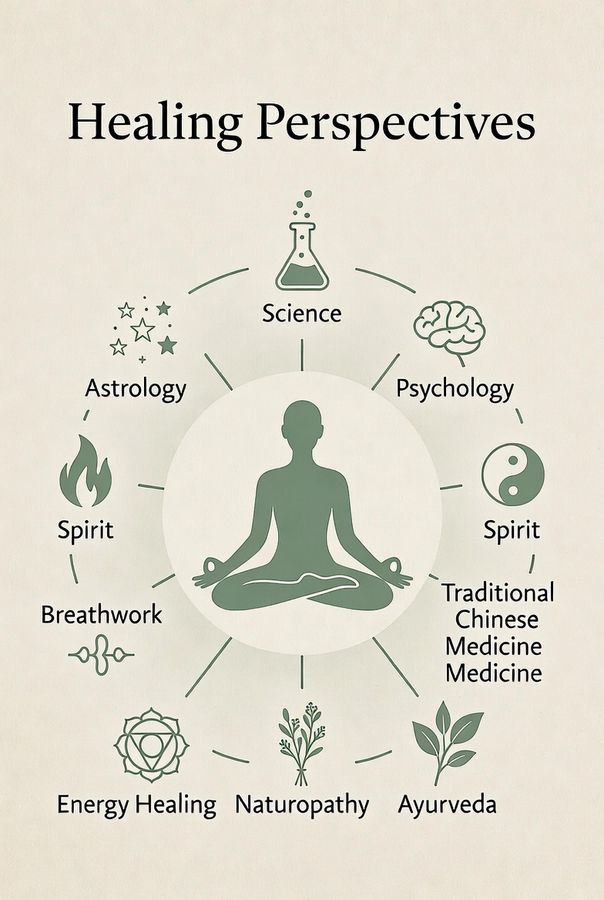
Nine Expert Perspectives on the Nervous System
“Different maps. Same territory.”
Sees the nervous system as an electrochemical communication network. Trauma is stored in altered neural pathways. Healing involves neuroplasticity — the brain's capacity to rewire itself. Offers precise mechanisms, measurable outcomes (HRV, brain imaging), and validation of ancient practices through modern research.
Sees the nervous system as the biological substrate of experience. Early attachment shapes nervous system development. Trauma creates lasting patterns. The therapeutic relationship provides corrective experiences. Contributes understanding of development, defense mechanisms, and the healing power of relationship.
Sees the nervous system through chi — life force flowing through meridians. What Western science calls sympathetic activation, TCM describes as excess yang or liver fire. Dorsal vagal shutdown becomes chi stagnation or kidney deficiency. Connects nervous system function to organ health, seasonal rhythms, and energetic balance.
Sees the nervous system through the doshas — particularly vata, the air/space principle governing movement and communication. Nervous system dysregulation is often vata imbalance. Constitutional understanding explains why different people respond differently to the same stressors and treatments.
Sees the nervous system connected to the whole body — particularly the gut-brain axis, hormonal balance, and nutritional status. Inflammation affects the brain. Gut bacteria produce neurotransmitters. Nutritional deficiencies impair nervous system function. Physical factors support or undermine regulation.
Sees the nervous system as the densest layer of the subtle body — where energetic patterns crystallize into physical form. Chakras, meridians, and the aura are expressions of nervous system state. A blocked heart chakra and a vagally-suppressed social engagement system may be two descriptions of the same phenomenon.
Sees the nervous system as the vehicle through which consciousness experiences embodiment. Regulation is not just health — it is the foundation for spiritual development. A dysregulated nervous system cannot sustain expanded states of consciousness. A regulated one becomes capable of holding more light, more presence, more truth.
Sees breath as the primary access point to the entire autonomic system. Before any technique, reads the client's nervous system state through their breath. The entire session is a response to that reading, adjusted moment by moment. Polyvagal theory named and explained what skilled breathworkers had always done intuitively.
Sees the nervous system as shaped by both personal history and transpersonal timing. Planetary archetypes map onto nervous system patterns — Saturn placements often correspond to chronic bracing, Mars to sympathetic reactivity, Neptune to dissociation. Astrology reveals which survival states are most familiar, and what the body needs to find safety.
The Cocoon Method practitioner holds all nine perspectives simultaneously. You are not choosing one lens — you are developing fluency in all of them, using whichever serves your client in the moment. When you can see through many perspectives, you are less likely to become rigidly attached to any single one.