Polyvagal Theory: The Revolution
“The autonomic nervous system is not a simple on-off switch, but a hierarchical system that evolved to support increasingly complex social behaviors. — Stephen Porges”
The Evolutionary Story
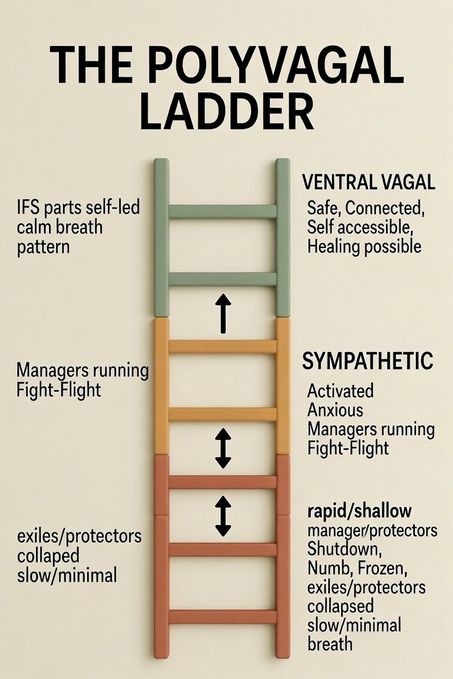
The Dorsal Vagus. The earliest vertebrates developed a simple vagal system that could slow metabolism and induce immobilization — playing dead as a survival strategy.
The Sympathetic System. As vertebrates became more mobile, they developed a system for active defense — enabling fight or flight and dramatically expanding survival options.
The Ventral Vagus. Mammals developed something entirely new: a vagal system that supports social engagement — nursing, play, bonding, and communication through facial expression and voice.
Healing always moves upward. You cannot jump from dorsal vagal collapse directly to ventral vagal safety — the system must pass through sympathetic mobilization first. We carry all three systems within us. They form a hierarchy: the newest (ventral vagal) is our default when we feel safe. Older systems activate when safety is not available.
The triune brain model is a powerful clinical map but not a precise neuroanatomical description. Modern neuroscience understands the brain as deeply interconnected — not three separate layers. What the model gets right, and what is strongly confirmed by research, is that survival-oriented circuits dominate when safety is absent, and that breath and body reach these circuits more directly than words alone. Hold the model as a map.